



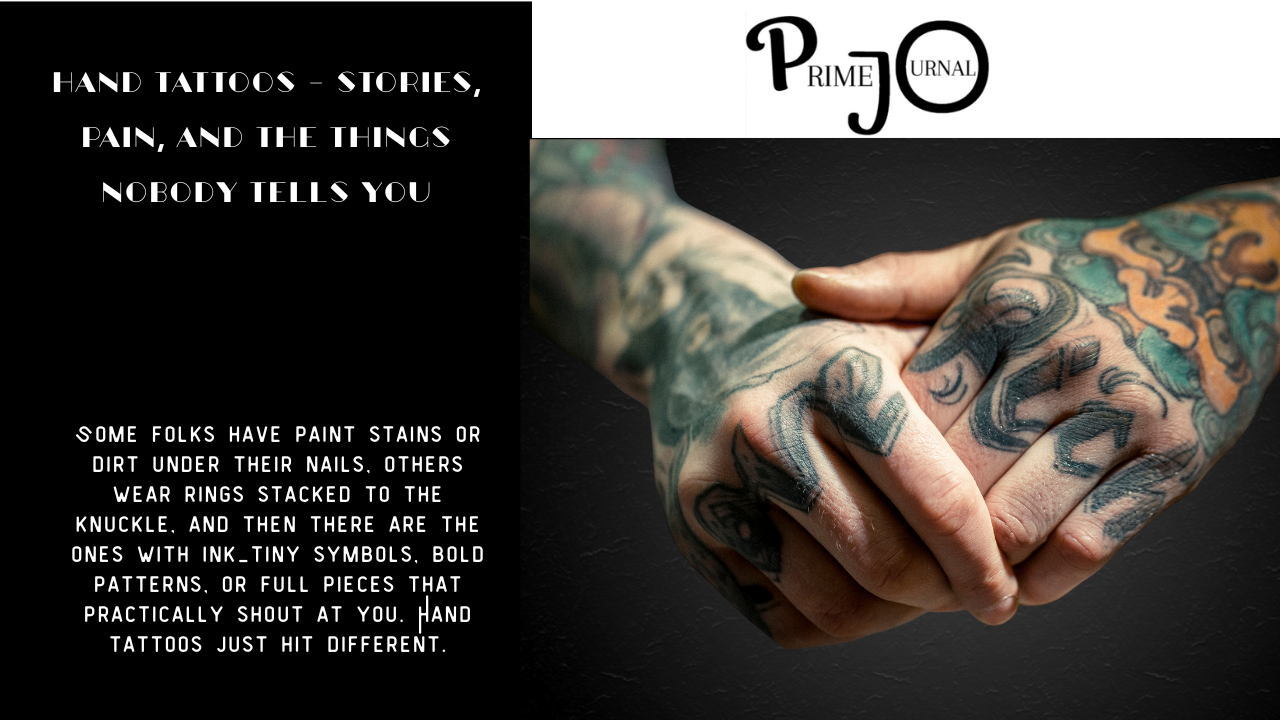
It’s strange… I’ve always noticed people’s hands before anything else. Some folks have paint stains or dirt under their nails, others wear rings stacked to the knuckle, and then there are the ones with ink—tiny symbols, bold patterns, or full pieces that practically shout at you. Hand tattoos just hit different.
They’re a statement you carry 24/7. You can’t shove them in a sleeve like a forearm piece or hide them under jeans. They’re there when you’re buying groceries, typing emails, shaking someone’s hand. Which is part of why they’re so fascinating to me—there’s no pretending they’re not there.
A Little History & Big Meanings
I started reading about this once (a 2 a.m. Wikipedia rabbit hole, you know how it goes). Turns out hand tattoos have been around for centuries—probably longer than that. In ancient Polynesian culture, for example, the patterns on the hands weren’t just pretty—they told people who you were, where you came from, maybe even your role in the community.
In Inuit traditions, certain markings on women’s hands were tied to rites of passage or spiritual beliefs. Then you’ve got the flip side—prison tattoos and gang symbols inked across the knuckles in bold, unmistakable letters. That’s where the “dangerous” image of hand tattoos comes from in a lot of modern minds.
Fast forward to now and the meaning has shifted again. These days you might see a delicate constellation design on a yoga teacher, a floral pattern on a fashion blogger, or bold tribal lines on an MMA fighter. Different worlds, same canvas.
Quick Biography Table Hand Tattoos
| Detail | Info (Human-Written Style) |
|---|---|
| Category | Body Art / Tattoo Culture |
| Main Keyword | Hand Tattoos |
| Popularity | Growing fast in the last decade thanks to social media and celebrity influence |
| First Known Use | Ancient tribal societies – often for identity, status, or protection |
| Symbolism | Varies by culture – can mean strength, rebellion, tradition, or personal story |
| Pain Level | High (thin skin, close to bone, lots of nerve endings) |
| Healing Time | 2–4 weeks for surface healing, but fading can happen quickly |
| Maintenance | Needs more touch-ups than tattoos on less exposed areas |
| Common Styles | Minimalist symbols, geometric patterns, floral art, traditional bold lines |
| Social Perception | Still mixed – some see it as bold fashion, others see it as unprofessional |
| Best For | People who want visible, statement-making ink they’re happy to show every day |
Pain: No Way Around It
Morning thought while sipping coffee: I wish someone had told me exactly how much it would hurt. I’d been through other Hand tattoos before—ribs, inner arm, back of the neck—so I figured I was ready. Nope. The hands are a whole other level.
The skin is paper-thin in places, and it’s full of nerve endings. Every time the needle touched bone, it was like a tiny electric shock traveling up my arm. My artist warned me. “We’ll need to work quick,” they said. That was tattoo-artist speak for: this is going to sting like hell.
And then there’s healing. Your hands are always doing something—washing, typing, holding your phone, scratching your head. It makes aftercare a bit of a nightmare. Scabs can crack open, ink can fade faster, and you have to be super careful about cleanliness. I learned to wash my hands like a surgeon without drenching the fresh tattoo.
The Artist’s Challenge
Afternoon brain here. Thinking about the design process makes me appreciate tattoo artists even more. The hand isn’t a nice flat page—it’s curved, knuckled, creased, and constantly moving. A straight line on paper can turn into a wave when you bend your fingers.
That’s why hand tattoo ideas need to be thought through differently. A bold, traditional piece with thick lines might survive a decade looking sharp, while a fine-line script might blur faster than you expect. That doesn’t mean you can’t do delicate designs—it just means you need an artist who understands skin movement and aging.
I’ve seen people do incredible 3D effects over the knuckles, or tiny minimalist dots that somehow still look clean years later. But I’ve also seen detailed portraits lose definition within a few months because… well, hands aren’t exactly a low-traffic area.
The Social Side of Things
Evening brain now—slightly tired, slightly blunt. Let’s be real: the stigma is better, but it hasn’t vanished.
I’ve met CEOs with full sleeves who still draw the line at visible hand ink. I’ve also met baristas, bartenders, and tattoo artists who see it as a badge of authenticity. The reactions you’ll get depend a lot on the world you move in. Some people will instantly judge, some will think it’s the coolest thing ever, and most will just… not care.
The only real question is—can you live with it being the first thing someone notices about you? If the answer’s yes, then the rest doesn’t matter as much.
Some Favorite Hand Tattoo Ideas
Not gonna lie, I have a whole mental folder of designs I’ll never get (because I like my job and my mother would probably faint). Here are some standouts I’ve seen over the years:
- Micro symbols on the sides of fingers – subtle but meaningful.
- Bold geometric shapes that flow with the hand’s structure.
- Nature-inspired patterns—waves curling over the thumb, tiny mountains by the wrist crease.
- Single, powerful words or initials that actually hold personal weight.
- Mini mandalas centered on the back of the hand for symmetry lovers.
If you’re planning one, try holding your hand in different positions while looking at the design mock-up. You’d be surprised how much the art changes when you grip something or stretch your fingers.
Things You Only Learn After
Here’s the part no one tells you: you’ll see your tattoo constantly. That might sound obvious, but think about it—most tattoos you only glimpse in mirrors or photos. With hand tattoos, it’s right there, every time you reach for a coffee cup or type on your laptop.
Some days it’ll make you smile, like a private little reminder of why you got it. Other days, you might wish you’d gone smaller. And yeah, you’ll probably end up explaining it to strangers in line at the grocery store at least once a month.
But that’s part of the magic. It’s not just art you wear—it’s art you live with, literally in your hands.
There’s something permanent beyond the ink—the memory of the day you got it, the artist’s laugh, the smell of the shop, the way you clenched your jaw when the needle hit bone. Years from now, the lines might fade, but those things? They’re forever.