



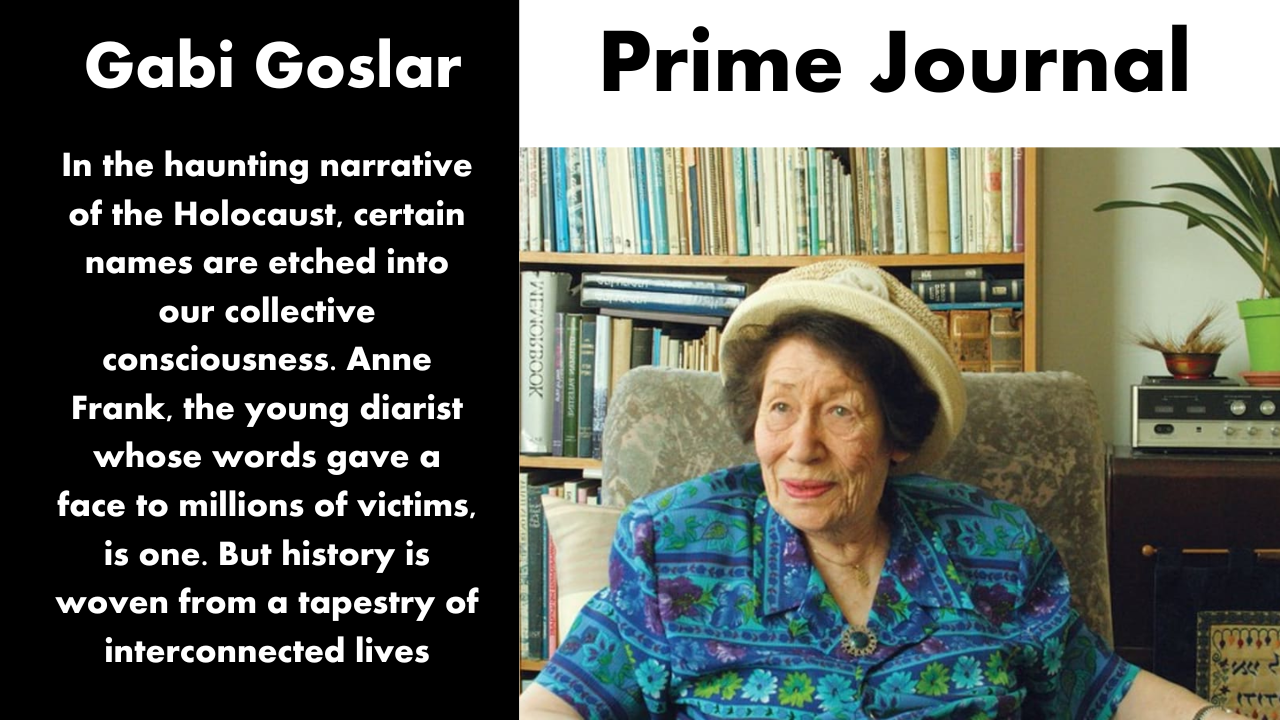
In the haunting narrative of the Holocaust, certain names are etched into our collective consciousness. Anne Frank, the young diarist whose words gave a face to millions of victims, is one. But history is woven from a tapestry of interconnected lives. Standing just beside Anne, both in the sunny days of childhood and the darkest shadows of war, was Gabi Goslar—Hanneli Goslar, as Anne knew her. Her story is not one of a famous diary, but of profound friendship, incredible survival, and a lifelong duty to memory. While Anne’s voice was tragically silenced, Gabi Goslar became a vital custodian of her legacy, sharing their story with the world for decades. This is the journey of a woman who witnessed history, lost her closest friend, and emerged with a message of resilience and hope.
A Friendship Frozen in Time
When we picture Anne Frank, we often see a solitary figure writing at a small desk. But before the Secret Annex, before the yellow stars and the sirens, she was simply a girl who loved movies, dreamed of romance, and shared secrets with her best friend. That friend was Gabi Goslar. Their friendship, forged on the playgrounds of Amsterdam, represents the normalcy that was so brutally stolen. Gabi Goslar‘s account is the essential counterpart to the diary; it is the voice from the outside, the living testimony to the girl behind the global icon. Her life offers a unique lens through which we can understand the full, devastating human cost of the Holocaust, not just through loss, but through the enduring strength of those who survived.
Early Life and a Bond Forged in Amsterdam
Childhood in Germany: A Foundation of Friendship
The story of Anne and Hanneli began not in the Netherlands, but in their native Germany. Both families were of German-Jewish descent and were caught in the rising tide of Nazi antisemitism. Gabi Goslar was born on November 12, 1928, in Berlin, just seven months before Anne Frank. Their families were acquainted, and the two girls likely crossed paths in their early years. This shared heritage and the experience of being uprooted would form an unspoken bond between them even before their friendship truly blossomed.
A New Life in the Netherlands: Sisters in Exile
In 1933, as the Nazi regime solidified its power, the Frank family fled to Amsterdam, seeking safety. The Goslar family followed suit a year later. It was in this new, hopeful environment that the friendship between Anne and Hanneli truly took root. They attended the nearby Montessori school together, were in the same class, and lived mere blocks from each other. Their world was one of schoolgirl crushes, birthday parties, and endless chatter.
- Anne: Extroverted, dramatic, expressive, and yearning to be seen.
- Hanneli (Gabi): More reserved, gentle, polite, and kind-hearted.
They were a classic case of opposites attracting, their differences creating a perfect balance. Anne, in her diary, would often refer to Hanneli by her nickname, “Lies,” and described her as one of her most cherished friends. In one of the most poignant entries, Anne writes about a dream she had of Hanneli, whom she saw “clad in rags, her face thin and worn.” She awoke gripped by guilt, wondering if her friend was suffering while she was in relative safety. This dream would prove to be tragically prophetic.
The War Years: Separation and a Fleeting Reunion
The Occupation and a Growing Divide
The Nazi invasion of the Netherlands in May 1940 shattered the girls’ world. Incrementally, but relentlessly, anti-Jewish laws were enacted, stripping away their freedoms. They were forced to wear yellow stars, could no longer visit non-Jewish friends, and were barred from parks, cinemas, and other public places. Despite this, the girls tried to maintain a semblance of normalcy.
The last time Gabi Goslar saw Anne Frank in person was in the spring of 1942. They met on the street, but something was different. Anne was distant and seemed preoccupied. She told Hanneli she and her family were going to Switzerland—a story the Franks had concocted to hide their plan to go into hiding. Confused and hurt by Anne’s odd behavior, Hanneli went home. She would not understand the reason for her friend’s secrecy until after the war.
The Glimpse Through the Barbed Wire: Bergen-Belsen
The Goslar family’s attempt to avoid deportation ultimately failed. In 1943, they were sent to the Westerbork transit camp and then, in February 1944, to the Bergen-Belsen concentration camp. By a twist of fate, Gabi Goslar and her younger sister, Rachel, were placed in a section of the camp for prisoners with potential foreign passports for exchange (the Goslars had papers for Palestine). It was here, in the bitter cold and squalor of Bergen-Belsen, that Gabi Goslar‘s path would shockingly cross Anne Frank’s one final time.
One evening, a fellow prisoner told Gabi Goslar that a girl named Anne Frank was in the adjacent camp, just on the other side of a barbed wire fence. Desperate to see her friend, Gabi Goslar managed to approach the barrier. What followed were several brief, harrowing conversations conducted through the darkness.
| Aspect | Details of the Reunion |
|---|---|
| Location | The barbed wire fence separating two sections of Bergen-Belsen camp. |
| Condition | Gabi Goslar was in a slightly “privileged” sector with extra food. Anne was in the catastrophic main camp, starving and exposed to the elements. |
| The Conversations | They spoke at night, risking punishment from guards. Anne, bereft and freezing, believed her entire family was dead. |
| The Act of Kindness | Gabi Goslar, showing incredible bravery, managed to assemble a small parcel of food (a sock filled with bread, sugar, and a glove) and throw it over the fence to Anne. |
| The Last Words | Their final exchange was cut short by guards. Anne, weakened and despairing, could barely stand. Gabi Goslar never saw her again. |
This act—throwing a small packet of food over a fence—stands as a monumental testament to human compassion in the face of utter inhumanity. It was the last known act of their friendship.
Life After Liberation: Bearing the Unbearable
The Devastating Truth and a New Beginning
Bergen-Belsen was liberated by British troops in April 1945. Gabi Goslar, though emaciated and ill, had survived alongside her sister. Their father had perished in the camp shortly before liberation. As she recovered, she began the painful process of searching for news of her friends. It was then that she learned the devastating truth: the Frank family had been betrayed, arrested, and deported. Otto Frank was the sole survivor. Anne and her sister Margot had died in Bergen-Belsen just weeks before liberation, victims of typhus and starvation.
The weight of this loss was immeasurable. Gabi Goslar had to rebuild a life from the ashes of a shattered world. In 1947, she immigrated to Mandatory Palestine (which would soon become Israel). She trained as a nurse, married a fellow Holocaust survivor, Dr. Walter Pinchass, and started a family. For many years, she was silent about her experiences, focusing on building a new future.
Becoming a Witness: The Voice for Those Who Were Silenced
The publication of Anne’s diary and its subsequent global fame changed the course of Gabi Goslar‘s life. As the world became captivated by Anne’s story, Otto Frank sought out his daughter’s old friend. He encouraged her to share her memories, to help people understand the vibrant, real girl behind the diary.
Gradually, Gabi Goslar embraced this role. She understood that her survival came with a responsibility. She began speaking publicly, first to small groups and eventually to audiences around the world. Her testimony was unique and powerful. She wasn’t just speaking about the Holocaust; she was speaking about Anne.
Her testimony provided:
- Context: She painted a picture of Anne’s life before hiding—the funny, lively, sometimes exasperating friend she knew.
- Validation: She confirmed the authenticity of Anne’s character and experiences as described in the diary.
- A Human Bridge: She connected the iconic diarist to the millions of students and readers who loved her, making Anne’s story even more real and heartbreaking.
The Legacy of Gabi Goslar: Memory Keeper
Author and Speaker: Sharing Her Story
In 1997, Gabi Goslar co-authored a memoir with a Dutch journalist, entitled “My Name is Anne, She Said, Anne Frank” (originally published in Dutch as “Herinneringen aan Anne Frank”). The book is an invaluable historical document, weaving together her own family’s story of persecution with her intimate memories of Anne. It stands as a crucial primary source for historians and biographers, including Melissa Müller in her acclaimed biography, Anne Frank: The Biography.
For the rest of her long life, Gabi Goslar was a dedicated educator. She tirelessly gave interviews and spoke at schools, museums, and memorials, including the Anne Frank House in Amsterdam. Her gentle demeanor and precise recall made her testimony incredibly impactful.
A Life of Meaning and Remembrance
Gabi Goslar‘s later years were dedicated to ensuring the lessons of the past were not forgotten. She saw the rise of new generations who knew little of the Holocaust and understood the danger of indifference. Her message was not one of hatred, but of warning, compassion, and the critical importance of standing up against bigotry in all its forms.
She passed away on October 28, 2022, in Jerusalem, at the age of 93. Her death marked the passing of one of the last living personal links to Anne Frank, but her voice and her story remain, preserved in her book, in countless recorded interviews, and in the memories of all who heard her speak.
FAQs
Q: How did Gabi Goslar survive the Holocaust?
A: She was held in a “privileged” section of Bergen-Belsen for potential prisoner exchanges. She and her sister were liberated by British troops in 1945.
Q: What did Gabi Goslar say about Anne Frank?
A: She described Anne as a lively, talkative, and magnetic personality, confirming the vibrant girl portrayed in the diary.
Q: Is the character “Lies” in Anne’s diary based on Gabi Goslar?
A: Yes, “Lies” was the pseudonym Anne used for her best friend, Hanneli Goslar (Gabi).
Q: Did any other members of the Goslar family survive?
A: Yes, her younger sister, Sanne, survived with her. Their father died in the camp days before liberation.
Q: Where can I learn more about Gabi Goslar’s story?
A: Read her memoir, “My Name is Anne, She Said, Anne Frank,” or visit resources from the U.S. Holocaust Memorial Museum or Yad Vashem.
Conclusion
The story of Gabi Goslar is a narrative of parallel lives: one cut devastatingly short, the other stretching long into the future. She was the friend who remembered the laughter, the confidant who shared the dreams, and the witness who saw the despair. Her life was defined by an unimaginable loss, but also by an unwavering commitment to the power of memory. She chose to use her profound grief as a force for education and peace, becoming the living bridge between the young girl the world fell in love with and the historical tragedy that claimed her.
Gabi Goslar’s legacy is a challenge to us all. It asks us to remember not just the statistics of the Holocaust, but the individual human beings—the friendships, the families, the dreams—that were destroyed. It is a powerful reminder that behind every name in the history books, there is a personal story waiting to be heard and honored.
Honor the memories of Anne Frank and Gabi Goslar by continuing to learn. Read The Diary of a Young Girl, visit a Holocaust museum, or listen to the recorded testimonies of survivors. Share their stories with the next generation. In a world where hatred and antisemitism are still present, their voices are more important than ever. Let’s ensure they are never forgotten.