

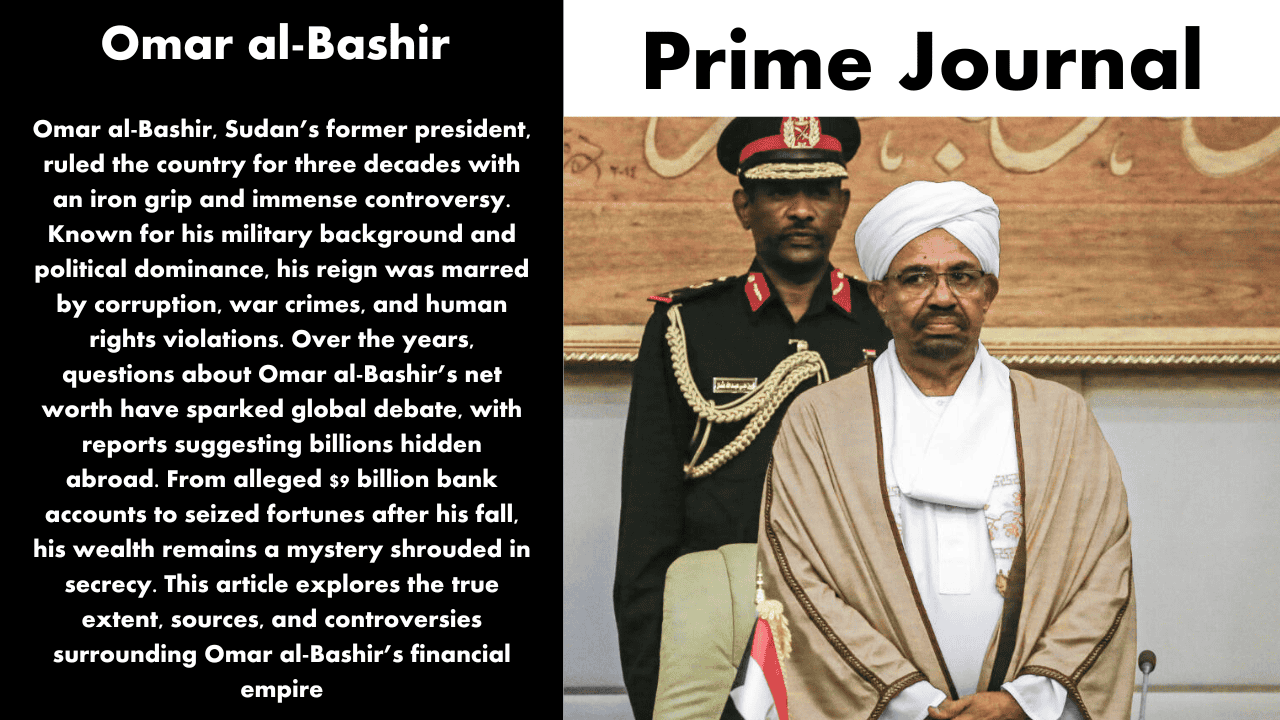
The question “Omar al-Bashir net worth” draws strong interest, not least because of the opaque and controversial nature of his finances. Over a three-decade rule in Sudan, accusations of corruption, embezzlement, and illicit wealth accumulation have surrounded his legacy. In this article, we examine available estimates, allegations, legal seizures, and expert commentary—all while highlighting credible sources and acknowledging uncertainties.
Why Omar al-Bashir’s Wealth Matters
Understanding the net worth of a leader like Omar al-Bashir is more than a matter of curiosity or gossip. It is a window into:
- Governance and corruption: How state resources may have been diverted.
- Transitional justice: Whether Sudan’s new authorities can reclaim stolen wealth.
- Historical record: Establishing a more accurate legacy of leadership, power, and accountability.
However, estimating his net worth is fraught with challenges: lack of transparency, conflicting claims, legal maneuvers, and political motivations. This article walks through those complexities.
Brief Biography & Rise to Power
To contextualize Omar al-Bashir’s finances, a brief sketch of his life and presidency is helpful.
- Born: January 1, 1944 in Hosh Bannaga, Sudan (some sources cite variant names)
- Military career: He rose through the ranks and by 1989 led a military coup that overthrew the government of Sadiq al-Mahdi.
- Rule: From 1989 (as Chairman of a military council) and from 1993 as President onward, he governed Sudan until being deposed in 2019.
- International accountability: He was indicted by the International Criminal Court (ICC) for crimes in Darfur in 2009.
Throughout decades in power, both supporters and critics claimed that he amassed large personal wealth—claims that persist to this day.
Estimating Omar al-Bashir’s Net Worth
Public estimates and celebrity-style listings
- CelebrityNetWorth lists Omar al-Bashir’s net worth at US $1 billion.
- Some media outlets repeat the same figure when ranking wealthy politicians in Africa, noting he is one of Sudan’s richest politicians.
- However, these figures tend to be speculative, lacking transparent accounting or audited disclosures.
Allegations of hidden funds & embezzlement
One of the most significant claims concerns $9 billion allegedly embezzled and held abroad:
- According to WikiLeaks cables, ICC prosecutor Luis Moreno-Ocampo claimed al-Bashir may have siphoned $9 billion from state coffers, possibly parked in British banks such as Lloyds.
- The Guardian and other outlets picked up those leaked cables, reporting that the funds may have been hidden in London bank accounts.
- The Sudanese government and bank denials have countered such claims; Lloyds, for example, said it found “no evidence” linking Bashir to accounts.
Thus, the $9 billion figure is contested and should be viewed as an allegation, not confirmed fact.
Confiscations, fines, and asset recoveries
Following his ouster in 2019, new Sudanese authorities attempted to recover assets:
- In May 2020, Sudan announced it had confiscated $3.5–4 billion worth of assets, properties, shares, and buildings associated with al-Bashir, his family, and close associates.
- In investigations conducted in 2019, law enforcement reportedly found cash suitcases in his residence with sums exceeding $10 million in multiple currencies.
- In December 2019, he was convicted for money laundering and corruption, though his sentence was fairly light (two years in a correctional facility) given his age and status.
- His second wife, Widad Babiker, was convicted in 2023 for illegally amassing wealth and had assets and funds ordered confiscated.
These measures reduce what might be considered a net (remaining) wealth.
Sources of Wealth: How Did He Accumulate Assets?
If al-Bashir indeed controlled vast wealth, where did it come from? Below are key mechanisms often cited.
State resources & oil revenues
- During his rule, Sudan was an oil-producing country; the revenues from oil exports were significant. Many analysts argue that much of the wealth of the ruling elite flowed from control over oil contracts, royalties, and state budgets.
- Control of state institutions (ministries, budgets, security apparatus) offered opportunities for redirecting funds or awarding skewed contracts.
Cronyism, patronage & illicit networks
- Crony networks: He is alleged to have placed trusted allies in key economic, military, and banking positions, thereby facilitating embezzlement or misallocation of state funds.
- Foreign aid, loans, and state guarantees might have been diverted into private ventures or shell companies benefitting insiders.
- Smuggling, illicit trade, and shadow economies in Sudan (due to weak governance) likely provided further channels for wealth extraction.
Foreign bank accounts & real estate
- The $9 billion claim centers on hidden bank accounts abroad—especially in London or possibly offshore jurisdictions. Real estate holdings abroad—though little public evidence—are often suspected in such cases.
- Use of proxies, shell corporations, or front companies may have masked ownership of properties or investments.
Legal Proceedings & Seizures
Trials, convictions, and corruption charges
- After being removed from power in April 2019, al-Bashir was first held under house arrest, then moved to Kobar Prison.
- In December 2019, he was convicted of money laundering and corruption and sentenced to two years in a correctional facility.
- He faced additional trials, including for incitement and participation in violence against protestors during the 2018–2019 mass uprisings.
- He also may face charges for the original coup of 1989.
Asset confiscation & recovery efforts
- Sudan’s Anti-Corruption and Regime Dismantling Committee reported confiscation of $3.5–4 billion in assets and holdings connected to al-Bashir, his family, and associates.
- Some assets might still be stuck in legal, administrative, or judicial limbo; full recovery may take years, if ever.
- Confiscated funds or assets are often subject to legal challenges, appeals, and international cooperation issues (if foreign jurisdictions are involved).
Challenges, Discrepancies & Criticisms
When assessing al-Bashir’s net worth estimates, one must be cautious because:
- Lack of audited financial disclosure: As an authoritarian regime, his administration did not publicly provide transparent personal financial statements.
- Political motivations: Post-regime governments have an interest in exaggerating claims or recovering assets, so some figures may be politically inflated.
- Overlapping claims: Some funds attributed to “Bashir” may actually belong to cronies, family members, or intermediaries.
- Denials and contradictions: Banks and individuals have denied connections to him. For example, Lloyds denied evidence tying him to accounts.
- Seized vs residual assets: Even after confiscations, some wealth may remain hidden or inaccessible.
Hence, any net worth figure—$1 billion or $9 billion—must be taken as a speculative estimate rather than confirmed fact.
Net Worth Estimate Summary
Below is a comparative table of the main figures associated with Omar al-Bashir’s wealth:
Interpretation:
- The $1 billion figure is plausible as a ballpark “public estimate” after factoring in confiscations and legal actions.
- The $9 billion is a more aggressive claim and should be treated with caution.
- The $3.5–4 billion confiscation marks a concrete recovery effort, though not necessarily the full extent of assets.
Implications & Lessons
On governance and corruption
The al-Bashir case highlights how long-term rulers may exploit power for wealth accumulation. It underscores the importance of systemic transparency, independent institutions, and checks on executive authority.
On transitional justice
Recovering assets from deeply embedded systems of corruption is complex. Even with confiscation laws, legal, diplomatic, and institutional hurdles slow the process—especially when assets are cross-border or held in opaque structures.
On historical narrative
The net worth of al-Bashir becomes part of his legacy: was he a transformative leader, a strongman with stability claims, or a plunderer of state resources? The financial dimension cannot be ignored in assessing his historical impact.
FAQs
Q1: What is Omar al-Bashir’s verified net worth?
Answer: There is no confirmed, audited figure. Public estimates commonly place it at $1 billion, though allegations go as high as $9 billion. After confiscations, the true remaining wealth is uncertain.
Q2: Did Sudan ever confiscate his assets?
Answer: Yes. In 2020, authorities claimed to have confiscated $3.5–4 billion in assets, properties, and shares tied to al-Bashir and associates.
Q3: Are the $9 billion claims credible?
Answer: The $9 billion figure stems from leaked diplomatic cables citing ICC prosecutor Luis Moreno-Ocampo. While significant, those claims lack full verification and are contested by banks and officials.
Q4: What legal consequences did Bashir face regarding his wealth?
Answer: He was tried and convicted in December 2019 on charges of corruption and money laundering, receiving a two-year sentence. He also had assets seized and faced further trials over violence and the 1989 coup.
Q5: Could he still have hidden assets abroad?
Answer: Possibly. Given the complexity of offshore banking and shell entities, some assets may remain undisclosed, outside Sudanese jurisdiction, or tied to proxies.
Q6: How reliable are net worth figures for political leaders?
Answer: They often rely on leaks, investigative journalism, or intelligence reports and may be inflated or suppressed for political purposes. Transparency is rare, especially in authoritarian regimes.
Q7: Where can I read more about his trial and asset seizures?
Answer: Trusted sources include the Wikipedia page on Omar al-Bashir, the Guardian’s report on the $9 billion claims and Al Arabiya’s coverage of asset confiscation
Conclusion
Estimating Omar al-Bashir’s net worth is inherently speculative, as it sits at the intersection of politics, secrecy, and incomplete records. The widely cited figure of $1 billion is a plausible baseline, but the more sensational claim of $9 billion remains unverified. What is more concrete is the $3.5–4 billion in assets confiscated by Sudan’s post-Bashir government—a testament to efforts at accountability.
Ultimately, any estimate must be contextualized: how much remains hidden, how much was legally seized, and how much actually belonged to him versus proxies. Still, the numbers matter—not just as tabloid fodder, but as a gauge of state capture and the challenges facing countries like Sudan in pursuing justice.
If you’re interested in deeper exploration of Sudan’s transitional justice, asset recovery mechanisms, or comparative cases of wealth in authoritarian regimes, I’d be happy to write follow-up articles. Just let me know your preferred focus.