
Who Is Gerhard Schröder?
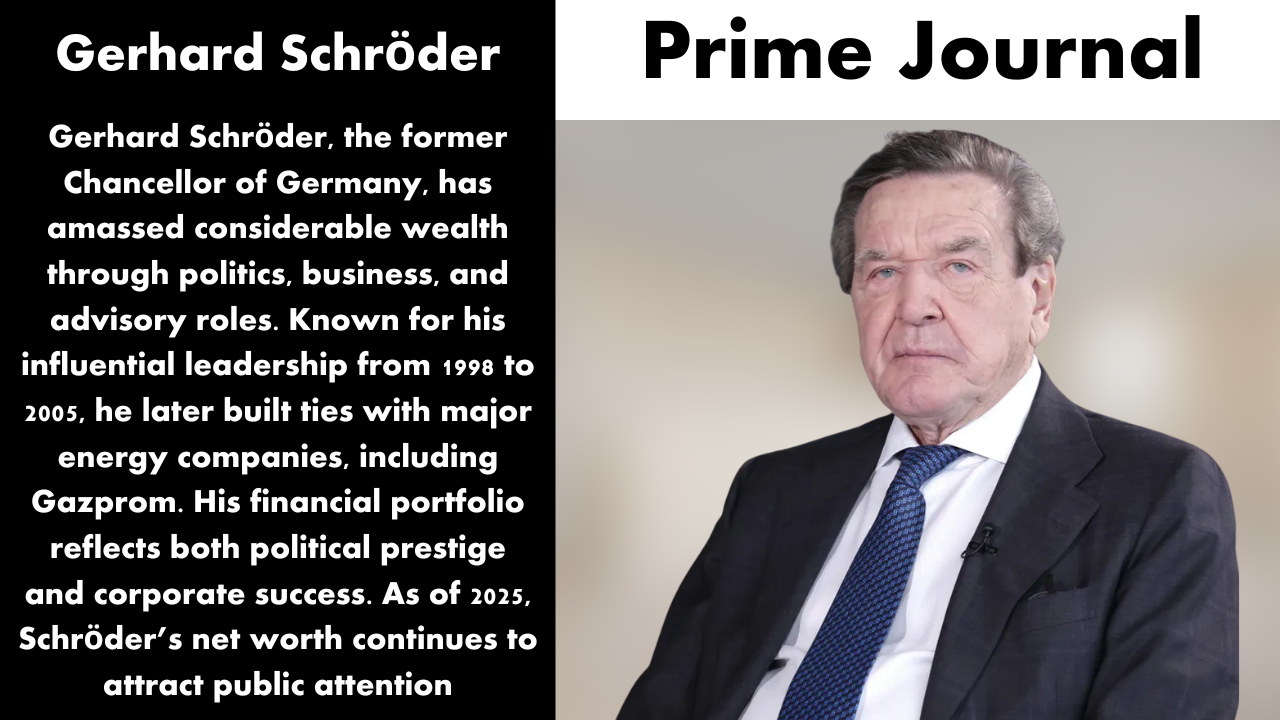
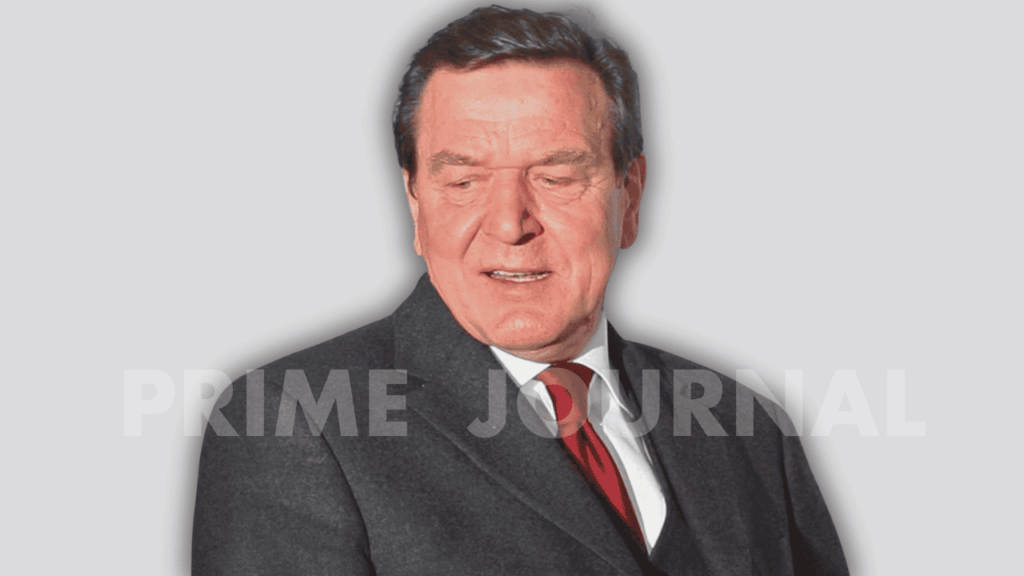
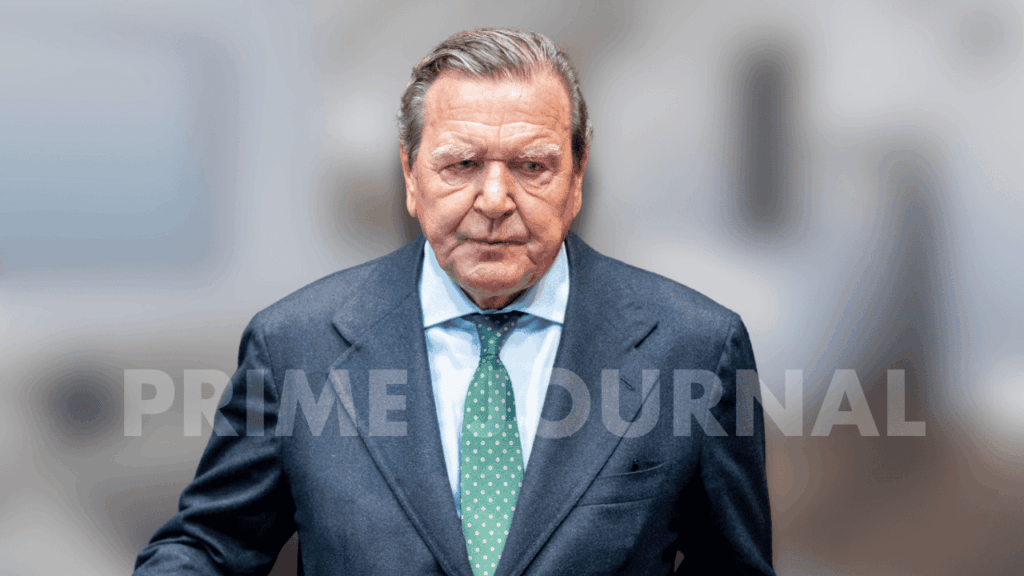
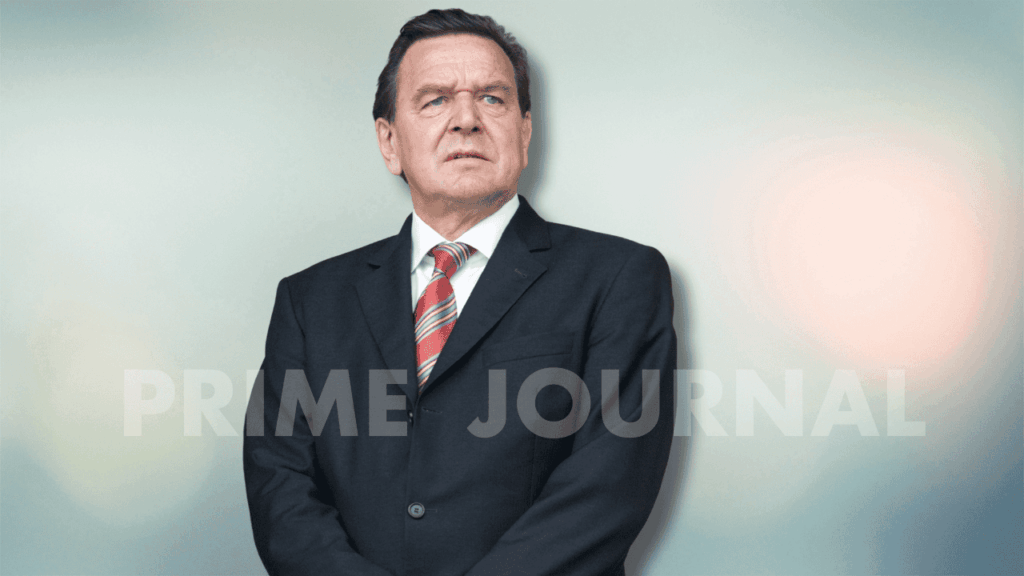
Gerhard Fritz Kurt Schröder (born 7 April 1944) is a German politician, lobbyist, and former lawyer who served as Chancellor of Germany from 1998 to 2005. Before that, he was Minister-President of Lower Saxony (1990–1998) and led the Social Democratic Party (SPD) from 1999 to 2004.
After leaving office, Schröder became a board member and advisor in multiple high-profile energy and pipeline ventures—most notably in Russian state-related companies (Rosneft, Gazprom, Nord Stream).His post-political career has drawn both criticism and scrutiny, particularly in light of geopolitical tensions.
Early in life, Schröder came from modest means. His father died during World War II, and his mother raised him and his siblings. Schröder left school early to work and later pursued legal studies in Göttingen, earning a law degree and entering legal practice.
Estimated Net Worth in 2025
Determining the precise net worth of a public figure—especially one with business interests, political ties, and private holdings—is challenging. However, multiple reputable sources and investigative outlets converge on a ballpark figure:
From these sources, we can reasonably assert:
Estimated Net Worth (2025): €20 million (≈ US$20–25 million, depending on exchange rate)
That said, this remains speculative—official disclosures are limited, and Schröder has not published a confirmed, audited net worth statement publicly. The estimates are based on known board roles, compensation, public records, and investigative journalism.
Reliability & Uncertainty
- Many figures rely on “best estimates” and may not capture hidden assets or debt.
- Currency fluctuations (EUR ↔ USD) affect conversions.
- Political and legal pressures (especially post-2022) may adjust valuation or income streams.
- Some sources may exaggerate or minimize based on political biases.
Thus, while the €20 million estimate is a widely echoed figure, readers should treat it as an informed approximation rather than an absolute truth.
Major Income Sources & Assets
If Schröder has built a net worth in the tens of millions of euros, how did he get there? Below are the principal sources and categories of his wealth.
1. Board and Supervisory Mandates in Energy & Industry
After leaving the chancellorship, Schröder became deeply involved in the energy sector, especially with Russian state-owned firms. His roles include:
- Rosneft (Russian state oil company): He served as Chairman of the Board of Supervisors.
- Nord Stream AG / Nord Stream 2 pipeline projects: He held supervisory roles and was a prominent figure in the pipeline’s promotion and governance.
- Gazprom (nomination and board discussions): While he paused some formal positions after 2022, earlier he was slated or nominated for board roles.
- Advisory roles and consulting contracts: For example, he joined the International Advisory Council of the China Investment Corporation.
- Rothschild Group / Investment Banking Advisory: He has served as a “global manager” or consultant for the Rothschild Group.
Compensation from such mandates can be substantial—six-figure sums or more annually—especially for someone with Schröder’s stature and political leverage.
2. Pension / “Ruhegehalt” as Ex-Chancellor
As a former German Chancellor, Schröder is entitled to a retirement pension (Ruhegehalt). According to German sources, that pension is approximately €8,700 per month (gross). Over a year, that pension yields over €100,000, contributing modestly to ongoing income.
3. Speaking Engagements, Consulting, and Royalties
- As a prominent political figure, Schröder can demand high rates for public speeches, lectures, or consulting engagements.
- These “soft income” sources often go undisclosed publicly, making precise estimation difficult.
- Over time, such engagements can cumulatively amount to hundreds of thousands or low millions of euros annually (in strong years).
4. Real Estate & Personal Holdings
- Although detailed public records of his real estate portfolio are scarce, it is typical for people of his means to invest in residential or commercial property.
- Any private shares or equity in firms or private trusts may also exist outside public scrutiny.
- Because Schröder has faced increasing scrutiny post-2022, some assets may have been restructured, relocated, or liquidated.
5. Liquidity / Cash & Investments
- A portion of his wealth likely lies in cash, securities, or investments (stocks, bonds, funds).
- These assets may be held domestically or internationally (depending on tax strategies and regulatory environment).
Summary of Income Allocation (Hypothetical)
Below is a rough hypothetical breakdown (percentages) of how his €20 million estimate might be distributed:
| Income / Asset Category | Estimated Share |
| Energy / Board Mandate Holdings | 40% |
| Private Equity / Investments & Securities | 25% |
| Real Estate & Property | 10% |
| Pension & Public Benefits | 5% |
| Speaking / Consulting / Soft Income | 20% |
This is illustrative to show that the bulk likely stems from energy / board roles and investments, with more modest weight from pension or speaking.
Liabilities, Expenses & Risks
Net worth is not just about assets and income; liabilities, costs, and risks play a major role. For someone in Schröder’s position, these include:
- Taxes & Regulatory Costs: Germany has relatively high tax rates, and income from international entities may attract additional liability or scrutiny.
- Legal and reputational risks: Controversies (especially regarding ties to Russia) pose potential financial liabilities, fines, or restrictions.
- Asset freezes or account blocks: Indeed, reports in 2024 mention Schröder’s bank instruments being blocked.
- Costs of maintaining staff, offices, and operations: For example, in 2021, the personnel cost for an office for the former chancellor amounted to €407,000.
- Currency risk and investment risk: If wealth is held in foreign assets, exchange rate fluctuations or market volatility can erode value.
- Divestments forced by political pressure: Following the Russian invasion of Ukraine, Schröder has faced pressure to sever ties with Russian firms, which may involve financial loss or contract termination.
Therefore, while his gross assets may suggest €20 million in net worth, the “net” after liabilities, risk buffers, and potential asset impairments might be lower.
Career Milestones & Financial Impacts
To appreciate how Schröder accumulated his wealth, it helps to view his career timeline and pivotal financial inflection points.
Early Years & Legal Career
- Schröder studied law at the University of Göttingen and completed his legal clerkship around 1972–1976.
- He became a practicing lawyer in Hannover before fully entering politics.
- While income in this phase would have been modest, it laid groundwork for legal contacts, reputation, and professional network.
Political Rise & Premiership (Lower Saxony)
- From 1990 until 1998, Schröder served as Minister-President of Lower Saxony.
- In these years, his political profile grew, allowing him to eventually secure roles with higher remuneration and influence.
Chancellorship (1998–2005)
- As Chancellor, Schröder earned a public salary commensurate with heads of government; however, the salary is dwarfed by post-office financial opportunities for former statesmen.
- Policy decisions like Agenda 2010 and energy reforms heightened his visibility and alliances with energy industries.
- Upon exiting office, his status and contacts positioned him to access lucrative board and advisory roles.
Post-Office: Pivot to Energy & Advisory Roles
- After 2005, Schröder turned extensively toward roles in energy, especially with Russian firms: Rosneft, Nord Stream, and Gazprom.He joined the International Advisory Council of China’s sovereign wealth fund.
- He also engaged in lecturing, consulting, and media work—activities that supplement his official remuneration.
Recent Challenges & Restrictions
- Since the 2022 Russian invasion of Ukraine, Schröder has faced intense criticism, leading to resignations or pauses in roles at Russian entities.
- In 2024, legal disputes led him to lose access to a Bundestag office and associated staff funding.
- Banks reportedly blocked some of his account transfers, citing regulatory or compliance concerns.
These developments can chip away at his revenue streams and asset liquidity.
Controversies & Legal/Political Fallout
Given Schröder’s high-profile connections—particularly with Russian state-linked firms—his net worth and financial dealings attract scrutiny. Here are major controversies and their implications:
Close Ties to Russian Energy
- Schröder has long been criticized for his role as a “lobbyist for Putin,” maintaining positions on boards of Russian state firms like Rosneft and Nord Stream.
- After Russia’s 2022 invasion of Ukraine, German political pressure mounted for him to sever those ties.
- Schröder eventually resigned as chairman of Rosneft and declined a Gazprom board nomination—but critics remain skeptical about his remaining influence.
Loss of Privileges & Office Access
- In 2022, the Bundestag voted to strip Schröder of his publicly funded office and staff, arguing he no longer performed duties befitting a former chancellor.
- His legal appeal to reverse this decision was rejected in 2024.
Bank Transfers Blocked
- Reports in mid-2024 asserted that some of his former compensation (e.g., ~€200,000 every six months from Nord Stream 2) was being blocked or rejected by German banks on compliance grounds.
- Such blocks raise questions about liquidity and access to income streams amid sanctions and regulatory pressure.
Ethical & Political Criticism
- Many within his own party, the SPD, have publicly distanced themselves from him over his Russia ties.
- Critics accuse him of conflict of interest—leveraging his political past for private gain in the energy sector.
- The Putin’s List database even categorizes him under “beneficiaries” for such ties.
Impact on Valuation
Such controversies can:
- Depress the value of contracts or roles (renegotiations, forced divestitures)
- Increase legal costs, fines, or reputational losses
- Cause loss of access to public benefits (e.g., pension, staff office)
- Lead to frozen assets or increased regulatory scrutiny
Thus, the headline “€20 million net worth” may not reflect the true net—once liabilities, contested assets, and risk reserves are factored in.
Comparison with Other Politicians’ Wealth
Understanding Schröder’s net worth is aided by context—how does he compare to other well-known political figures?
- In Germany: According to FTD, Schröder is often ranked among the richest ex-politicians in Germany, with an estimated 20 million euros in net worth.
- Globally: While $20 million is substantial, many global leaders, ex-presidents, or heads of state surpass that (especially those with business empires or dynastic wealth).
- For example, among Germany’s richest, some industrial magnates or media moguls dwarf Schröder’s sum.
It’s fair to say Schröder’s wealth is significant—especially relative to many career politicians—but not in the realm of billionaire status.
FAQs
1. What is Gerhard Schröder’s net worth in 2025?
Estimates commonly place his net worth at ~€20 million (roughly US$20–25 million) based on aggregated sources and public records.
2. How credible are these net worth estimates?
They are approximations based on publicly known roles, compensation, and media investigations—but Schröder has not publicly disclosed full, audited financial statements. Hidden assets or liabilities may shift the effective net worth up or down.
3. What are his major sources of income?
- Board and supervisory roles in energy firms (Rosneft, Nord Stream)
- Pension as ex-Chancellor (~€8,700 per month)
- Consulting, speaking fees, and advisory contracts
- Investments, real estate, equity holdings
4. Why is Schröder’s post-political income controversial?
His extensive ties to Russian energy entities (especially after 2022’s war) have led to accusations of conflict of interest, lobbying for autocracies, and leveraging political fame for private gain. 5. Has Schröder lost privileges or assets due to his political affiliations?
Yes. The Bundestag revoked his publicly funded office and staff, and his appeal to regain it was denied in 2024. Some bank transfers to him have also reportedly been blocked
6. Does he pay taxes on his income?
While details are not fully public, his income from German roles is subject to German taxation. Cross-border revenue (e.g., from Russian or international mandates) may also be taxed or scrutinized under international tax law and sanctions regimes.
7. Could his net worth decline in coming years?
Yes. Continued pressure on his Russian ties, legal exposure, potential asset freezes, or reputational damage could erode his earnings or force divestment.
8. Is his €20 million net worth large for a former German chancellor?
Yes, it is relatively substantial—but not extraordinary compared to global standards. It places him among the richer ex-politicians in Germany, though many in business or industry have far higher net worths.
Conclusion
Gerhard Schröder’s financial profile reflects a transition from public official to energy insider and global adviser—a move that has allowed him to amass a substantial net worth, commonly estimated around €20 million. However, the opaque nature of political finances, shifting geopolitical pressures, and contested legal standing make any figure provisional.
His story is a cautionary tale of how political capital can translate into economic capital—and how volatile that balance becomes when politics, ethics, and commerce intersect.