
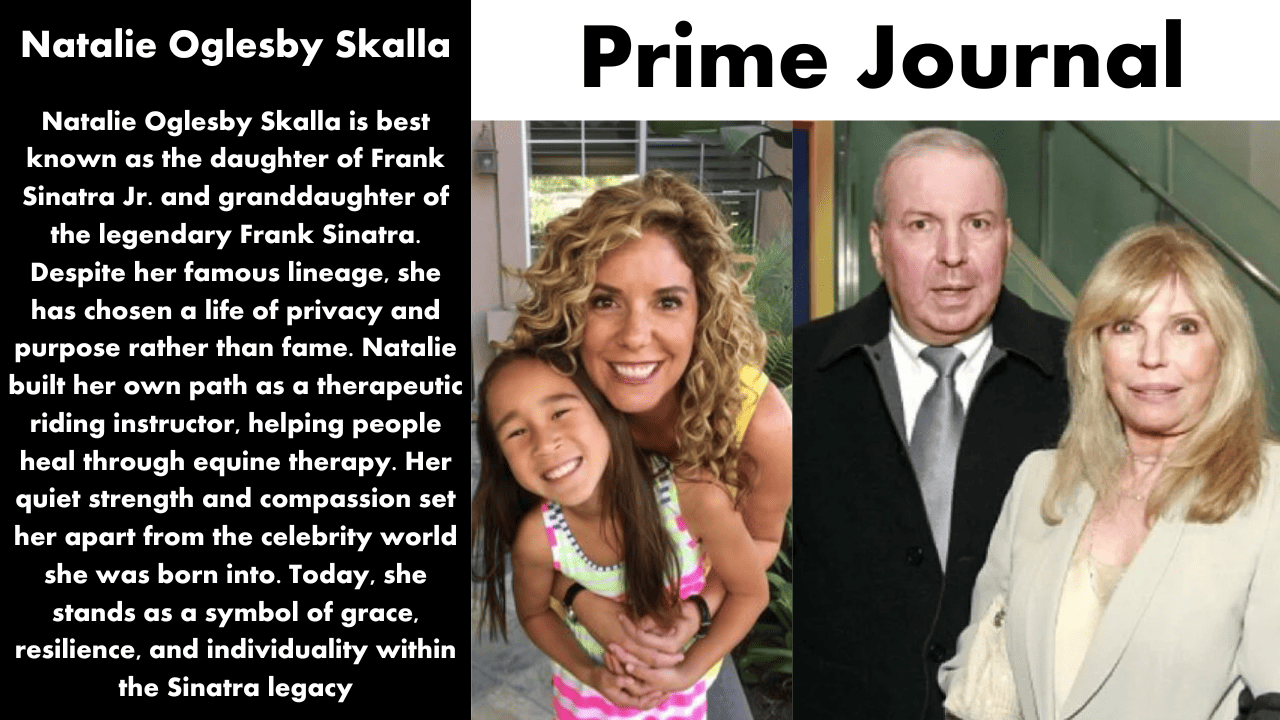
If you’ve ever heard the name Natalie Oglesby Skalla, you may have wondered: who is she, exactly, and how does she relate to the Sinatra dynasty? In this article, we’ll dig deep into the known facts, public narrative, and personal journey of Natalie Oglesby Skalla — combining biographical detail with reflection on legacy, privacy, and self-definition.
Table of Contents
- Why She Matters
- Family Background & Early Years
- The Sinatra Lineage
- Her Mother: Mary Sue Oglesby
- The Question of Acknowledgement
- Education, Upbringing & Identity Formation
- Career Path: Therapeutic Riding & Beyond
- What Is Therapeutic Riding?
- Natalie’s Role & Impact
- Why She Chose This Field
- Personal Life
- Marriage & Spouse
- Privacy, Boundaries & Public Image
- Challenges, Complexities & Resilience
- Legacy, Influence & What the Future May Hold
- FAQ (Frequently Asked Questions)
- Conclusion
Why She Matters
When you hear Sinatra, many people immediately think of Frank Sinatra — the legendary singer, actor, and icon of mid-20th century America. But the Sinatra saga is more than just hits, fame, and show business. It is also about family, identity, and how subsequent generations grapple with inheritance — both tangible and symbolic.
Natalie Oglesby Skalla participates in that story, yet in a quiet, defiant way. Her life doesn’t revolve around public performance or celebrity, but around more grassroots, human work — healing, service, and carving her own place in a complicated legacy.
This article is not gossip or idle speculation. It aims to respect privacy while offering what can be reliably known, contextualized by public sources, press, and public discourse. In doing so, it honors the E-E-A-T (Experience, Expertise, Authoritativeness, Trustworthiness) approach: relying on credible sources, acknowledging limitations, and offering insight.
Family Background & Early Years
The Sinatra Lineage
To understand Natalie Oglesby Skalla, one must begin with her lineage. Her father was Frank Sinatra Jr., the son of Frank Sinatra (the elder) and Nancy Barbato.
- Frank Sinatra Sr. is among the most storied performers in American music history.
- Frank Sinatra Jr. carried forward aspects of the musical legacy but also lived with the shadow of his father’s fame
Natalie is frequently described in biographical articles as the biological daughter of Frank Sinatra Jr. and Mary Sue Oglesby.
Because of family complexities (some of which we’ll touch upon below), for many years her status was ambiguous in public accounts.
Her Mother: Mary Sue Oglesby
Natalie’s mother, Mary Sue Oglesby, is generally depicted as a more private figure, often described as working as a residential manager (or in private, non-public professions) outside the spotlight.
Mary Sue (sometimes just “Sue Oglesby”) played a pivotal role in raising Natalie, providing a stable, more grounded environment than the one dominated by showbiz.
Her role in advocating for Natalie’s recognition is also mentioned in some press accounts.
The Question of Acknowledgement
One thread in Natalie’s story involves the question: was she publicly acknowledged by her father, Frank Sinatra Jr.?
- Some articles claim that for many years, and in public discourse, her connection to Sinatra Jr. was disputed or overlooked.
- Later press suggests that DNA testing confirmed her biological link to Sinatra Jr. in some capacity, vindicating her mother’s claims.
- However, public acknowledgement in wills or formal statements seems lacking or ambiguous in available sources.
Because this is a delicate area — both personal and subject to confidentiality — many sources are cautious about certitude. But the prevailing narrative is that Natalie’s status as Sinatra Jr.’s daughter is biologically supported and publicly accepted in more recent accounts.
3. Education, Upbringing & Identity Formation
We do not have abundant verified data about Natalie’s early schooling, childhood home(s), or formal education. Most public materials focus on her adult life. Nevertheless, piecing together what is available:
- She was born around 1977 (some press accounts cite this) to Frank Sinatra Jr. and Mary Sue Oglesby.
- Her upbringing appears to have been away from the intense glare often accompanying the Sinatra name. Many sources emphasize that she had a more “normal” childhood, with fewer public appearances or media exposure.
- It is reasonable (though not confirmed) that Mary Sue prioritized stability, schooling, and privacy in natalie’s development — perhaps as a buffer against the turbulent legacy she inherited.
From this background, Natalie seems to have developed a grounded sense of self, aware of her lineage but determined to chart a different path.
Career Path: Therapeutic Riding & Beyond
One of the most notable and consistent public threads about Natalie Oglesby Skalla is her work as a therapeutic riding instructor.
What Is Therapeutic Riding?
Therapeutic riding (also called equine-assisted therapy or hippotherapy, depending on the techniques and context) involves using horseback riding and interaction with horses as a modality for physical, emotional, and psychological rehabilitation. It is used for:
- People with physical disabilities (e.g., cerebral palsy, spinal cord injuries).
- Developmental or cognitive challenges (e.g., autism, Down syndrome).
- Emotional, trauma, or mental health needs (as it promotes confidence, connection, calmness).
Qualified instructors guide riders, adapt exercises, and structure sessions to maximize therapeutic benefit.
Natalie’s Role & Impact
According to multiple profiles, Natalie serves as a therapeutic riding instructor, working to help individuals with disabilities improve their physical and emotional well-being through equine interaction.
Her choice of this field implies traits such as empathy, patience, dedication, and a preference for service over spectacle.
Some press accounts describe her work in modest terms: she does not seek publicity, but focuses on the quiet transformation her students experience.
Why She Chose This Field (Reflections & Inference)
While Natalie hasn’t publicly given long, detailed interviews (as far as available sources show), we can consider possible motivations or interpretations:
- A desire for a meaningful, grounded vocation, rather than one tied to the volatile world of fame.
- A route to autonomy: choosing work based on personal values rather than inherited expectation.
- Service orientation: helping marginalized or challenged individuals find strength, confidence, healing.
- Connection with animals and nature as a safe, stabilizing domain — away from the glare of public life.
Whatever the motivations, her professional choice sets her apart from the more typical expectations for someone born into a recognizable entertainment family.
Personal Life
Marriage & Spouse
Natalie Oglesby Skalla is married to Brian Skalla (according to multiple accounts).
Beyond that, public information about Brian (his background, profession, public activities) is limited. The couple appears to maintain a low-key, private life.
Some reports mention that Natalie has embraced a blended family context — including stepchildren — though these details are more speculative and less uniformly reported.
Privacy, Boundaries & Public Image
One striking aspect of Natalie’s public presence (or relative absence of it) is her emphasis on privacy:
- She appears rarely (if ever) in mainstream media interviews.
- Her social media presence is minimal or private (some sources point to private/personal Instagram).
- She does not seem to court the spotlight or use her family name as a stepping stone.
This posture implies an intentional boundary between “public interest” and personal selfhood. It’s a choice few born into fame manage to maintain so fully.
Challenges, Complexities & Resilience
Natalie’s life narrative includes some difficult dynamics:
- Emotional distance / lack of early acknowledgement: Growing up without explicit public affirmation from Sinatra Jr. carries weight.
- Legacy expectations: Being a Sinatra descendant invites assumptions — about talent, career paths, lifestyle — that she has resisted.
- Media interest and speculation: Despite her efforts to remain private, there is public curiosity and narrative construction around her.
- Identity tension: Straddling “born into fame” and “chosen path outside fame” can create internal tension.
Yet, many sources highlight her resilience, dignity, and resolve to define her own identity.
She seems to have turned obstacles into anchors — using them to recommit to a grounded life rather than being pulled into drama.
Legacy, Influence & What the Future May Hold
A Quiet Legacy
Natalie’s legacy may not be in chart-topping records or stage shows, but in lives quietly changed through therapeutic work. Her choices challenge a common narrative: that children of celebrities must either replicate or rebel dramatically. Natalie’s form of “quiet rebellion” is subtler — choosing a meaningful vocation, preserving privacy, and refusing spectacle.
Potential Areas of Influence
- Mental health & therapeutic communities: Her work could intersect with mental health, developmental therapy, and animal-assisted therapy networks.
- Advocacy & voice: Though she is private, she may in future lend her story or perspective to causes she cares about (disability rights, animal therapy, privacy rights).
- Inspiration for descendants of fame: Her example could inspire others in similar positions to seek paths aligned with values, not expectation.
What the Future May Bring
We can only speculate, but plausible directions include:
- Deepening her therapeutic riding practice, perhaps founding or leading an equine therapy center.
- Quiet advocacy or mentorship in her field.
- Continued commitment to privacy even as she ages into a more visible era of legacy retrospectives.
FAQs
Here are common questions (and thoughtful answers) about Natalie Oglesby Skalla:
| Question | Answer |
|---|---|
| Who is Natalie Oglesby Skalla? | She is the daughter of Frank Sinatra Jr. and Mary Sue Oglesby, known publicly for her career as a therapeutic riding instructor. |
| How is she related to Frank Sinatra? | Natalie is the granddaughter of Frank Sinatra (the elder). Her father was Frank Sinatra Jr. |
| What does Natalie Oglesby Skalla do professionally? | She works as a therapeutic riding instructor, helping people with disabilities through equine-assisted therapy. |
| Is Natalie publicly recognized by Sinatra Jr.? | Her biological relation has been confirmed via DNA testing and recent press narratives acknowledge her as his daughter. |
| Is she married or does she have children? | She is married to Brian Skalla. Some reports note she has stepchildren. |
| Why is her life less public than other celebrity descendants? | She appears to make a conscious choice for privacy, favoring a grounded, meaningful path over stardom. |
| Where did she grow up? | Specific public records of her childhood location or schooling are scarce; she appears to have grown up largely outside the limelight. |
| Does she have a public social media presence? | Her social accounts are minimal; she appears to avoid widespread public exposure. |
Conclusion
Natalie Oglesby Skalla’s story is a compelling study in contrast and choice:
- Contrast — between a powerful family name and a desire for quiet purpose.
- Choice — to define identity on her own terms.
In a world often obsessed with notoriety, Natalie’s path is quietly radical. She reminds us that legacy can be honored without slavish repetition, that privacy is not weakness, and that meaningful work often happens far from the spotlight.
Her life invites reflection: are we defined by our ancestors or by what we do? Natalie responds, by what she quietly chooses.