




In today’s technology-driven world, when organizations demand high throughput, reliability, security and scale, one of the unsung heroes beneath the surface is the mainframe. This article takes a deep look at the concept of the NS Mainframe — analysing what it is, how it works, where it’s used, and why it remains relevant in the 2020s.
We’ll cover architecture, use-cases, benefits, limitations and future trends — all with a human-friendly tone, real-world examples, and SEO-friendly structure. (Related: [Your Article Title])
What is NS Mainframe?
The term “NS Mainframe” refers to an enterprise-grade, high-performance mainframe computing system designed to support massive workloads, many concurrent users, mission-critical applications and extremely high levels of reliability.
In essence:
- It is the backbone of large organisations where “downtime is not an option”.
- It typically supports transaction processing, large-scale data management, high throughput I/O and high concurrency.
- It is engineered for longevity, stability and security.
Why the “NS”?
The “NS” prefix is often used in articles as shorthand for this type of mainframe or for a brand/series of mainframe solutions. It may also erroneously be conflated with the mainframe system of the railway corporation Norfolk Southern Corporation (NS) which uses “mainframe” infrastructure internally.
Example definition:
“An NS Mainframe is a powerful, high-performance computing system designed to handle massive workloads and support numerous simultaneous users with incredible reliability.”
Evolution & History
Early days
Mainframe computing has its roots in the 1950s and 1960s when large organisations adopted centralized computers. The NS Mainframe inherits that legacy — with many of the same design principles (reliability, scale) but modernised.
The transition to modern era
Over time, as computing changed, mainframes evolved:
- Support for virtualization (logical partitions)
- Integration with distributed systems and cloud
- Enhanced security, real-time analytics
The NS Mainframe as discussed in current articles includes modern features like cloud integration and hybrid environments.
Why still relevant today
Despite the rise of cloud, microservices and distributed computing, mainframes remain relevant because:
- They handle very large, mission-critical workloads with minimal downtime.
- Many legacy enterprise systems were built on mainframes and continue to run there.
- They offer unique reliability, scalability and security features that are harder to replicate in commodity servers.
Key Features and Capabilities
Here are some of the standout features of an NS Mainframe system:
| Feature | Description |
|---|---|
| Reliability / Availability | Extremely high uptime (often 99.999% or better) so systems stay online. |
| Scalability / Performance | Ability to manage thousands (or tens of thousands) of simultaneous users, very high transaction throughput. |
| Security & Compliance | Hardware-level encryption, strong access control, real-time monitoring. |
| Legacy & Modern Integration | Support for older applications (COBOL, PL/I) and newer apps (Java, Linux) simultaneously. |
| Efficiency & Cost of Ownership | Although high upfront cost, long lifespan and consolidated workloads can reduce total cost over time. |
Additional semantic / LSI keywords
- enterprise computing
- mission-critical systems
- high-performance mainframe
- legacy application support
- hybrid cloud mainframe
- transaction processing system
Architecture and Core Components
Hardware stack
Typical components include:
- High-performance processors optimised for parallel transactions.
- Large memory (RAM) and fast I/O channels (to avoid bottlenecks).
- Redundant subsystems (power, cooling, storage) to ensure uptime.
Software stack & operating environment
- A dedicated mainframe OS (in many cases) or Linux on mainframe hardware.
- Workload managers, virtualization layers, logical partitions (LPARs).
- Tools for batch processing, transaction management, database operations.
Integration & connectivity
- APIs and middleware to connect to distributed systems and cloud platforms.
- Terminal access (e.g., 3270 emulation) for users familiar with classic mainframe screens.
Example architecture diagram (you would include an image)
Use an image showing blocks: CPU → Memory → I/O channels → Storage → Network → Clients + cloud link.
Use Cases & Industry Applications
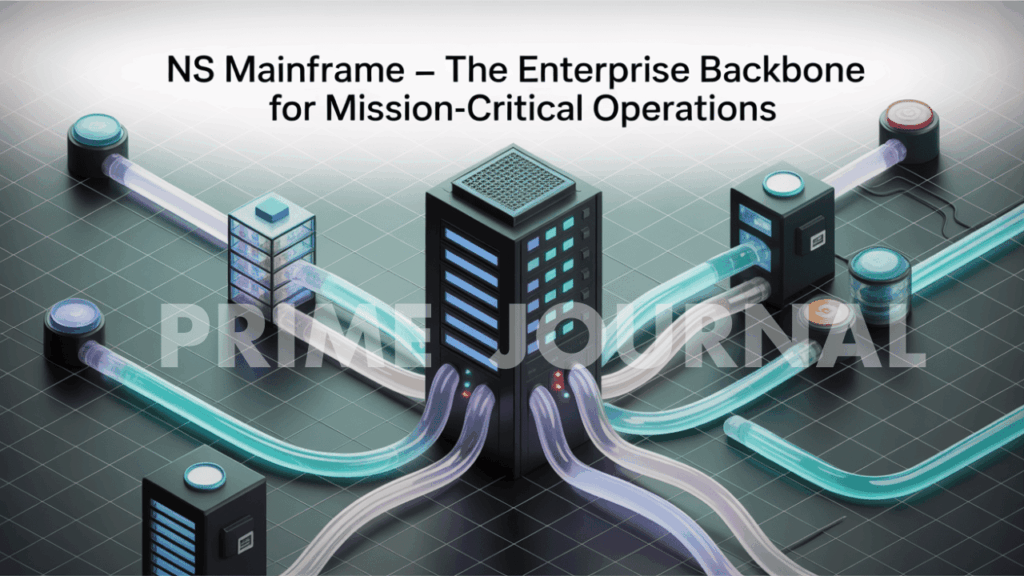
Mainframes like NS Mainframe power many industries where reliability and scale matter.
Banking & Finance
- Real-time transaction processing (ATMs, card networks, stock exchanges).
- Fraud detection engines running 24/7.
Insurance
- Claims processing, risk analytics, policy systems.
Government & Public Sector
- Large-scale citizen databases, tax systems, social benefits portals.
Healthcare
- Electronic health records (EHR), large-scale patient data, regulatory compliance workloads.
Transportation & Logistics
- For example, the railway company Norfolk Southern uses mainframe systems (login portals and monitoring) for crew scheduling and operations.
Real-world example:
On the forum r/railroading, one user commented:
“That crew call mainframe thingy starts calling you for a 3 am extra.”
This shows how mainframe systems are used for real-time operations in transportation.
Benefits of NS Mainframe Adoption
- Unmatched reliability: fewer failures, less downtime, smoother business continuity.
- High throughput & concurrency: able to process heavy workloads with minimal latency.
- Support for legacy systems: Many organisations have decades-old applications; mainframes allow them to persist.
- Consolidation & cost savings: Instead of many servers, one mainframe can handle vast loads — potentially lower operational costs over time.
- Security & compliance readiness: Designed for industries where data sensitivity is high, regulatory demands are strict.
Challenges and Considerations
Not everything is perfect — there are trade-offs to consider.
High upfront cost
Purchasing and configuring a mainframe can be expensive, as can be the infrastructure (power, cooling, real estate).
Skill-set shortage
Fewer engineers trained in classic mainframe technologies (COBOL, JCL, mainframe OS) versus modern distributed systems.
Modernisation & integration challenges
While mainframes are integrating with cloud and modern dev-ops approaches, bridging them with newer architectures still poses complexity.
Perception & agility
Some organisations see mainframes as “old-tech” and fear vendor-lock-in or lack of agility compared to microservices or cloud-native solutions.
Quick comparison: Mainframe vs distributed/cloud
| Criterion | Mainframe (NS Mainframe) | Distributed / Cloud |
|---|---|---|
| Reliability | Very high (5-9’s uptime) | Good, but often more fault-domains |
| Scale (IO/transactions) | Extremely high per box | Scales by adding nodes |
| Upfront cost | Very high | Lower, pay-as-you-go |
| Skills required | Rare, specialised | Broader talent pool |
| Agility / DevOps | Historically less agile; improving | High agility, many frameworks |
| Legacy support | Excellent for legacy apps | Legacy often needs refactor |
Modern Trends & Future Outlook
Hybrid and cloud-integrated mainframes
Modern mainframe platforms are not isolated — they connect with public/private clouds, run container workloads, support APIs and integrate with DevOps pipelines.
AI, analytics and big data on mainframes
As organisations push more analytics and AI workloads, mainframes are evolving to accommodate large data volumes, real-time processing and advanced analytics.
Sustainability and efficiency
Mainframes are often optimised for energy and space efficiency compared to sprawling server farms. This makes them relevant in an era of sustainability.
Future skill development
Because of the talent shortage, organisations are investing in training, automation and abstraction layers to make mainframe operations more manageable.
Outlook summary
The NS Mainframe remains a viable, even vital, part of enterprise IT infrastructure — especially when reliability, scale and legacy support matter. However, success depends on modernising, integrating and aligning with broader IT strategy.
FAQs
Q1: What exactly does “NS Mainframe” mean?
Answer: The term refers to a high-performance mainframe computing system customised for enterprise use — built for scale, reliability and mission-critical workloads. It may not be a single brand name, but rather a concept or generic label used in many articles. For example, one source defines it as “a powerful, high-performance computing system … designed to handle massive workloads and support numerous simultaneous users.”
Q2: Why do companies still use mainframes when cloud computing is so popular?
Answer: Mainframes offer unique advantages: ultra-high reliability, huge throughput, strong legacy application support, and often lower long-term cost for certain workloads. Many companies have decades of mission-critical applications built on mainframes and rewriting them is risky, expensive and time-consuming. Also, for certain workloads (banking, transactions, government), the stability and control of mainframes remain compelling.
Q3: What are typical industries or use-cases for NS Mainframe systems?
Answer: Industries include banking & finance, insurance, government, healthcare, transportation and logistics. Key use-cases: real-time transaction processing, large-scale batch jobs, enterprise resource planning (ERP), asset-tracking, regulatory compliance systems. For example, the railway operations of Norfolk Southern use mainframe scheduling systems.
Q4: What are the primary drawbacks of adopting an NS Mainframe?
Answer: The main challenges: high upfront cost; specialized skill-set scarcity; perceived agility limitations compared to cloud-native; complexity in modernising or integrating with newer architectures. Organisations need to weigh these against the benefits.
Q5: How can organisations modernise their mainframe environment?
Answer: Some best practices include:
- Integrating mainframes with hybrid cloud or containerised architectures.
- Automating routine operations and deploying monitoring tools.
- Training/ upskilling staff or partnering with vendors who support mainframe operations.
- Migrating non-mission-critical workloads where appropriate, while keeping the mainframe for core functions.
- Monitoring and optimizing cost, performance and energy usage.
Q6: Is the NS Mainframe future-proof?
Answer: Yes — with caveats. As long as it is modernised and integrated into the broader enterprise IT landscape, mainframes continue to evolve (with AI/ML, analytics, cloud connectivity). But if left as a legacy “black box”, it risks becoming a bottleneck or a cost burden. Leading commentary affirms that modern mainframes support cloud, container workloads and new frameworks.
Conclusion
In summary, the NS Mainframe represents the enduring backbone of many enterprise IT systems. When you consider reliability, massive workload capacity, security and legacy support, nothing else quite matches the mainframe in certain scenarios.
If your organisation:
- has mission-critical applications in finance, government, healthcare or logistics,
- has legacy workloads that cannot be easily migrated,
- demands near-zero downtime and extreme scalability,
… then a mainframe strategy (including an NS Mainframe-style approach) may be not only justified but imperative.
Next steps
- Conduct an audit: evaluate your existing workloads, determine which are mainframe-candidates.
- Align with business goals: what SLAs, uptime, performance do you need?
- Explore hybrid architectures: how can the mainframe integrate with cloud or other modern technologies?
- Invest in skills: ensure your team knows how to manage, modernise and monitor such systems.
- Stay informed: keep abreast of mainframe innovations (analytics, AI, sustainability) so you don’t get locked into yesterday’s technology.
Ready to explore how NS Mainframe (or equivalent enterprise-class mainframe) can transform your IT infrastructure? Reach out to a trusted systems consultant, schedule a mainframe readiness assessment, and map your roadmap. Your business-critical workloads deserve the foundation of reliability, scale and security that only a mainframe can provide.