



If you’re a gamer looking to unlock the full potential of your HSSGameStick, understanding the Manual Settings Hssgamestick is crucial. Whether you’re chasing better performance, sharper graphics, or custom control layouts, this comprehensive guide walks you through everything you need to know — from basic setup to advanced tweaks.
In this article, we’ll explore how to navigate settings, optimize performance, and troubleshoot common issues on your HSSGameStick. We’ll also answer frequently asked questions to make manual configuration easy, even if you’re a beginner.
What Is HSSGameStick?
The HSSGameStick is a compact gaming console designed to plug directly into an HDMI port on your TV or monitor. It often runs a lightweight gaming OS (similar to RetroArch or EmuELEC) and supports retro titles and modern emulator fronts out of the box. These consoles are popular for nostalgic gamers who want a simple, all-in-one game delivery system from the couch.
Manual settings on the HSSGameStick allow you to move beyond default configurations and tailor the device to your personal preferences, gaming requirements, and environmental setup.
Why Adjust Manual Settings on HSSGameStick?
The default settings on the HSSGameStick are designed to offer a one‑size‑fits‑most experience, but they’re not tailored to:
- Your TV or monitor’s native resolution
- Your controller preferences
- Your gaming style
- Your audio setup
Adjusting manual settings helps you:
- Improve graphics quality
- Reduce input lag
- Personalize controller responses
- Optimize network performance
- Manage storage and saves efficiently
Step‑by‑Step: Accessing Manual Settings
Manual settings are found within the device’s main Settings Menu:
- Power on the HSSGameStick and connect via HDMI.
- Navigate to the Home Screen.
- Select the Settings (⚙️) icon.
- Enter Manual Settings to explore configurations. :
Display & Video Output Settings
Fine‑tuning display settings can drastically improve your visuals and input responsiveness.
Resolution
- 1080p – Best balance for most TVs
- 720p – Better performance on lower‑end devices
- Auto – Let the system detect optimal resolution
Tip: Use 4:3 for classic retro games and 16:9 for widescreen TVs.
Aspect Ratio
| Aspect Ratio | Best Use Case |
|---|---|
| 4:3 | Classic retro titles |
| 16:9 | Modern widescreen TVs |
Refresh Rate
Match this setting to your TV panel’s capacity (e.g., 60Hz) to avoid screen tearing or stutter.
Overscan / Underscan
Adjust overscan to ensure no part of the screen is cut off — especially useful on older TVs.
Audio & Sound Configuration
Audio levels and output types can greatly impact immersion:
- Master Volume: Increase or decrease global audio.
- Output Devices: HDMI, USB headsets, Bluetooth options where supported.
- Equalizer & Profiles: Set different EQ bands for gaming, music, and movies — if available.
Pro Tip: Use Bluetooth headphones for late‑night sessions without disturbing others.
Customize Your Gameplay
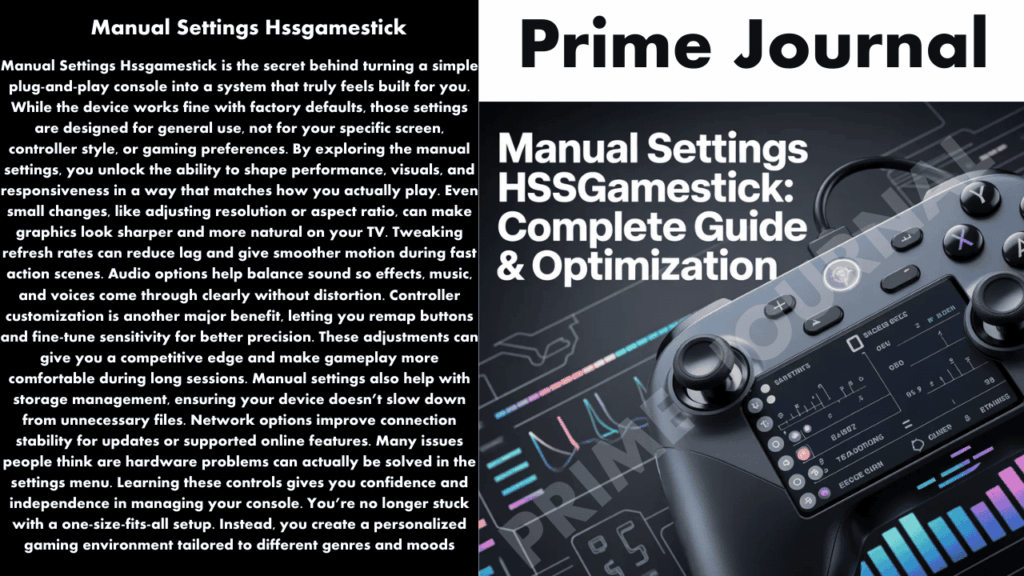
The HSSGameStick supports detailed controller adjustments:
Button Mapping
Reassign button functions to suit your play style — useful for action or fighting games.
Sensitivity & Dead Zones
- Higher sensitivity: Faster character/camera movement
- Larger dead zones: Reduce accidental inputs
- Smaller dead zones: Precision control for competitive play
Vibration & Feedback
Turn on vibration for immersion or off for quieter game sessions.
Network & Connectivity Settings
A stable connection is necessary when downloading games or syncing updates:
- Wi‑Fi Setup — Choose 5GHz for faster speeds.
- DNS Configuration — Use Google DNS (8.8.8.8) or Cloudflare (1.1.1.1) for improved connectivity.
Tip: Wired connections via USB Ethernet adapters can further reduce lag during online gaming.
Storage & Memory Management
HSSGameSticks often have limited memory — make the most of it:
Expand Storage
Use a microSD card or USB flash drive formatted in FAT32/exFAT.
Regularly backup save files and remove old unused games to free space.
Advanced Manual Settings (For Power Users)
If you want deeper customization:
Firmware Updates
Regularly check for over‑the‑air or manual USB updates to improve stability and add new features.
Emulator & Core Tweaks
Some HSSGameStick models let you choose different emulator cores (e.g., for NES or SNES), frame skip options, and graphic filters.
Troubleshooting Common Issues
Here’s how to fix some frequent problems:
FAQs
Q1: How do I access manual settings on my HSSGameStick?
A: Power the device on, go to the home screen, press the Settings icon, and look for Manual Settings. There you’ll find display, audio, controller, and advanced options. :
Q2: What resolution should I use?
A: 1080p is standard for most modern TVs, but 720p may improve performance on older screens. Always match the resolution to your TV’s native setting for best clarity.
Q3: Can I connect external controllers?
A: Yes — most versions support Bluetooth and USB controllers. Pair them via the Controller Settings menu.
Q4: My games aren’t loading; what should I do?
A: Try clearing the cache from Settings → Storage, update firmware, or ensure the ROM file format is correct.
Q5: How to optimize network settings for online play?
A: Use a 5GHz Wi‑Fi band, configure DNS to Cloudflare or Google DNS, or connect via a wired adapter.
Conclusion
Understanding and adjusting Manual Settings Hssgamestick transforms your gaming experience — whether you’re aiming for nostalgic retro vibes or modern gameplay smoothness. By tailoring display, audio, controller, and system options, you’ll play smarter, not harder.