

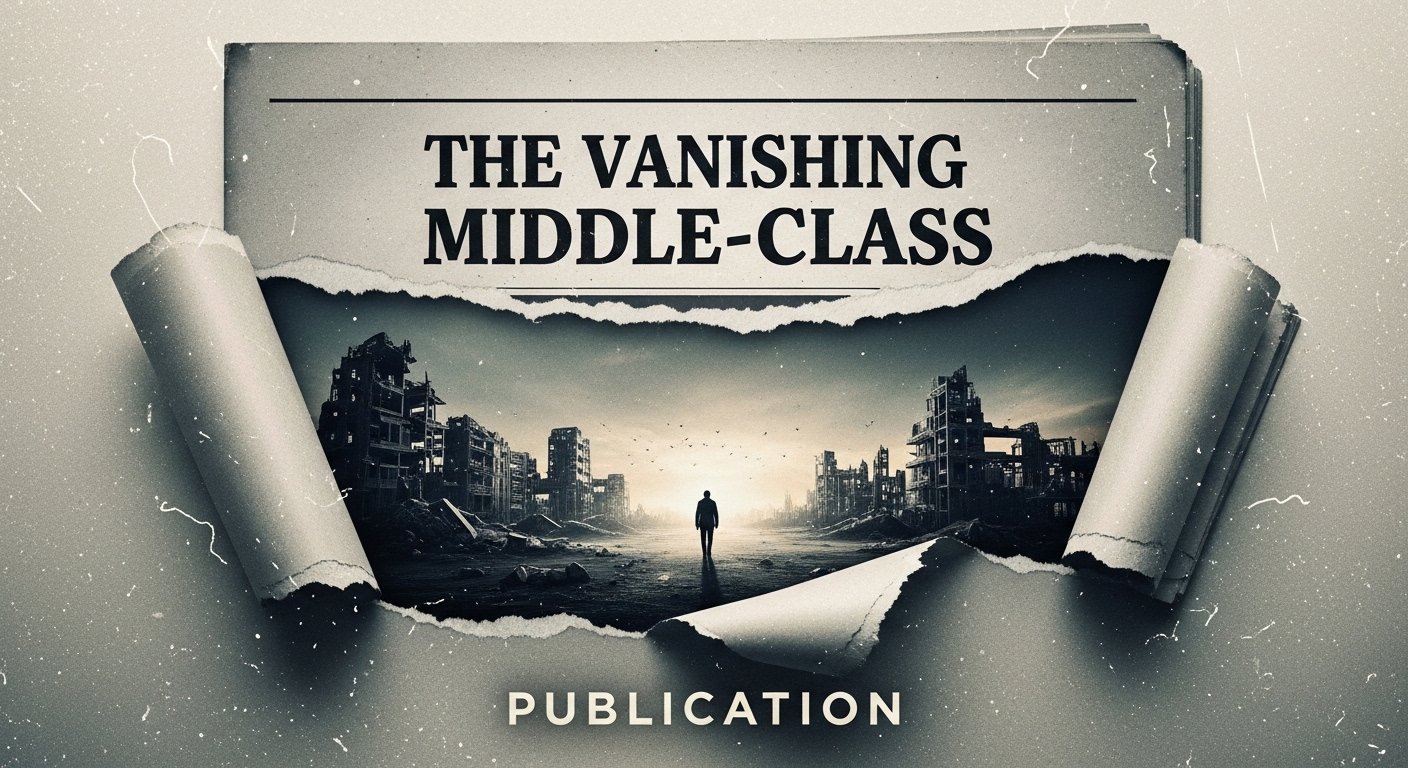
Small journals used to occupy a defensible position in publishing. Too specialized for mass media, too rigorous for amateur blogs, they served niche audiences with professional standards. Academics published in them. Industry professionals read them. Libraries subscribed. The model was not lucrative, but it was stable.
That stability is dissolving. The economics that supported mid-tier publications are being squeezed from both directions. On one end, major institutional publishers consolidate market share through brand recognition and distribution networks. On the other, AI-generated content floods the space with material that looks professional enough to compete for attention.
The middle-class publication cannot match the resources of large publishers or the volume of automated content. It exists in an increasingly narrow gap between entities that can afford human expertise and systems that do not require it. Each year, that gap narrows.
Universities and professional associations used to anchor this tier. They needed venues to publish research that was credible but not groundbreaking, specialized but not obscure. These publications provided peer review, editorial oversight, and archival stability. The value proposition was gatekeeping: we ensure quality so you do not have to verify every claim yourself.
AI undermines this gatekeeping function by making the surface markers of quality trivially easy to reproduce. Proper formatting, academic tone, citation structures, and technical vocabulary no longer signal that humans with expertise evaluated the work. They just signal that someone used the right template.
AI Content Looks Professional Enough to Be Dangerous
The quality bar for distinguishing legitimate publications from sophisticated fakes has risen beyond where most readers operate. A well-prompted AI can produce articles with proper abstract structures, methodology sections, literature reviews, and discussion frameworks. The output reads like scholarship because it was trained on scholarship.
Design compounds this problem. Publication templates are widely available. Modern web tools make professional layouts accessible to anyone. A predatory journal can look indistinguishable from a legitimate one. The visual and structural signals that used to help readers assess credibility no longer reliably indicate anything.
Tone presents the same issue. AI writing matches the formal, objective style of academic and professional publishing. It avoids first person, uses passive voice appropriately, and maintains consistent terminology. The confidence level stays calibrated to sound authoritative without being obviously promotional. Reading a single article, you cannot tell if a human expert wrote it or if an algorithm assembled it from existing texts.
This surface-level credibility is dangerous precisely because it works. Readers trained to look for professional presentation, proper citations, and technical language find all those markers present. What they cannot easily detect is whether the content represents original research, synthesizes existing knowledge accurately, or simply recombines phrases from its training data into plausible-sounding claims.
The damage appears slowly. A researcher cites an AI-generated article that sounds credible but contains subtle errors. Those errors propagate into subsequent work. Other AI systems trained on that corrupted corpus reproduce and amplify the mistakes. The pollution spreads through citation networks faster than human review can identify and correct it.
When Editorial Identity Becomes Optional
Legitimate journals build identity through editorial perspective. The selection of topics, the standards for evidence, the theoretical frameworks they favor, and the questions they consider important all reflect intentional choices. Over time, readers learn what a publication stands for and use that knowledge to contextualize what they read.
AI-generated publications lack this coherence because they lack intent. They optimize for volume and topical relevance, not for advancing particular intellectual agendas or maintaining consistent standards. An AI can produce articles on climate science, economic policy, and medical research in the same day using completely incompatible methodological assumptions because it has no underlying worldview to maintain.
This creates journals that exist without a point of view. They publish whatever gets submitted or whatever topics are trending. The editorial voice, when it appears at all, is generic and interchangeable. There is no “house style” in any meaningful sense because there is no house, just a content management system accepting submissions and running them through formatting templates.
The economic incentive for these publications comes from citation gaming and credentialing. Researchers need publication credits. Some will pay to be published, especially in fields where legitimate venues have high rejection rates. AI-driven journals can accept everything, charge processing fees, and generate enough publication volume to look established. The business model works even if the content is worthless.
For readers, this environment makes evaluation exhausting. You cannot rely on publication venue as a quality signal. You cannot assume peer review happened in any rigorous sense. You have to evaluate every article individually on its merits, which requires expertise most readers lack. The cognitive load of navigating this landscape pushes people toward familiar, branded sources even when those sources have their own credibility problems.
Readers Can’t Tell the Difference, Yet
The current situation persists because most readers still operate on heuristics that no longer work. They assume professional design means professional content. They trust citations without checking them. They accept confident assertions as evidence-based claims. These shortcuts were once reasonable because producing convincing fakes required more effort than producing real scholarship.
That calculation reversed. Generating a fake article with proper formatting, plausible citations, and academic tone now takes minutes. Producing genuine scholarship still takes months or years. The economic advantage shifted entirely to fabrication.
The lag between when this shift occurred and when it becomes widely recognized creates a window where deception thrives. People have not yet updated their evaluation strategies to match the new reality. They still use rules like “published in a journal means peer-reviewed” or “lots of citations means well-researched” even though both assumptions are now frequently wrong.
This lag will eventually close. Enough people will encounter AI-generated content that contradicts their expertise or makes obvious errors that skepticism will become the default. But the correction process is slow and uneven. Experts in one field may recognize AI slop in their domain while remaining vulnerable to it in adjacent areas.
The transition period is chaotic. Trust in all publications suffers, not just the fraudulent ones. Legitimate mid-tier journals get caught in the same credibility collapse as predatory ones because readers cannot reliably distinguish between them. The institutions that maintained quality for decades lose their audience anyway because the signal-to-noise ratio in their category became too poor.
The broader pattern extends beyond academic publishing. AI Chat systems provide answers that sound authoritative without committing to accuracy so you have to be specific about what you want. AI Document Generator tools produce professional reports that may or may not reflect reality so you have to supervise what is being created.
Authority Will Be Rebuilt, Not Inherited
The respectable middle of publishing is not coming back in its previous form. The economic and technological conditions that supported it have changed irreversibly. What emerges next will look different and will need to establish credibility through mechanisms that AI cannot easily fake.
This might mean radical transparency: showing the entire review process, publishing reviewer comments, and making all data and methods fully open. It might mean smaller, more focused publications with named editorial boards whose reputations are directly at stake. It might mean community-based verification where distributed expertise evaluates claims collectively. People seek shortcuts like Alight Motion Mod APK downloads because the legitimate version costs money and effort they would rather avoid.
What will not work is assuming that past institutional credibility transfers to future content. Readers who got burned by predatory journals disguised as legitimate ones will not trust publication venue alone. They will need proof that verification happened, not just assurances that it did.
The rebuild will be expensive and slow. It requires investment in human expertise at exactly the moment when automation promises to make that expertise unnecessary. The publications that survive will be those that can articulate why human judgment matters and demonstrate that it actually occurs in their process.
In every case, the shortcut wins short-term. Convenience, speed, and cost-savings create immediate advantages. The long-term consequences appear gradually as trust erodes, quality declines, and systems optimized for volume fail when accuracy matters.
For mid-tier publications, the moment of reckoning has arrived. Continuing to operate as if authority is inherited will fail. The institutions that rebuild will do so by proving their value explicitly, repeatedly, and transparently. The rest will disappear into the noise they helped create.