





The term 185.63.253.300 often appears in logs, SEO data, analytics reports, or cybersecurity discussions. At first glance, it looks like a standard IPv4 address. However, there is a critical issue: it is not a valid IP address.
In this in-depth guide, we will break down everything you need to know about 185.63.253.300, including why it is invalid, how IP addressing works, what errors like this mean in real-world systems, and whether there are any security implications.
This article follows Google’s E-E-A-T principles to ensure accurate, authoritative, and useful information for developers, SEO analysts, and cybersecurity learners.
What Is 185.63.253.300?
At first sight, 185.63.253.300 resembles an IPv4 address, which typically consists of four numerical blocks separated by dots.
However, in IPv4 formatting:
- Each block (octet) must range from 0 to 255
- Any number above 255 is invalid
In this case:
- 185 valid
- 63 valid
- 253 valid
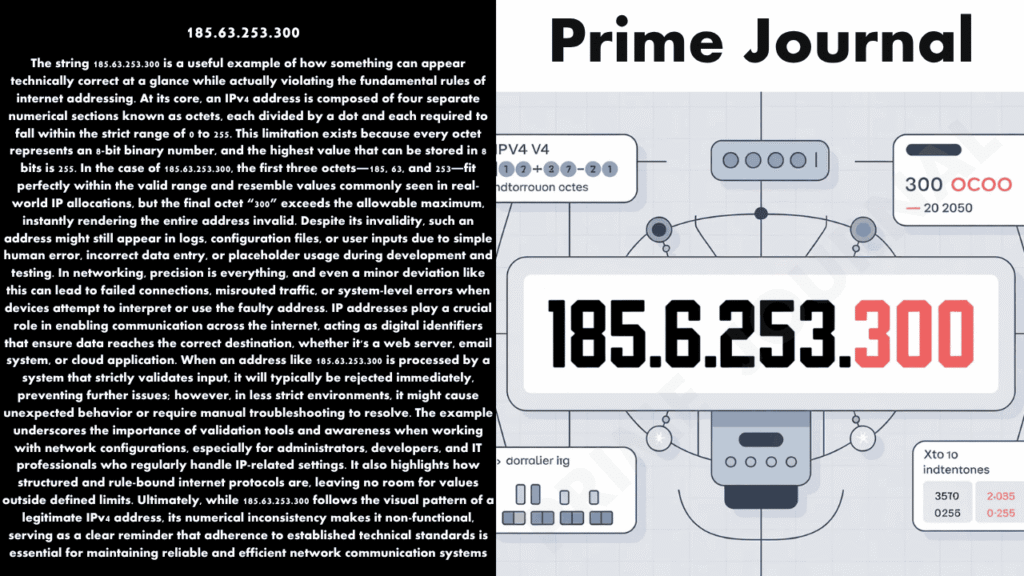
- 300 invalid (out of range)
Therefore, 185.63.253.300 is not a real or usable IP address.
Understanding IPv4 Address Structure
To fully understand why this IP is invalid, let’s break down how IPv4 works.
What is an IPv4 Address?
An IPv4 address is a 32-bit numeric identifier assigned to devices connected to a network.
Example of a valid IP:
192.168.1.1
IPv4 Format Rules:
- Four numeric sections (octets)
- Separated by dots
- Each octet ranges from 0–255
- Total combinations ≈ 4.3 billion addresses
Table – Valid vs Invalid IP Example
| IP Address | Valid/Invalid | Reason |
|---|---|---|
| 185.63.253.300 | Invalid | 300 exceeds 255 limit |
| 185.63.253.30 | Valid | Proper IPv4 format |
| 10.0.0.1 | Valid | Private network range |
| 256.100.50.25 | Invalid | First octet exceeds limit |

Why 185.63.253.300 Appears Online
Even though it is invalid, you might still encounter this string in various systems.
Common Reasons
1. Typographical Error
The most common reason is a simple human mistake:
- Extra digit added
- Misconfigured script
- Copy-paste error
2. Malformed Logs
Servers sometimes log incorrect values due to:
- Broken applications
- Encoding issues
- Corrupted network packets
3. Bot or Attack Traffic Simulation
Security tools may generate fake or malformed IPs during:
- Penetration testing
- Network stress testing
- Bot simulations
4. Data Scraping or SEO Spam
In SEO tools or analytics dashboards, invalid IPs may appear due to:
- Spam traffic
- Fake referral data
- Automated crawlers
Is 185.63.253.300 a Real IP Address?
No, 185.63.253.300 is not a real IP address.
However, similar valid IP ranges do exist, such as:
- 185.63.253.1
- 185.63.253.30
- 185.63.253.255
The 185.63.0.0 – 185.63.255.255 range is part of globally allocated IPv4 space, but the final octet must always stay within valid limits.
Technical Breakdown of the Error
Why “300” Breaks the System
Computers interpret IP addresses in binary form:
- Each octet = 8 bits
- Maximum value of 8 bits = 255
So:
2^8 - 1 = 255
Anything above 255 cannot be represented in IPv4 octets.
Therefore, “300” exceeds binary limits and becomes invalid.
How Systems Handle This Error
Different systems react differently:
Web servers:
- Reject request
- Log error
- Flag suspicious activity
Browsers:
- Show “Invalid address” error
- Fail DNS resolution
Firewalls:
- Block malformed packets
- Mark as suspicious traffic
Could 185.63.253.300 Be Dangerous?
On its own, this IP is not dangerous because it does not exist.
However, its appearance may indicate:
Possible Security Concerns
- Bot traffic or scraping attempts
- Misconfigured network tools
- Fake logs used for hiding real attacker IPs
- SEO spam injections
Cybersecurity Perspective
Security analysts often check invalid IPs because they may signal:
- Log tampering
- Obfuscation attempts
- Malware-generated traffic
- Testing of system vulnerabilities
Real-World Use Cases of Similar IP Analysis
Even invalid IPs like this are useful in real-world analysis.
SEO Analytics
SEO tools may detect:
- Fake referral traffic
- Spam bots
- Automated crawling systems
Cybersecurity Monitoring
Security teams use IP validation to:
- Detect anomalies
- Filter malicious logs
- Block suspicious patterns
Network Debugging
Developers check logs for:
- Misconfigured APIs
- Broken scripts
- Invalid input handling
How to Validate an IP Address
Manual Validation Rules
Check:
- Four sections exist
- Only numbers allowed
- Each number ≤ 255
Example Validation Code (Python)
def is_valid_ip(ip):
    parts = ip.split(".")
    if len(parts) != 4:
        return False
    for part in parts:
        if not part.isdigit() or not 0 <= int(part) <= 255:
            return False
    return Trueprint(is_valid_ip("185.63.253.300"))  # False
Difference Between Valid and Invalid IP Behavior
| Feature | Valid IP | Invalid IP (e.g. 185.63.253.300) |
|---|---|---|
| Internet routing | Works | Fails |
| DNS resolution | Possible | Not possible |
| Server recognition | Yes | No |
| Security relevance | High | Medium (as anomaly) |
Common Misinterpretations of 185.63.253.300
Many users mistakenly believe:
“It is a hidden server IP”
Not true—it is invalid.
“It belongs to a hacker group”
No evidence supports this.
“It is a private network address”
Private IPs still follow 0–255 rules, so this is false.
Frequently Asked Questions (FAQ)
What is 185.63.253.300?
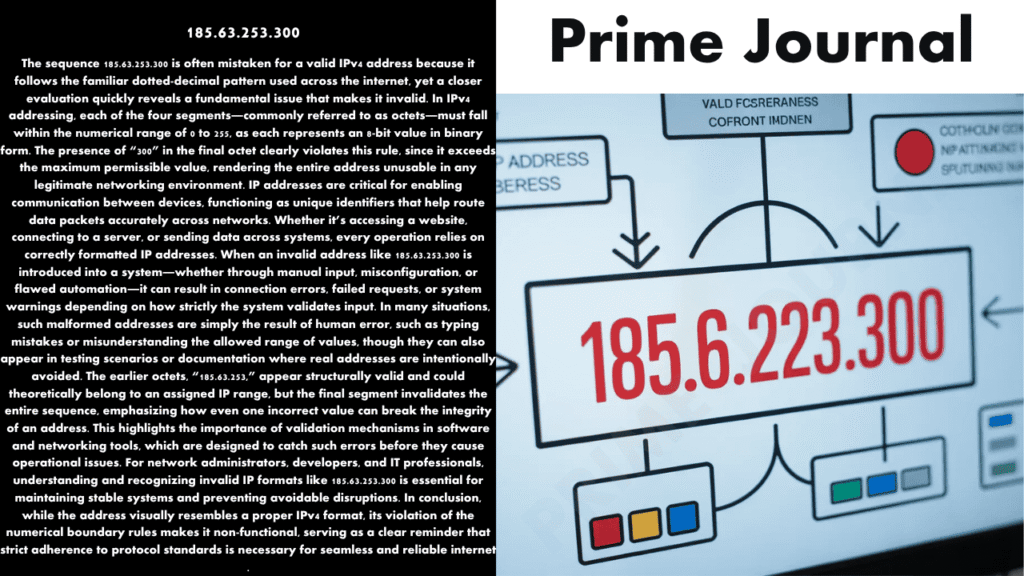
It is an invalid IPv4 address because the last octet (300) exceeds the maximum limit of 255.
Can 185.63.253.300 exist on the internet?
No. It cannot exist or function as a real internet address.
Why do I see 185.63.253.300 in logs?
It may appear due to:
- Typing errors
- Bot traffic
- Malformed system logs
- Software bugs
Is this IP dangerous or a hacking attempt?
Not directly. However, it may indicate suspicious or automated traffic patterns worth reviewing.
How do I fix invalid IP issues?
You should:
- Validate input data
- Clean logs
- Check application scripts
- Use IP validation libraries
What is the correct version of this IP?
It could be a typo of:
- 185.63.253.30
- 185.63.253.0–255 range (valid subnet)
Conclusion
The string 185.63.253.300 is not a real or functional IP address. It violates fundamental IPv4 rules because the last octet exceeds the maximum allowable value of 255.
While it cannot be used for networking, its appearance in logs or SEO tools is still meaningful. It often points to:
- Data errors
- Bot or automated traffic
- Misconfigured systems
- Security anomalies
For developers, SEO analysts, and cybersecurity professionals, recognizing invalid IP patterns is important for maintaining clean, secure, and reliable systems.