



Setting up TGArchiveConsole Set Up correctly is essential for ensuring smooth performance, efficient data handling, and long-term system stability. Whether you’re a beginner exploring the tool for the first time or an advanced user looking to optimize your workflow, this guide will walk you through everything in a clear, structured, and practical way.
In this article, we will cover installation, configuration, best practices, troubleshooting, and expert tips to help you master the setup process.
What is TGArchiveConsole?
TGArchiveConsole is a powerful utility tool designed for managing, archiving, and processing data efficiently. It is often used in environments where large-scale data handling, logging, or structured storage is required.
Key Features:
- Data archiving and retrieval
- Console-based management interface
- High performance for large datasets
- Custom configuration support
- Secure and scalable architecture
For more general information on console-based systems, you can refer to:
https://en.wikipedia.org/wiki/Command-line_interface
Why Proper TGArchiveConsole Set Up Matters
A proper setup ensures:
- System stability
- Faster processing speed
- Reduced errors and crashes
- Better data organization
- Enhanced security
Improper configuration can lead to:
- Data corruption
- Performance bottlenecks
- Security vulnerabilities
- System failures
That’s why following a structured setup process is crucial.
System Requirements
Before starting the TGArchiveConsole Set Up, ensure your system meets the minimum requirements.
Minimum Requirements
| Component | Requirement |
|---|---|
| Operating System | Windows/Linux/macOS |
| RAM | 4 GB minimum |
| Storage | 500 MB free space |
| Processor | Dual-core CPU or higher |
| Network | Stable internet (optional) |
Recommended Requirements
| Component | Requirement |
|---|---|
| RAM | 8 GB or more |
| Storage | 2 GB+ SSD |
| Processor | Quad-core CPU |
| OS | Latest version |
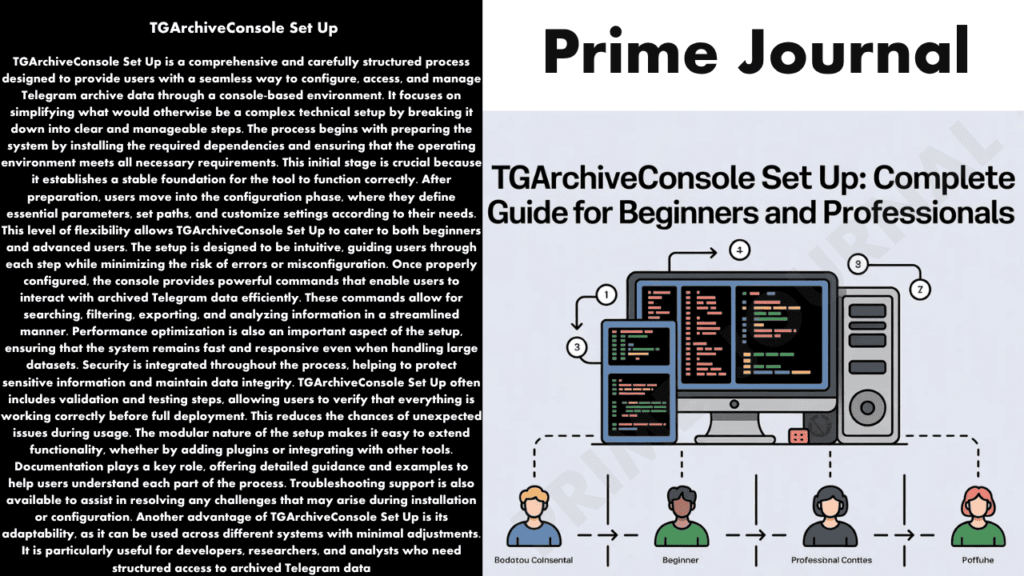
Step-by-Step TGArchiveConsole Set Up
Follow these steps carefully to ensure a successful installation and configuration.
Download the Software
- Visit the official source or trusted repository.
- Download the latest stable version.
- Verify file integrity if checksums are provided.
Install the Package
For Linux:
sudo apt install tgarchiveconsole
For Windows:
- Run the
.exeinstaller - Follow the setup wizard
For macOS:
- Use the
.dmginstaller - Drag and drop into Applications
Initialize the Console
After installation:
tgarchiveconsole init
This command initializes the configuration files and sets up the environment.
Configure the Settings
You will typically find a config file:
/config/tgarchiveconsole.conf
Open and edit it:
[general]
mode=production
log_level=info[storage]
path=/data/archive
max_size=10GB[security]
enable_auth=true
Step 5: Start the Console
tgarchiveconsole start
This will launch the console and begin operations.
Step 6: Verify Installation
Run:
tgarchiveconsole status
If everything is configured correctly, you should see:
- Active status
- Running services
- No error messages
Configuration Settings Explained
Understanding configuration is key to mastering TGArchiveConsole Set Up.
General Settings
| Setting | Description |
|---|---|
| mode | Defines environment |
| log_level | Controls logging detail |
Storage Settings
| Setting | Description |
|---|---|
| path | Storage location |
| max_size | Maximum storage capacity |
Security Settings
| Setting | Description |
|---|---|
| enable_auth | Enables authentication |
| encryption | Encrypts stored data |
Best Practices for Optimization
To get the best performance from your setup:
1. Use SSD Storage
- Faster read/write speeds
- Improved performance
2. Regular Updates
- Always use the latest version
- Fixes bugs and security issues
3. Enable Logging
- Helps in debugging
- Monitors system health
4. Backup Configuration
- Prevents data loss
- Allows quick recovery
5. Optimize Resource Usage
- Allocate appropriate RAM
- Avoid overloading the system
Common Issues and Troubleshooting
1. Installation Errors
Solution:
- Check system requirements
- Run as administrator
- Re-download the file
2. Console Not Starting
Solution:
- Check logs
- Verify configuration
- Restart the system
3. Slow Performance
Solution:
- Increase RAM allocation
- Reduce concurrent tasks
- Use SSD storage
4. Data Corruption
Solution:
- Restore from backup
- Enable data validation
- Use secure shutdown procedures
Security Considerations
Security is critical in TGArchiveConsole Set Up.
Recommended Practices:
- Enable authentication
- Use encrypted storage
- Restrict access permissions
- Regularly update software
External Resource:
Learn more about cybersecurity:
https://www.cisa.gov/cybersecurity
FAQs About TGArchiveConsole Set Up
1. What is TGArchiveConsole used for?
TGArchiveConsole is used for managing, storing, and processing data through a console-based system. It is commonly used in data-intensive environments.
2. Is TGArchiveConsole difficult to set up?
No, the setup is straightforward if you follow the steps carefully. Beginners can install and configure it without advanced technical knowledge.
3. Can I use TGArchiveConsole on Windows and Linux?
Yes, it supports multiple operating systems including Windows, Linux, and macOS.
4. How can I improve performance?
You can improve performance by:
- Using SSD storage
- Increasing RAM
- Optimizing configuration
- Keeping the system updated
5. What should I do if the console crashes?
Check logs, verify configuration files, and restart the system. If needed, reinstall the software.
6. Is TGArchiveConsole secure?
Yes, if configured properly with authentication, encryption, and restricted access, it is highly secure.
7. Do I need internet for setup?
Not necessarily. However, internet may be required for downloading and updates.
Conclusion
Setting up TGArchiveConsole Set Up correctly is essential for achieving optimal performance, stability, and security. By following the steps outlined in this guide, you can ensure a smooth installation, efficient configuration, and long-term reliability.
From installation to optimization and troubleshooting, this guide covers everything you need to confidently use TGArchiveConsole in real-world scenarios.