



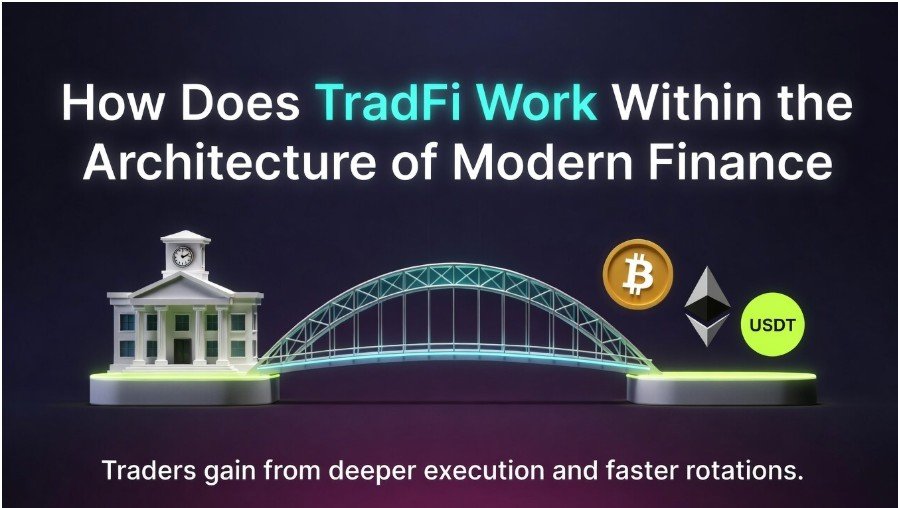
Modern finance architecture combines legacy centralized structures with emerging digital layers. TradFi forms the foundation: regulated institutions central banks payment networks exchanges and clearing houses that process the majority of global capital flows. It handles fiat currencies debt equity derivatives commodities and cross-border payments with established rules and intermediaries.
In current market conditions TradFi integrates blockchain elements stablecoins and tokenized assets while maintaining core functions: monetary policy transmission liquidity provision risk management and regulatory compliance. Digital innovations add speed transparency and programmability but do not replace the system. They augment it.
I have followed these interactions closely. TradFi provides scale trust and finality. Digital layers bring efficiency and accessibility. Understanding how does TradFi work today means seeing it as the stable backbone that adapts selectively to faster more open technologies. Traders who know the mechanics exploit hybrid edges.
The architecture is layered and interconnected. Let’s break down how TradFi functions its key processes and how it fits into the broader modern picture.
Core Layers and Participants in TradFi
Central banks sit at the top. They set interest rates manage reserves issue currency and act as lender of last resort. Their decisions ripple through all markets influencing borrowing costs asset prices and risk appetite.
Commercial and investment banks form the middle layer. They take deposits make loans underwrite securities provide custody market-make and facilitate payments. They connect retail corporates institutions and governments.
Broker-dealers and asset managers execute and manage investments. They offer access to equities bonds derivatives and funds. Clearing houses and central counterparties reduce counterparty risk by guaranteeing trades and managing margin.
Exchanges and trading venues provide transparent price discovery and order matching. Settlement systems complete the cycle moving cash and assets between parties.
Regulatory bodies enforce rules capital requirements disclosure and investor protection across the stack. This creates trust and stability that digital alternatives still build toward.
These participants interact through defined protocols rails and cycles. Money moves predictably but with deliberate speed to ensure safety.
Key Processes and How They Operate
Monetary policy transmission starts with central bank rates. Banks adjust lending deposit and funding costs. This influences bond yields mortgage rates and corporate borrowing. The effect propagates to asset prices and economic activity.
Payment clearing and settlement follow structured paths. Domestic transfers use real-time gross settlement or net settlement systems. Cross-border payments rely on correspondent banking networks SWIFT messaging and nostro/vostro accounts. Settlement occurs in T+0 to T+2 depending on instrument.
Trading execution uses centralized order books. Market makers provide liquidity. Trades clear through central counterparties that collect margin and manage default risk. Settlement delivers cash and securities through depositories.
Risk management relies on capital requirements leverage limits collateral haircuts and stress testing. Institutions hold buffers to absorb losses. Clearing houses mutualize risk among members.
These processes ensure reliability scale and finality. They come with cost time and access barriers that digital alternatives target.
Integration Points with Digital and Blockchain Layers
TradFi increasingly incorporates blockchain features where efficiency gains justify change.
Stablecoins integrate into payment rails. Banks and corporates use them for faster cheaper cross-border transfers while maintaining fiat redemption.
Tokenized securities settle on-chain or hybrid chains. Delivery-versus-payment mechanisms combine blockchain finality with regulatory compliance.
Custody hybridizes. Regulated providers offer segregated wallets with on-chain transparency and proof-of-reserves.
Central bank digital currencies pilots explore programmable money for policy transmission and financial inclusion.
These integrations preserve TradFi strengths. Regulation oversight and institutional trust stay intact. Blockchain adds speed programmability and cost reduction.
Here is a comparison of key processes in pure TradFi versus hybrid modern architecture:
| Process | Pure TradFi Operation | Hybrid Modern Architecture | Practical Impact for Traders |
| Payment Settlement | Correspondent banking multi-day | Stablecoins + blockchain rails instant | Faster cross-border reduced FX costs |
| Securities Settlement | T+1/T+2 central depository | Tokenized DVP on-chain or hybrid | Quicker capital recycling lower tie-up |
| Collateral Management | Manual bilateral agreements | On-chain programmable collateral | Automated margin calls higher mobility |
| Monetary Policy Transmission | Rate changes bank lending channels | Potential CBDC programmable money | More direct policy impact faster effects |
| Liquidity Provision | Market makers exchanges | Hybrid AMMs + traditional pools | Deeper 24/7 liquidity in growing segments |
| Risk & Compliance | Post-trade audits manual checks | Smart contract rules real-time monitoring | Lower overhead faster onboarding |
This table shows where integration delivers measurable advantages.
Practical Implications for Traders
Leverage TradFi depth for large-size execution and reliable hedges. Use major forex pairs government bonds or blue-chip indices when digital liquidity thins.
Monitor hybrid flows. Rising tokenized treasury volumes signal institutional risk-on. Declines often precede broader deleveraging.
Construct layered portfolios. Keep core in TradFi instruments for stability add digital momentum for upside and tokenized yields for income. Rebalance on macro triggers.
Calculate hybrid efficiency. Effective rotation cost equals average settlement delay multiplied by expected daily return plus fee percentage. Integrated access drops this near zero.
Another metric: cross-layer correlation hedge. Hedge ratio equals position value multiplied by rolling correlation divided by hedge volatility. Update regularly to optimize protection.
Test small. Allocate across traditional and tokenized instruments. Track execution cost settlement speed and correlation stability during volatility.
Follow regulatory updates. Changes in CBDC pilots tokenized rules or stablecoin reserves redirect capital between layers.
Conclusion
TradFi works within modern finance architecture as the regulated centralized foundation that provides scale trust liquidity and compliance. It adjusts by integrating blockchain settlement payment rails tokenization and hybrid custody while preserving core safeguards.
Traders gain from deeper execution reliable hedges faster rotations and new yield sources. Build layered portfolios enforce strict risk controls monitor integration flows and macro signals. Adapt as hybrid features deepen.
In interconnected markets understanding TradFi mechanics is essential. Position for efficiency manage risks diligently let structural improvements compound returns. The architecture evolves steadily. Stay informed trade smart and keep capital active.