




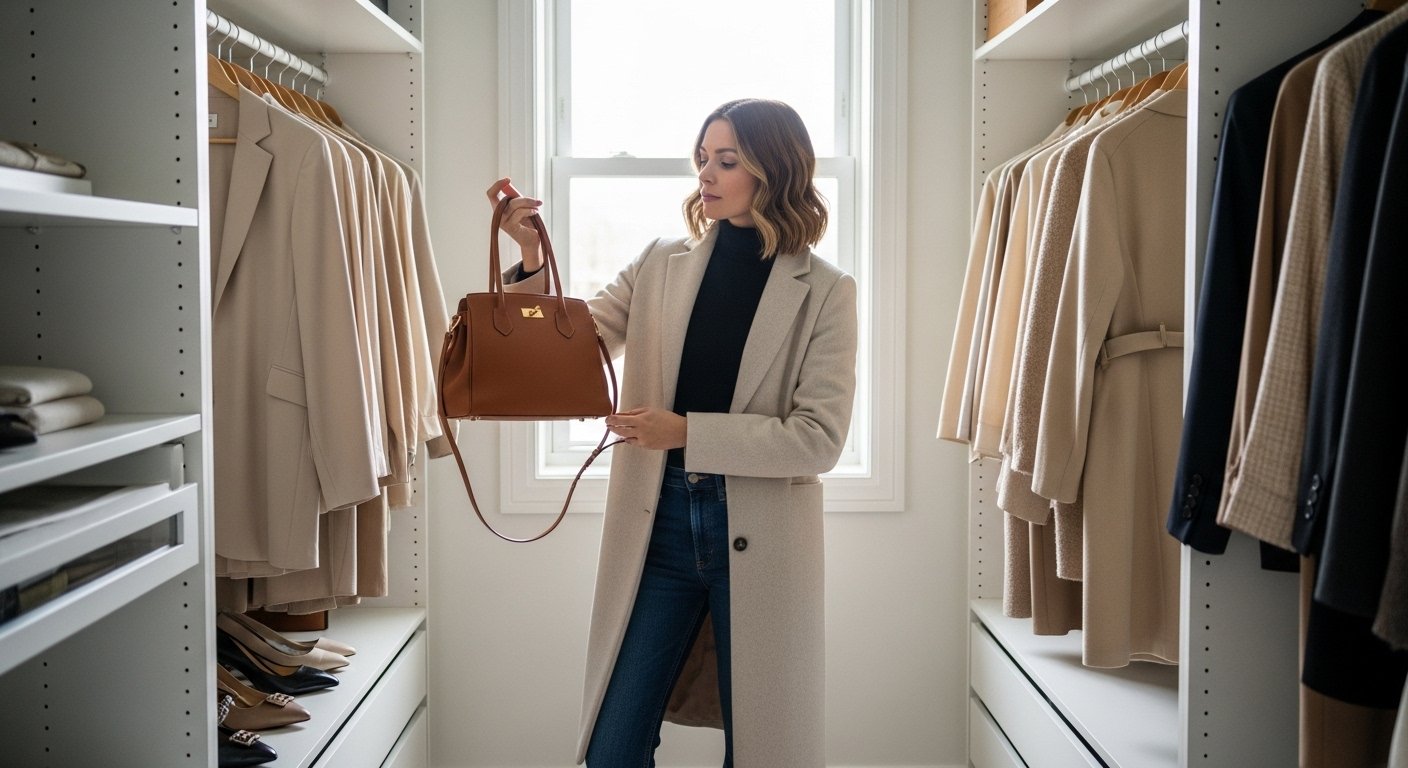
There is a quiet shift happening in women’s fashion, and it has nothing to do with hemlines, colour palettes, or what walked the runway last season. The women who are getting the most compliments, spending the least money, and feeling the most confident when they get dressed in the morning are doing something counterintuitive. They are buying less.
Not less as in settling. Not less as in giving up on style. Less as in deliberate. They have figured out that a wardrobe of 35 well-chosen pieces outperforms a wardrobe of 120 random ones in every way that matters. And once you understand why, the old approach of buying more starts to feel like a trap rather than a treat.
The Overconsumption Problem No One Wants to Talk About
The fashion industry releases roughly 100 billion garments per year globally. That is more than twelve items for every person on the planet, and the number has doubled in the last two decades. In the UK alone, an estimated 350,000 tonnes of clothing ends up in landfill each year, according to the Waste and Resources Action Programme (WRAP).
Most of this waste is not damaged or worn out. It is simply unwanted. Bought on impulse, worn a handful of times, then discarded to make room for the next round of impulse purchases. The average garment is now worn just seven times before it is thrown away. That is not a wardrobe. That is a revolving door.
The women opting out of this cycle are not anti-fashion. Many of them love clothes deeply. But they have drawn a line between loving fashion and being consumed by it. Their approach is rooted in intention rather than accumulation, and the results are hard to argue with.
What Intentional Dressing Actually Looks Like
The principle is simple enough that it fits in a sentence: own fewer pieces, but make sure every single one earns its place. In practice, this means building a wardrobe where everything coordinates. Where a top works with three different bottoms. Where a blazer elevates a casual outfit and sharpens a formal one. Where nothing sits unworn because nothing was bought without a purpose.
This is sometimes called capsule dressing, though the term can feel rigid. It is really just thoughtful shopping applied consistently over time. Brands like Willow and Thread have tapped into this shift, designing collections where every piece is built to pair with the others. The focus is on versatility and longevity rather than seasonal novelty. It is a model that makes more sense the longer you think about it.
The women doing this well tend to share a few habits. They know their colour palette. They understand which silhouettes flatter them. They shop with specific gaps in mind rather than browsing for inspiration. And they invest more per piece but spend less overall because every purchase is deliberate.
The Economics That Make It Work
The financial argument for intentional dressing is compelling once you look at the numbers. The average UK household spends roughly 1,200 pounds per year on clothing, according to the Office for National Statistics. Studies consistently show that most people only wear about 20 percent of what they own regularly. That means roughly 960 pounds per year is going toward clothes that rarely leave the wardrobe.
Flip the approach. Spend that same 1,200 pounds on 15 to 20 quality pieces instead of 40 to 50 disposable ones. Each item gets worn regularly because each item was chosen for a reason. The per-wear cost drops dramatically. A 80-pound blouse worn 100 times over two years costs 80 pence per wear. A 20-pound blouse that pills after a few months and gets worn eight times costs 2.50 per wear. The maths consistently favours quality.
Women who make this shift report cutting their annual clothing spend by 30 to 50 percent within the first year. That is 360 to 600 pounds redirected toward savings, travel, or anything more meaningful than a drawer full of forgotten tops.
Style as a Form of Self-Knowledge
Beyond the practical benefits, there is something deeper happening when women move toward intentional dressing. It requires a level of self-awareness that impulse shopping never demands. You have to know what you actually like, not what a brand tells you to like. You have to understand your lifestyle, not dress for a fantasy version of it. You have to be honest about what flatters you and what does not.
This is why the women who dress with the most intention often seem the most effortlessly stylish. Their choices reflect genuine self-knowledge rather than trend compliance. A woman in a perfectly fitted white shirt, tailored trousers, and one thoughtful accessory will always look more put together than someone drowning in this season’s must-haves.
It is worth noting that “quality basics” does not mean boring. The best timeless wardrobe essentials have character. Thoughtful details like a curved hem, a considered sleeve, a fabric that drapes properly. The difference is that these details serve the wearer rather than serving a trend cycle.
The Sustainability Question
It would be incomplete to discuss this shift without acknowledging the environmental dimension. Fashion accounts for approximately 10 percent of global carbon emissions, and the industry is the second largest consumer of water worldwide. These figures are not abstract. They represent a tangible cost that every consumer participates in with every purchase.
Buying fewer, better garments and wearing them longer is one of the most impactful choices a consumer can make. A 2024 Deloitte survey found that 40 percent of UK shoppers now factor sustainability into their fashion purchases, up from 28 percent just four years earlier. The trend is accelerating, particularly among women aged 25 to 45 who are making purchasing decisions for themselves and, increasingly, for their families.
The shift is not about guilt. It is about alignment. Women who care about sustainability and quality and looking their best are discovering that all three goals point in the same direction: buy less, choose well, and wear it properly.
How to Start Making the Shift
The transition does not require a dramatic wardrobe purge. The most sustainable approach is gradual. Start by paying attention to what you already reach for every day. Those pieces reveal your true style preferences better than any trend report.
Next, notice the gaps. Most women discover they have plenty of “sometimes” pieces but lack strong everyday essentials. A blouse that works across five settings. Trousers that fit properly and hold their shape. A layering piece that ties everything together. Those foundational items are where your next purchases should go.
Apply one rule to every future buy: does this work with at least three things I already own, and will I wear it at least 30 times? If both answers are yes, it belongs in your wardrobe. If not, it is just noise.
The Bigger Takeaway
Fashion will always evolve. Trends will come and go. The industry will continue pushing volume because that is how its economics work. None of that has to dictate how you participate.
The women who are dressing the best right now are the ones who stopped playing by those rules. They are not chasing what is new. They are investing in what works. And the result is a closet that feels like a curated collection rather than a cluttered afterthought.
That is not deprivation. That is freedom.
This article was contributed by Willow and Thread, a women’s fashion brand focused on versatile, quality wardrobe essentials designed for real life. Explore their collections at willowandthread.shop.