




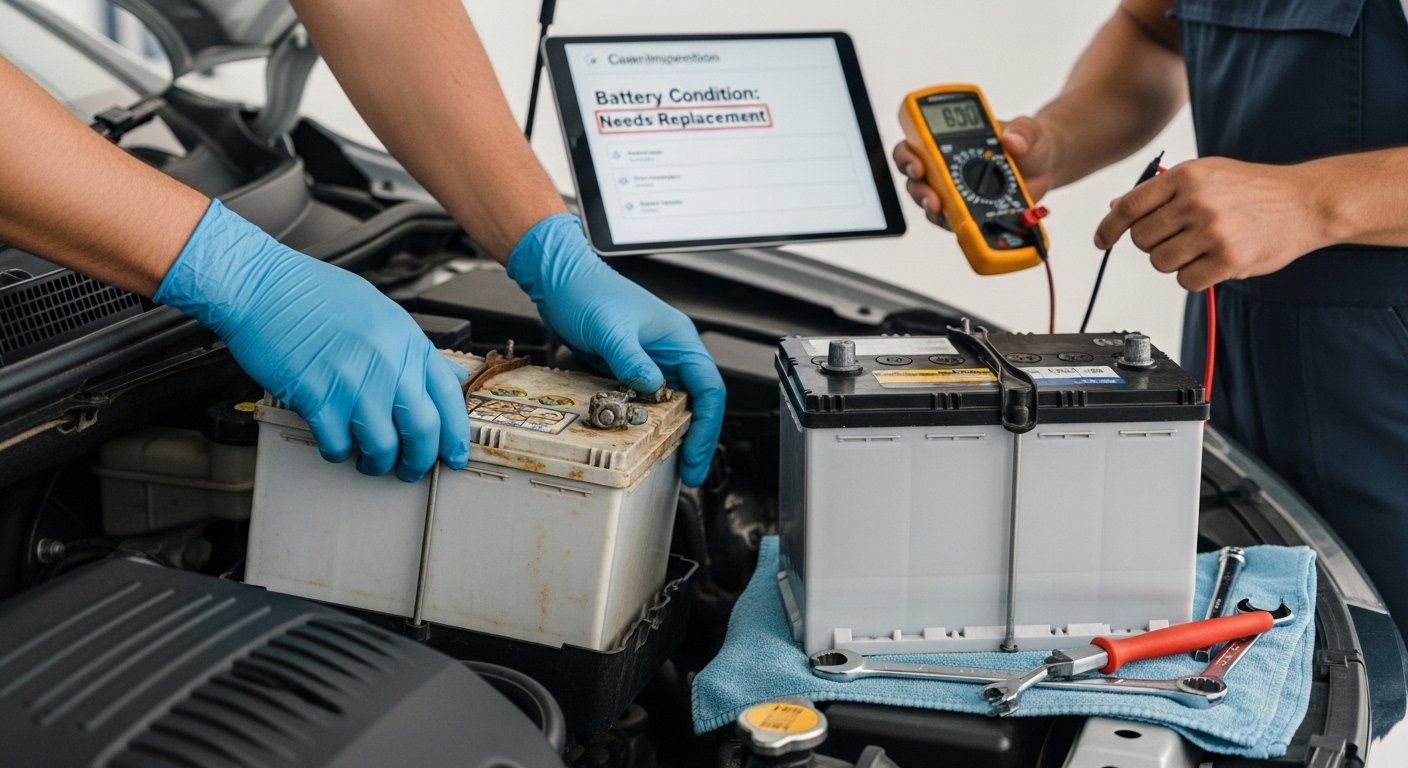
What happens when your car refuses to start on a busy morning in Sheikh Zayed Road traffic? That sinking feeling, the silence when you turn the key, it is almost always the battery. But here is the thing: car battery failure rarely happens without warning. The signs are there, hidden under the hood, waiting to be caught during a proper car battery inspection. In a city like Dubai, where heat kills batteries faster, knowing the right time for car battery replacement is not just smart, it is survival.
How Car Battery Works in Modern Vehicles
Ever wonder what actually happens when you start your car? It is not just magic under the hood, it is the battery doing all the heavy lifting. A car battery stores electrical energy and delivers it to start the engine. It powers the starter motor, ignition system, and all electronics before the engine takes over. Once running, the alternator kicks in and keeps charging the battery. Modern vehicles depend on stable voltage. From sensors to ECUs, screens to headlights, everything needs battery power. Even hybrids and EVs use a 12V battery for systems like lights, locks, and control modules. If that small battery dies, the whole car can shut down. Newer models now use AGM or EFB batteries, especially in stop-start cars. These handle heat, traffic, and electrical loads better, which matters in places like Dubai.
💡 Quick facts:
- Full charge = 12.6V
- Running charge = 13.7V to 14.7V
- Below 12.4V? Battery is weakening.
So next time your car hesitates, glitches, or gives low-light warnings, do not ignore it. It might not be software. It could be the battery quietly asking for attention. That small black box under the hood? It keeps everything alive.
Signs Your Car Battery Needs Replacement
Most people wait until the car dies before checking the battery. That is exactly when it’s too late. A weak battery gives off clues, but they’re easy to miss if you are not paying attention. These are the signs that your car battery is slowly giving up. And yes, most of them show up when you least expect them.
- Engine struggles to start
you turn the key or push the button, and the engine hesitates. It cranks slower than usual. That delay is often the battery not delivering enough cold cranking amps. Especially common during early mornings or after long parking. - Dashboard lights flicker or dim
you might notice the cluster lights dimming or blinking when you start the car. That voltage drop signals the battery is not holding stable charge anymore. Electronics need consistent current, when that drops, lights react first. - AC & radio reset randomly
If your infotainment system or climate control resets while driving or after ignition, it’s a hint. Power interruptions like this mean the battery is struggling to support even basic electrical load during startup. - Clicking sound, no start
you hear multiple clicks but no engine turnover. That’s the starter not getting enough power. Often mistaken for a faulty starter motor, but many times it’s the battery delivering insufficient peak current. - Remote key not responding well
when unlocking or locking becomes unreliable, even from close range, low battery voltage could be interfering with the central locking system’s receiver. It’s subtle but noticeable over time. - Battery age above 3 years
Batteries don’t last forever. If it’s over three years old, especially in Dubai’s heat, performance drops fast. Even if it starts fine today, failure can be sudden once the lifespan ends.
Most of these signs sneak up gradually. But by the time the car fails to start, the battery’s already gone. Spotting issues early means you can plan a car battery replacement, not get stuck on the road.
Car Battery Inspection | How to Catch Failure Before It Happens
You can’t always trust how a battery “feels.” Just because the car starts today doesn’t mean it will tomorrow, especially in Dubai’s extreme heat, where battery life drops faster than usual. A quick Car Inspection Dubai tells the truth. Not assumptions. Not guesses. Just facts, and it does it in under 10 minutes.
- Voltage reading (Should be 12.6V): A full battery holds 12.6 volts when the engine is off. If it drops below 12.4V, that’s already considered weak. Below 12.0V? That’s a battery near failure. Most shops use a digital multimeter to check this in seconds.
- Cold Cranking Amps (CCA) rating: CCA tells how well your battery can start the engine, even under stress. For a typical SUV in Dubai, it should have around 600–800 CCA. If a test shows it’s dropped to 400 or less, starting will become slower and unreliable, especially in the early morning or after sitting idle.
- Internal resistance check (Measured in mΩ): Higher resistance & weaker battery. A healthy battery will show resistance between 3–7 milliohms (mΩ). Above 10 mΩ? That’s a clear sign the battery is breaking down inside, even if voltage seems okay.
- Terminal condition & cable health: Corrosion or loose terminals cause voltage drops and misfires. During inspection, mechanics remove the clamps, clean them, and check for acid leakage or white sulfate build-up, common in older batteries. Even a good battery won’t work if the connection is weak.
- Charging system test (Alternator Output): If the alternator is undercharging, the battery will suffer. A healthy alternator pushes out around 13.7 to 14.7 volts while the engine is running. If it’s too low, the battery never gets fully recharged. If it’s too high, it may cook the battery over time.
- Battery age from date code: Most batteries have a production date code printed on the top or side, like “A3” for Jan 2023. If the battery is older than 36 months, especially in Dubai weather, it’s already at high risk of failure. Even if it seems fine, internal wear is building up.
A battery test doesn’t just show if it’s dead, it shows if it’s about to die. And that’s what matters. You get real numbers, real data, and a clear answer: recharge, replace, or wait. No guesswork. No surprises on the highway.
When Is the Right Time for Car Battery Replacement?
You don’t need to wait for the car to leave you stuck in traffic or dead at a fuel station. In Dubai, batteries don’t give long warnings, they just fade out under the heat. The smart move? Know when the battery is already getting weak, and plan your car battery replacement before it turns into a breakdown.
- Low Resting Voltage: Below 12.4V (with engine off) means the battery is not fully charged. Under 12.0V? It’s already close to failure.
- Weak Cold Cranking Amps: If CCA drops by 40% or more from the original rating, the engine will struggle, especially on hot mornings or after long parking.
- High Internal Resistance: A battery showing more than 10 milliohms (mΩ) on test means it’s aging inside, even if voltage looks normal.
- Electronics Act Up: Flickering lights, reset radio, or dim dashboard during startup? That’s a voltage dip, the battery can’t handle the load anymore.
- Frequent Boosts: If you’ve jump-started the car twice this season, it’s already unreliable. You shouldn’t be boosting a healthy battery.
- Battery Age over 3 Years: Even good batteries wear out. In Dubai, once it crosses 36 months, it’s already in the danger zone, especially if parked outside.
Knowing this saves more than time. It protects your alternator, avoids random shutdowns, and gives you the power to choose your car battery replacement, not have it forced on you by a dead engine. You don’t replace it when it fails. You replace it before it ruins your day.
Why OEM Matters in Every Car Battery Replacement in Dubai
Think all car batteries are the same? They’re not, and drivers in Dubai find that out the hard way. We’ve seen it too often: someone gets a cheap replacement, it works for a while… and then dies early, sometimes without warning. If you’re spending money on car battery replacement Dubai, OEM-grade isn’t just a better option, its protection. Dubai’s heat, traffic, and electrical load are brutal on batteries. Low-quality ones don’t stand a chance. Here’s what makes OEM batteries different, and why they matter more here than anywhere else.
- Designed for Exact Voltage Needs: Modern vehicles aren’t simple. From your ECU to the camera sensors, everything needs stable voltage. OEM batteries are matched to your car’s original specs, so nothing gets overpowered or underpowered.
- Handles High Heat Better: Not all batteries are built for 45°C. OEM batteries come with thicker plates and stronger casings, they resist heat damage and don’t dry out internally like generic ones do.
- Real Amp Ratings & Not Just Labels: A battery might say its 750 CCA, but cheaper brands often fall short under real load. OEM batteries deliver true output, even when your car’s AC, lights, and infotainment are all running.
- Smarter Charging Compatibility: With stop-start tech, AGM systems, and energy management in newer models, you need a battery that talks to your car. OEM batteries sync with your alternator and voltage regulator properly. No errors. No reprogramming.
- Perfect Fit & No Modification: Loose clamps, mismatched terminals, or wrong height? Not with OEM. Fitment is exact. That means no rattling, no short circuits, and no corrosion from poor connections.
- Longer Life & Lower Hassle: OEM batteries are built to last 3 to 5 years in harsh weather. Cheaper ones? Often fail in 12 to 18 months. That means more replacements, more costs, and more roadside trouble.
When you’re already investing in a car battery replacement, doing it with an OEM-grade battery means you’re not gambling with your commute. You’re buying something that works the way your car expects, every time you hit the ignition. Replace it once, and replace it right. That’s what OEM is for.
A dying battery doesn’t always shout, sometimes it just whispers through slow starts, flickering lights, or random system resets. And in Dubai’s heat, even the best battery can go from “fine” to “dead” in a single afternoon. Waiting until it fails means giving up control over when and where your day comes to a stop.
If your car is hesitating, if the voltage is dropping, or if your battery is more than three years old, trust your instincts. A quick check can save you from an expensive breakdown. Car battery replacement isn’t just a repair. It’s a reset. A moment where you take back peace of mind, knowing your car will start every single time, no matter how hot the road gets.