




Compliance programs in most organizations are more fragmented than they appear on paper. Controls exist in one system, evidence sits in shared folders, audit documentation lives in spreadsheets, and the people responsible for each piece rarely have clear visibility into what the others are managing. When an audit arrives, the process of pulling everything together becomes a scramble that consumes weeks of effort and still produces documentation that is incomplete or inconsistent.
McKinsey’s 2025 Global GRC Benchmarking Survey of 193 corporate leaders found that compliance management scores an average of just 2.9 out of 4.0 across industries, with significant gaps in systematic monitoring, reporting, and risk-based approaches to compliance controls. That score reflects what compliance and risk leaders already know from experience: most organizations are managing compliance reactively, with infrastructure that was not designed for the demands of a modern regulatory environment.
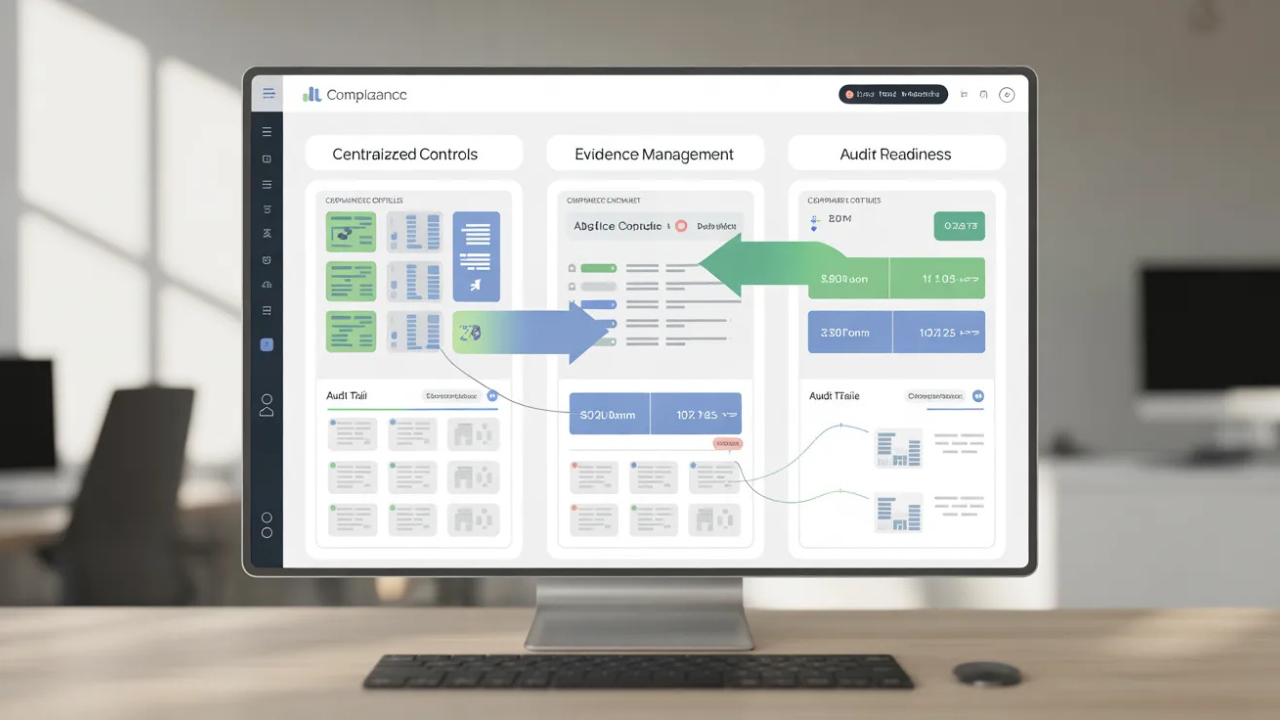
Modern compliance management software addresses this by centralizing the three things that fragmented programs consistently struggle with: controls, evidence, and audit readiness. This blog explains how that centralization works in practice and why it changes the compliance function in ways that point solutions and manual processes simply cannot replicate.
Why Fragmentation Is the Core Compliance Problem
Fragmented compliance systems create more than operational hassle. They create risk. When controls, policies, evidence, and ownership are spread across multiple tools, teams lose visibility into what is current, what is missing, and who is responsible. That makes control gaps harder to detect and accountability harder to enforce.
The biggest problem shows up during audits. Evidence such as control tests, policy acknowledgments, incident logs, and risk assessments often sits across emails, shared drives, and folders, making retrieval slow, manual, and unreliable.
This is why compliance management software matters. It centralizes controls, evidence, and accountability in one system, helping organizations move from scattered documentation to true audit readiness.
How Compliance Management Software Centralizes Controls
Controls are the mechanisms through which organizations operationalize their compliance obligations. A control might require quarterly access reviews for privileged user accounts, monthly reconciliation of specific financial records, or annual training completion by employees in regulated roles. Each control has an owner, a frequency, a testing procedure, and an expected outcome.
Managing that across dozens or hundreds of controls, multiple regulatory frameworks, and a large organization is not feasible through spreadsheets or manual tracking. Compliance management software creates a centralized control library where every control is defined, assigned, and monitored from a single location.
The practical benefits of centralization start with visibility. Compliance managers can see the status of every control at any point in time, which are operating as designed, which are overdue for testing, which have failed a recent test, and which are mapped to regulatory requirements that have recently changed. That visibility is not possible when controls are distributed across systems and tracked informally.
Centralization also enables control mapping, which is one of the most time-saving capabilities in a modern compliance platform. A single control often satisfies requirements across multiple regulatory frameworks simultaneously. An access review control may address requirements under SOX, ISO 27001, and an internal governance policy at the same time. When controls are centralized and mapped to the frameworks they satisfy, organizations avoid duplicating effort across frameworks and can immediately identify coverage gaps when a new regulation is introduced.
Control ownership and accountability are also significantly clearer in a centralized system. Each control is assigned to a specific owner who receives automated reminders when testing is due, escalations when deadlines pass, and notifications when the control definition is updated. Accountability is built into the process rather than enforced through manual follow-up.
How Evidence Is Managed Centrally and Made Retrievable
Evidence management is where many compliance programs have their most significant operational weakness, and where compliance management software delivers some of its clearest practical value.
Every control test generates evidence. Every policy acknowledgment is evidence. Every risk assessment, incident record, and audit response is evidence. Across a compliance program of any meaningful size, the volume of evidence that needs to be collected, organized, and retained is substantial. The question is not whether organizations collect this evidence. Most do. The question is whether it is stored in a way that makes it retrievable, attributable, and credible when it is needed.
Compliance management software creates a structured evidence repository that is linked directly to the controls and frameworks the evidence supports. When a control test is completed, the evidence is attached to that specific control record in the system. When a policy is acknowledged by an employee, the attestation record is stored against the relevant policy version. When an incident is investigated and resolved, the documentation is tied to the related control or risk record.
This structure means that when an auditor asks for evidence of a specific control over a defined time period, the compliance team does not need to search across systems or reconstruct records. The evidence is in the system, linked to the control, timestamped, and attributed to the person who collected or generated it. The response time drops from weeks to hours.
Evidence centralization also supports ongoing control monitoring rather than point-in-time assessments. When evidence is consistently collected and stored in the system throughout the year, compliance managers can identify trends, spot controls that are showing signs of degradation before they fail, and demonstrate continuous compliance rather than a compliance posture that was assembled for audit purposes.
What Audit Readiness Actually Looks Like in Practice
Gartner research found that when organizations implement embedded, workflow-based controls, the number of employees who miss compliance obligations drops by more than half, specifically by 58%. That finding points directly at the practical difference between compliance programs that are built into operational workflows and those that rely on periodic reminders and manual tracking. Compliance management software operationalizes this principle by making compliance tasks part of how work gets done rather than a separate administrative burden.
Audit readiness in a well-configured compliance management platform looks meaningfully different from audit readiness in a fragmented program. The difference is most visible in three areas.
- Pre-audit preparation time. In fragmented programs, preparing for an audit typically involves weeks of documentation assembly, chasing evidence from across the organization, and reconciling inconsistencies between what different teams have recorded. In a centralized platform, pre-audit preparation is primarily a matter of generating reports and reviewing the completeness of evidence that has been collected throughout the year. The preparation work is distributed across the program rather than concentrated into a single high-pressure period.
- Auditor response time. When auditors make requests during an audit, the speed and completeness of responses matters. Slow or incomplete responses signal to auditors that the compliance program is not well-managed, which tends to generate more scrutiny rather than less. A centralized platform allows compliance teams to respond to specific evidence requests quickly and completely, because the evidence is organized and retrievable rather than scattered.
- Findings and remediation tracking. Audits produce findings that need to be tracked through to resolution. In fragmented programs, finding tracking often happens in spreadsheets that are not connected to the controls or evidence they relate to. Compliance management software tracks findings, assigns remediation owners, sets deadlines, and monitors completion within the same system where the underlying controls and evidence are managed. The audit cycle closes cleanly rather than trailing off into unresolved action items.
The Operational Shift That Centralization Enables
The benefits described above are real and measurable, but they point to something more significant than efficiency gains. When controls, evidence, and audit readiness are managed from a centralized platform, the compliance function shifts from reactive to proactive.
Reactive compliance is characterized by audit preparation as a distinct activity, evidence collection as an event rather than an ongoing practice, and control gaps discovered by auditors rather than internal monitoring. It is the mode most organizations operate in when their compliance infrastructure is fragmented, because fragmented infrastructure makes continuous monitoring practically impossible.
Proactive compliance, enabled by centralization, means that the compliance team knows the status of every control in real time, that evidence is being collected as work happens rather than assembled under pressure, and that gaps are identified internally before they become audit findings. The audit becomes a verification of a program that is already operating well, rather than a test of whether the organization can reconstruct evidence of compliance in a compressed timeframe.
That shift has consequences beyond the compliance function. Leadership gets reliable visibility into the organization’s actual compliance posture rather than a periodic snapshot. Risk decisions are based on current data rather than stale assessments. And the resources consumed by audit preparation can be redirected toward substantive compliance work rather than administrative reconstruction.
The organizations managing compliance most effectively are not necessarily those with the largest compliance teams or the most elaborate policy libraries. They are the ones whose compliance infrastructure allows them to demonstrate, at any moment, that their controls are operating, their evidence is intact, and their program is current. Compliance management software is what makes that demonstration possible, by replacing fragmentation with the centralization that genuine audit readiness requires.