



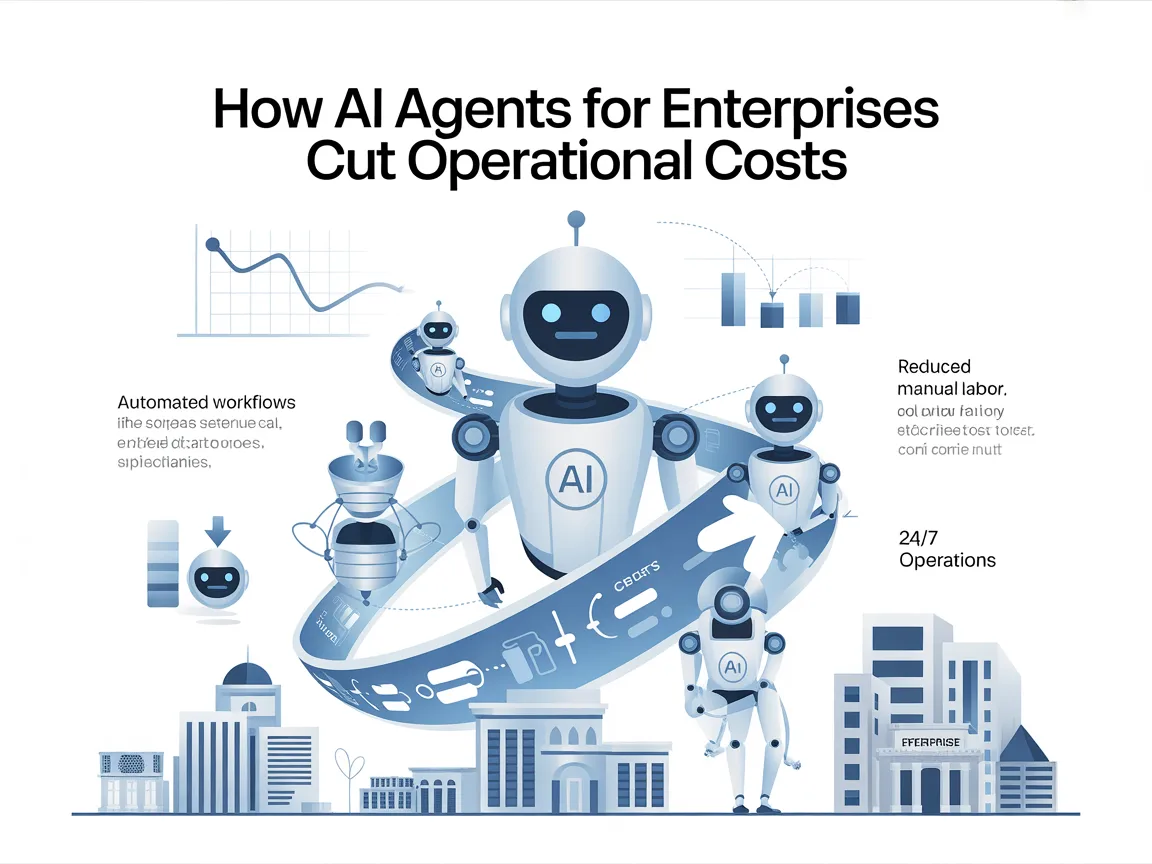
Enterprise budgets are under pressure from every direction. Headcount costs keep rising, legacy systems demand constant maintenance, and manual workflows quietly drain productivity across every function. For leaders trying to find structural efficiencies rather than surface-level fixes, AI agents have moved from an interesting idea to an active priority.
According to McKinsey, applying AI to customer care functions alone could increase productivity at a value ranging from 30 to 45 percent of current function costs.
For enterprise leaders evaluating where to begin, it helps to first understand how these systems are built and what makes them different. This breakdown of enterprise AI agents covers the key frameworks driving deployment today and is a practical starting point before committing to any platform or strategy.
The Real Cost Problem Enterprises Face
Enterprise operational costs are largely driven by high-volume, repetitive work that is time-consuming, error-prone, and expensive to staff at scale. Understanding where this drag comes from is essential before evaluating any solution.
HR teams handle the same onboarding questions week after week. Finance teams manually key in invoice data that could be processed automatically. Customer support departments manage thousands of tickets that follow identical resolution paths. Legal teams spend hours on initial document reviews that require no specialist judgment. None of this work is complex, but the cumulative cost of doing it manually is significant.
Traditional automation tools like robotic process automation (RPA) have addressed parts of this problem, but only within narrow limits. RPA systems are essentially rule-based instructions. They break when inputs change, cannot process unstructured data like emails or PDFs, and require constant maintenance when underlying systems update. The moment an edge case appears, a human must intervene.
AI agents operate differently. They reason through context, adapt to variation, and collaborate with other agents to complete entire workflows end to end without a human in the loop. They do not just execute instructions. They understand what needs to be done and determine how to do it.
Where AI Agents Cut Costs Most Effectively
The cost reduction case for AI agents is not theoretical. Across enterprise functions, savings are appearing in documented, measurable ways: lower cost per transaction, shorter cycle times, and significantly reduced error rates. The functions where the impact is most pronounced are also the ones where manual workload has historically been highest.
Customer Support
Customer support is where the ROI case for AI agents is most immediate and easiest to measure. High-volume, repetitive ticket handling is exactly the kind of work AI agents handle well, and the difference in cost per interaction is significant at enterprise scale.
AI agents managing Tier 1 support can handle password resets, FAQ-level queries, order status checks, and policy questions autonomously, around the clock, without adding headcount.
Finance and Accounting
Finance functions carry enormous manual processing overhead. Invoice handling, purchase order approvals, reconciliation, and financial close processes all involve significant data entry and verification work that is both slow and error-prone when handled manually.
AI agents applied to accounts payable workflows can automate the end-to-end process from invoice receipt to approval routing and payment scheduling. The result is faster cycle times, lower cost per invoice, and a meaningful reduction in errors that would otherwise require costly downstream corrections and audits.
Human Resources
HR teams operate under persistent volume pressure. Recruiting pipelines, onboarding workflows, policy queries, and compliance documentation collectively consume a significant share of HR capacity, much of it on tasks that are routine and repeatable.
AI agents can handle initial candidate screening, respond to employee policy questions, generate onboarding documentation, and manage compliance workflows without HR staff involvement. This frees HR professionals to focus on the work that requires genuine human judgment: culture-building, complex employee relations, and strategic workforce planning.
Sales and Marketing
Sales productivity is often constrained not by talent but by the administrative overhead surrounding core selling activity. Lead research, CRM updates, outreach sequencing, and follow-up scheduling all consume time that could otherwise go toward actual selling.
According to McKinsey’s 2025 research on agentic AI, fewer than 10 percent of use cases deployed ever make it past the pilot stage. The enterprises that do break through do so by embedding AI agents into specific sales and marketing workflows rather than deploying broad horizontal tools that deliver diffuse, hard-to-measure benefits. The result is more productive reps, faster pipeline movement, and lower cost per acquisition.
IT and Operations
IT service desks are another high-volume function where AI agents deliver clear cost reductions. Routine service requests, system monitoring, anomaly detection, and known-issue remediation can all be handled autonomously, reducing the volume of tickets that require human intervention and cutting the average time to resolution.
In manufacturing and operations, AI agents monitoring equipment and production systems can flag anomalies before they become failures, reducing unplanned downtime that carries substantial direct and indirect costs.
Why Traditional Automation Falls Short
Many enterprise leaders already have RPA or basic automation in place and reasonably wonder why AI agents are necessary on top of what they have built. It is a fair question, and understanding the answer is important before committing to any new automation strategy.
RPA has delivered real value in specific, structured workflows. But its limitations become apparent as enterprises try to scale automation beyond narrow, rule-based tasks. RPA breaks when inputs change. It cannot handle unstructured data. It requires constant maintenance as underlying systems update. And it has no ability to reason through ambiguity or handle exceptions without human escalation.
The practical consequence is that enterprises relying solely on RPA are automating a small fraction of what is actually automatable. The large majority of enterprise workflows involve some degree of variation, unstructured input, or multi-step judgment that RPA simply cannot accommodate.
AI agents fill that gap. They combine perception, reasoning, and action. They can read an email, determine intent, pull relevant information from multiple systems, take action, and update records, all without a human in the loop. They handle exceptions as a matter of course because they understand context rather than just matching patterns.
What Separates Successful Deployments from Stalled Ones
Most enterprise AI initiatives do not fail because the technology does not work. They fail because of how they are deployed. Understanding what distinguishes successful implementations from stalled pilots is critical before committing to a rollout strategy.
Several principles consistently separate the organizations seeing measurable cost reductions from those stuck in the pilot phase.
- Start with high-volume, bounded workflows. The fastest and most defensible ROI comes from processes that are repetitive, data-rich, and well-defined. Customer support triage, invoice processing, and HR query handling are proven starting points because the baseline is measurable and the improvement is visible.
- Think in workflows, not tasks. An AI agent that handles a single step in a process delivers limited value. An agent that orchestrates an entire end-to-end workflow, from intake through resolution and record-keeping, delivers compounding value across every instance it runs.
- Prioritize compliance and security from the start. AI agents will access sensitive data across HR, finance, legal, and customer records. Any platform under serious consideration needs to meet the compliance standards relevant to your industry, including SOC 2, HIPAA, GDPR, and ISO 27001, with both cloud and on-premises deployment options available.
- Redesign the workflow, not just the tooling. Layering AI onto a broken or inefficient process produces a faster broken process. The organizations seeing real cost reduction are the ones that rethought how the work should be done, then built AI into that redesigned process from the ground up.
The Cost of Waiting
The pace of enterprise AI agent adoption is accelerating, and the gap between early movers and those still evaluating is widening with each quarter. Enterprises that deploy AI agents now build institutional knowledge, refine their workflows, and develop operational capabilities that are genuinely difficult to replicate quickly.
Those that continue to evaluate while competitors execute face not just higher costs in the short term, but the prospect of competing against organizations that have already internalized AI-native operations across their most important functions.
Operational efficiency has always been a competitive differentiator. What AI agents do is collapse the timeline between identifying inefficiency and eliminating it, at a scale and speed that was not possible with previous generations of automation. For enterprise leaders, the question is no longer whether AI agents reduce operational costs. The evidence is consistent on that point. The question is how quickly and systematically your organization moves from evaluation to execution.Understanding the right enterprise AI agents and the frameworks that power them is a practical first step toward making that move with confidence.