


Retail organizations across the United States are facing a measurable shift in how decisions get made. Inventory planning that once relied on seasonal intuition now depends on pattern recognition across millions of data points. Customer segmentation that used to require weeks of manual analysis can now happen in near real time. The pressure is not coming from a single direction — it is coming from supply chain volatility, changing consumer expectations, labor cost increases, and competition from digital-first brands that have been operating with AI-supported workflows for several years.
What this means in practice is that retail executives and operations leaders are no longer asking whether AI belongs in their business. They are asking which kind of AI investment is appropriate, what realistic timelines look like, and which external partners have the technical depth and sector-specific understanding to make implementation work. Choosing a consulting and development partner is one of the more consequential vendor decisions a retail organization can make — the wrong fit can result in systems that do not connect to existing infrastructure, or tools that require more internal capacity to maintain than the business currently has.
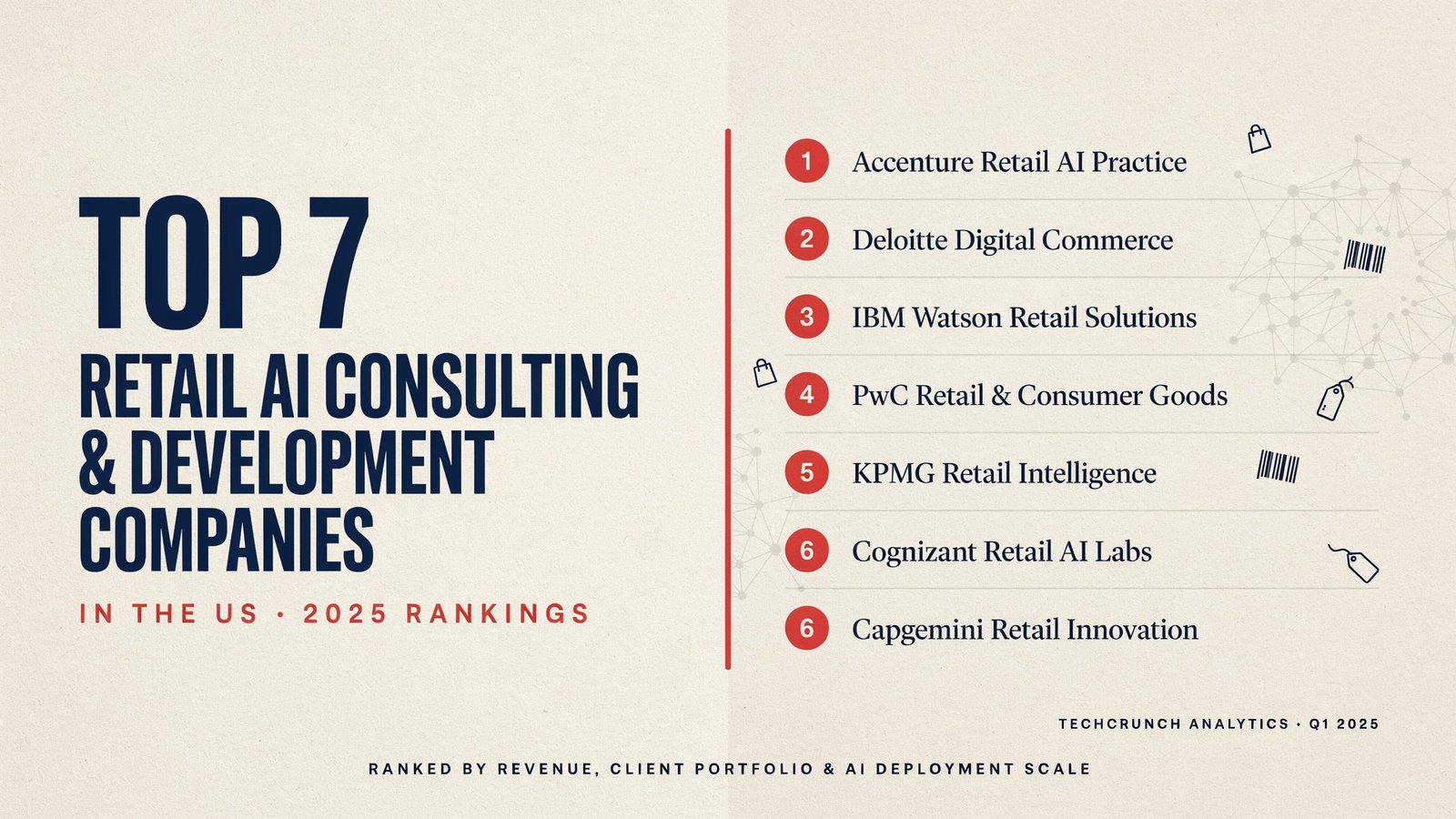
This ranking is designed to support that evaluation. The seven companies listed here represent a range of specializations, delivery models, and sector focus areas. Each has a documented track record working within retail environments, and each brings a distinct approach to the problem of integrating AI into retail operations.
What to Look for When Evaluating a Retail AI Consulting and Development Company
Not every firm that calls itself an AI consultancy has meaningful experience in retail. The distinction matters because retail AI involves a specific set of requirements: real-time data handling at scale, integration with point-of-sale and inventory systems, demand forecasting that accounts for local variables, and personalization engines that operate without degrading customer experience. A firm that works primarily in financial services or healthcare will bring different assumptions to the engagement, and those assumptions can create friction when they meet the operational realities of retail.
When assessing any retail ai consulting and development company, it is worth examining where their previous work has been deployed, not just what tools or frameworks they use. A company that has built recommendation engines for e-commerce at scale has confronted problems that a firm with only internal enterprise automation experience has not. The technical capability gap may not be visible in a proposal, but it tends to surface once implementation begins.
As noted in McKinsey’s State of AI research, the organizations that see the most consistent returns from AI investments are those that pair strong technical development with organizational change management. This is a useful lens for evaluating consulting partners: are they building something and leaving, or are they helping the business absorb and operate the capability they have built?
The Difference Between Advisory Work and Full Development
Some firms operate primarily at the strategy and advisory level. They assess readiness, define use cases, and produce roadmaps. Others build the actual systems. A meaningful number do both, which can be an advantage when continuity between the strategic recommendation and the technical execution is important. Understanding where a firm’s core capacity sits — advisory, development, or integrated — changes the nature of the engagement and the internal resources required to make it successful.
Sector Depth Versus General AI Capability
Sector depth in retail means familiarity with the data structures, operational rhythms, and regulatory context that shape how AI gets deployed in that environment. A firm with general AI capability can build sophisticated models; a firm with retail sector depth knows which models are worth building, where the data quality problems typically live, and how to manage the gap between what a system produces and what store managers will actually trust and use.
The Seven Companies Worth Evaluating in 2025
The following firms have demonstrated credible work within retail AI, across use cases including demand forecasting, personalization, visual merchandising automation, pricing intelligence, and supply chain optimization. They vary in scale, service model, and the types of retail clients they have worked with.
1. Codewave
Codewave operates as a retail ai consulting and development company with a specific focus on experience-led digital products. Their work in the luxury retail segment is notable because luxury presents distinct AI challenges — smaller data sets, higher variability in customer behavior, and brand sensitivity around automation. Their approach emphasizes building systems that reflect the operational character of the client rather than deploying generic frameworks.
2. Publicis Sapient
Publicis Sapient brings significant scale and cross-functional capability to retail AI engagements. Their work tends to span customer data platforms, digital commerce infrastructure, and supply chain systems. For large retailers managing complex omnichannel environments, their capacity to coordinate across departments and technology stacks is a practical advantage. Engagements are typically mid-to-long term, which reflects the complexity of the problems they take on.
3. Slalom
Slalom has built a recognized practice in retail and consumer goods, with AI work that connects data engineering, cloud architecture, and applied analytics. They operate through a regional market model, which can support closer working relationships with clients who value proximity and consistent team continuity. Their retail work often centers on personalization infrastructure and inventory intelligence.
4. DataRobot (now Skan.ai partner ecosystem)
DataRobot provides automated machine learning capabilities that retail organizations have applied to demand forecasting, churn prediction, and pricing optimization. Their platform model means that internal teams can eventually operate and retrain models without continuous external support, which is a meaningful consideration for retailers who want to build internal capability over time rather than remain dependent on a vendor.
5. Fractal Analytics
Fractal has a strong presence in retail and consumer packaged goods, with AI work that includes trade promotion optimization, assortment planning, and customer lifetime value modeling. Their depth in applied analytics — not just AI tooling — means they can address problems that sit at the intersection of data strategy and operational decision-making. They have worked with several of the largest US grocery and mass retail chains.
6. Tiger Analytics
Tiger Analytics positions itself around data science and AI with a focus on measurable business outcomes. In retail, their work has included price elasticity modeling, markdown optimization, and customer segmentation. They tend to work well with mid-market retailers who have reasonable data infrastructure but lack the internal data science capacity to move from raw data to deployable models independently.
7. Mu Sigma
Mu Sigma has worked with major US retailers on decision science problems that involve both analytical modeling and process redesign. Their model is built around embedding analytical thinking into how a business makes decisions, not just building individual tools. For retail organizations that want AI to influence day-to-day operations rather than sit in a separate analytics function, this approach has practical relevance.
How Retail Organizations Are Using AI Consultants in Practice
Across engagements with retail clients, a few use cases appear consistently, not because they are the most technically sophisticated, but because they address problems where AI produces consistent, verifiable improvements that operations teams can measure and act on.
• Demand forecasting at the store and SKU level, reducing both overstock and out-of-stock conditions that directly affect revenue and customer experience.
• Dynamic pricing tools that adjust recommendations based on competitive data, margin targets, and inventory position without requiring manual intervention at scale.
• Customer segmentation models that go beyond transactional history to incorporate behavioral signals, enabling marketing and merchandising teams to make more targeted decisions.
• Personalization engines for e-commerce that adapt product display, search ranking, and promotion targeting based on real-time session behavior.
• Visual merchandising tools that analyze planogram compliance at scale using computer vision, reducing the manual audit burden for category management teams.
• Supply chain exception management systems that surface anomalies earlier, giving procurement and logistics teams more time to respond before disruptions affect store availability.
What Makes an AI Engagement Succeed or Fail in Retail
Retail AI consulting engagements fail for reasons that are rarely technical. The more common failure modes involve poor alignment between what the AI system produces and what the people using it are able to interpret and act on. A demand forecasting model that generates predictions at a level of granularity the planning team cannot process will not improve decisions — it will create noise. A pricing tool that conflicts with a buyer’s existing judgment without providing clear explanation will be ignored.
Change Management as a Technical Requirement
The most durable retail AI implementations treat internal adoption as part of the technical problem, not a soft afterthought. This means designing outputs in formats that match how store managers, buyers, and operations teams already work. It means building explanation into the system — not just a result, but a reason the system arrived at that result. And it means building feedback mechanisms so the system improves based on the decisions people actually make, not just the data they feed it.
Data Readiness Is Often Underestimated
Most retail organizations underestimate the state of their data before an AI engagement begins. Point-of-sale data may be inconsistent across store formats. Product master data may have duplication or classification errors that affect how models interpret assortment. Customer identity resolution across online and in-store channels may be incomplete. A competent retail ai consulting and development company will surface these issues early, but the resolution work typically falls on the client — and it takes longer than most project plans anticipate.
Questions That Help Differentiate Vendors During Evaluation
When speaking with firms on this list or others, a small set of questions tends to separate firms with genuine retail experience from those applying general AI methodology to a retail-labeled engagement.
• Can they describe a specific retail deployment where the initial model underperformed and explain how they diagnosed and corrected it?
• How do they handle integration with legacy point-of-sale or ERP systems that are not cloud-native?
• What does their handoff process look like — do they train internal teams or leave documentation?
• How do they define success for a retail AI engagement, and what does the measurement process look like over the first twelve months?
Closing Thoughts
The market for retail AI consulting in the United States is maturing, which means the quality difference between firms is becoming easier to see. Early-stage hype has faded, and what remains is a set of organizations that have either built credible track records in retail environments or are still working to develop them. For retail leaders making vendor decisions in 2025, the most useful filter is not which firm has the most sophisticated technology or the largest team — it is which firm has confronted the specific operational problems your business is facing and has a defensible record of navigating them.
The companies listed here represent a reasonable cross-section of the market, from boutique specialists to large-scale consultancies. Each serves a different profile of retail client, and choosing well means being honest about the scale, complexity, and internal capacity of your own organization before the engagement begins. Doing that work upfront — rather than discovering the misalignment three months into a project — is the most reliable way to make a retail AI investment produce the outcomes the business actually needs.