



Investors and tech infrastructure watchers often ask: what is the VRT stock price today, and what does it imply for the future? In this detailed article, we’ll examine the current pricing, historical performance, financials, business model, future outlook, risks, and what analysts are saying. By the end, you’ll have a solid grasp of VRT as a stock, and whether it fits in your portfolio.
Note: When we say “VRT,” we mean Vertiv Holdings Co., the data-center infrastructure and critical power/cooling company (NYSE: VRT).
What is VRT / Vertiv Holdings? <a name=”what-is-vrt”></a>
Vertiv Holdings Co. (ticker VRT) is a U.S.-based company specializing in critical infrastructure, power and thermal management, and data center solutions.
Key facts:
- It serves data centers, communications networks, and industrial environments.
- Core product lines include uninterruptible power supplies (UPS), power distribution, cooling/thermal systems, rack infrastructure, monitoring software, and related services.
- Vertiv operates globally — more than 130 countries — with manufacturing and service locations to support its operations.
- The company invests significantly in R&D, holds many patents, and often emphasizes its technology and innovation efforts, particularly as data centers adopt more advanced cooling and power techniques.
Because the demand for AI, cloud, and high-density computing continues to rise, firms like Vertiv are viewed as “picks and shovels” plays — companies that provide enabling infrastructure rather than owning the assets themselves.
Current VRT Stock Price & Key Metrics <a name=”current-price”></a>
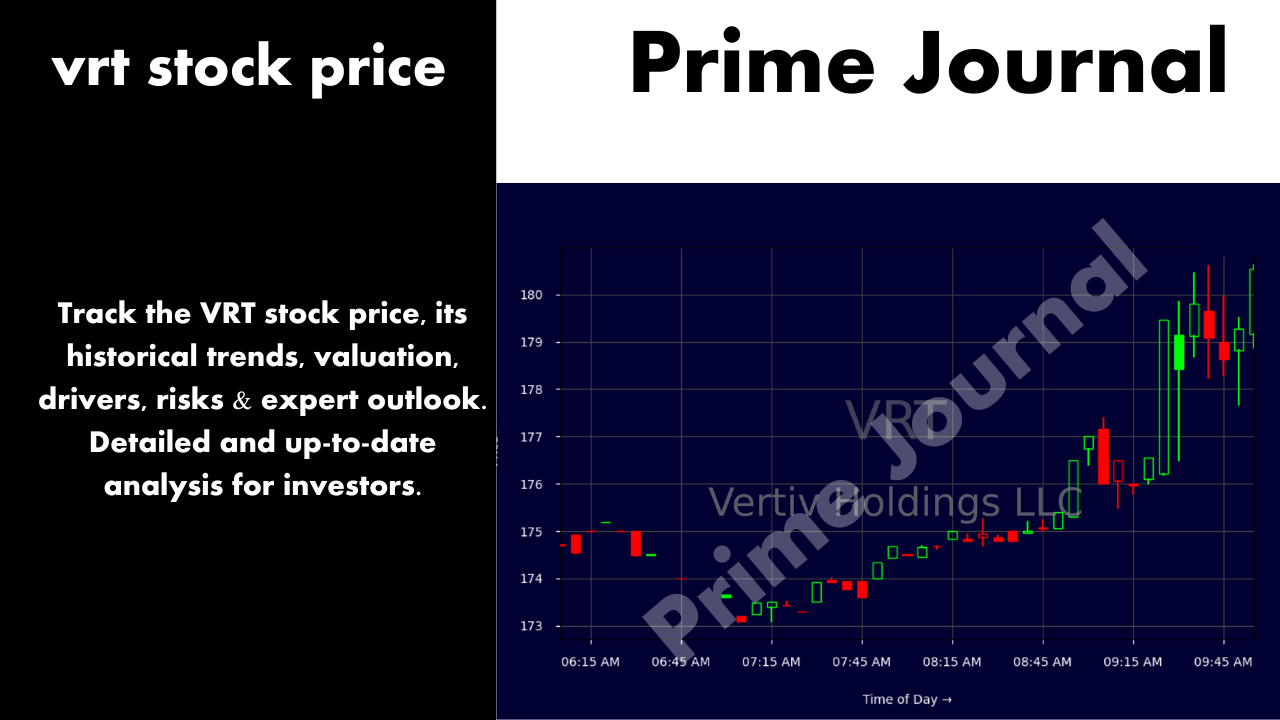
As of the most recent market data:
Here are some key metrics for VRT:
| Metric | Value |
|---|---|
| Ticker | VRT (NYSE) |
| Latest Price | ~$169.01 USD (as per above) |
| 52-Week Range | ~$53.60 – $155.84 (note: historical record highs and lows) |
| Market Cap | ~ $51–55 billion per various sources |
| Outstanding Shares | ~ 380 million shares |
| Analyst Consensus Price Target | ~ $154.73 (some variation) |
Notes & caveats:
- Different sources may show slightly varying “latest” prices due to delays or differences in refresh times (e.g., Yahoo Finance, MarketWatch, Zacks).
- The 52-week low of ~$53.60 reflects a deep sell-off earlier (e.g., in 2025) before recovery.
- The price target from analysts is averaged but subject to revision as new data arrives.
Historical Performance & Price Trends <a name=”historical”></a>
1 Price Cycles & Major Moves
VRT’s stock has experienced significant volatility over the past few years:
- It reached a 52-week high near $155.84 before a correction.
- Earlier in 2025, it sank to $53.60, representing a dramatic drawdown during tech/AI “rotation” phases.
- Since that low, the stock has rebounded strongly, driven by renewed optimism around AI infrastructure demand.
- For example, as of mid-2025, the stock was up ~25% year-to-date (depending on the point in time).
2 Volatility & Technical Observations
- Some analysts note low implied volatility in options, suggesting the market expects moderated price swings (or lacks clarity).
- The recovery from the bottom has been aided by bullish upgrades and strong order growth in data center infrastructure.
- However, the stock remains sensitive to news and sentiment swings in the tech / AI / infrastructure sectors (e.g., Microsoft unveiling a new cooling system triggered a ~6% drop).
In sum, VRT has had bouts of extreme volatility, but in the recent period it has shown a meaningful rebound, positioning it as a “recovery + growth” name.
Business Model & Revenue Drivers <a name=”business-model”></a>
To understand VRT stock price movements, it’s vital to grasp how Vertiv’s business works and what drives its revenue, margins, and growth.
1 Core Segments & Offerings
Vertiv’s offerings can be broadly grouped as:
- Critical Power & Thermal Management
- UPS systems (backup power)
- Power distribution units (PDUs)
- Cooling / thermal management (liquid and air cooling)
- Racks, modular infrastructure, integrated systems
- Software, Monitoring & Control
- Infrastructure management platforms
- Remote monitoring, analytics, predictive maintenance
- Services & Field Support
- Installation, maintenance, spares
- Engineering services, site audits
These segments create both capex-led sales (selling equipment) and recurring income (service contracts).
2 Key Growth Drivers
Some of the main tailwinds:
- Explosion in AI / High Performance Computing (HPC): As AI workloads intensify, demand for thermal and power solutions rises.
- Data Center Deployment Growth: Hyperscalers, cloud providers, edge infrastructure, 5G expansion
- Technology Transition: New cooling paradigms (liquid cooling, microfluidics) may shift the demand curve.
- Upgrade Cycles & Replacement: As data centers age, they require retrofit, modernization, and efficiency upgrades.
- Geographic / Regional Growth: Growth in emerging markets, expansion of compute infrastructure globally
3 Margins & Scale Effects
- Equipment sales can carry higher margins, but competition and commoditization pressure exist.
- Services and software offer more stable margins and recurring revenue — a desirable quality.
- Vertical integration (manufacturing, supply chain) and scale can help manage cost pressures, especially in components and raw materials.
The interplay of capex and recurring revenue helps Vertiv smooth its business cycles and provides multiple levers for growth.
Fundamental Analysis: Financials & Valuation <a name=”fundamental-analysis”></a>
Let’s dig into Vertiv’s financial condition, profitability, valuation, and how attractive it is from a fundamental perspective.
1 Recent Earnings & Guidance
Vertiv’s Q4 / recent quarterly performance was notable:
- It reported adjusted EPS of $0.99 on revenue of $2.35B (a ~26% YoY growth) — both surpassed consensus.
- However, its future guidance was slightly cautious. For the next period, it projected EPS in the ~$0.57–0.63 range.
- For full-year 2025, Vertiv aims for adjusted EPS of ~$3.55 and revenues around ~$9.2B.
These results indicate a strong growth base but highlight the sensitivity to demand shifts and margin pressures.
2 Valuation Metrics & Comparisons
Some valuation-related points:
- The average analyst target (~$154.73) suggests modest upside from current levels.
- Some analysts have upgraded their targets due to accelerating AI spend; e.g., Melius raised its target to $165.
- On the flip side, Barclays trimmed its target sharply (from $111 to $100), pointing to concerns about a slowdown.
- Valuation multiples (P/E, P/S, EV/EBITDA) vary widely depending on assumptions. Vertiv is often compared to infrastructure and industrial peers rather than pure tech.
- The company’s fair value per Morningstar is ~ $119 (somewhat conservative).
Thus, valuations are mixed: bullish when AI demand seems secure, cautious when macro or sector sentiment sours.
3 Financial Health & Balance Sheet
- Vertiv carries debt, but its service and recurring revenue helps mitigate cyclicality.
- Cash flow generation is important; if it can consistently convert orders into cash, that supports long-term sustainability.
- Watch for underlying cost inputs (materials, energy, labor) and foreign exchange exposure in global operations.
In summary, Vertiv is not a risk-free growth story, but its foothold in enabling infrastructure gives it a unique positioning.
Analyst Ratings & Price Targets <a name=”analyst-ratings”></a>
Here’s what analysts are saying about VRT stock in mid-2025:
- Melius Research upgraded VRT from “Hold” to “Buy,” raising their target to $165, citing AI infrastructure demand.
- Evercore ISI, Citi, and others have also maintained bullish/optimistic views.
- Some caution exists: Barclays cut its target to $100 and maintained a more neutral stance.
- Many analysts see VRT as a key infrastructure play in the AI and data center build-out.
Takeaway: Most analysts lean bullish, but there’s dispersion in target ranges, and some express caution around future capex cycles.
Key Catalysts & Risks <a name=”catalysts-risks”></a>
1 Potential Catalysts (Upside Drivers)
- Sustained AI / hyperscale investment: A continued wave of AI deployments boosts demand for cooling, power, and data center expansion.
- Technological disruption: If Vertiv can lead or benefit from new cooling methods (e.g., liquid cooling, microfluidics) it could command premium margins.
- Strong backlog & order growth: A healthy backlog signals future revenue visibility. Some reports cite increasing order growth.
- Strategic acquisitions or partnerships: Enhancements to product lines, entry into adjacent markets (e.g., by acquiring rack or cabinet businesses). For instance, Vertiv acquiring Great Lakes is one such move. Growth in emerging regions with rising data center demand.
2 Risks & Headwinds
- Cyclicality of capex: If hyperscalers or enterprises slow infrastructure spending, demand could falter.
- Technological disruption / competition: New cooling or power technologies by competitors (e.g. Microsoft’s microfluidic cooling system) could erode Vertiv’s market.
- Macro / interest rate environment: Rising rates or tighter capital markets may dampen investment.
- Execution risk: Supply chain constraints, margin erosion, integration of acquisitions.
- Valuation compression: In frothy markets, multiple re-ratings can reverse quickly if sentiment shifts.
- Currency & international exposure: Since Vertiv operates globally, FX swings and geopolitical risks matter.
Overall, VRT is exposed to both powerful tailwinds and significant volatility if conditions worsen.
Comparisons with Peers and Alternatives <a name=”peer-comparison”></a>
To contextualize VRT’s appeal, let’s compare it with some peers or adjacent plays:
- Applied Digital (APLD): A company more focused on owning and operating data center / AI infrastructure itself. Some investors compare VRT vs APLD as complementary infrastructure vs operator plays.
- Other infrastructure / industrial names: Firms in cooling, power electronics, rack solutions, or data center supply chains.
- Pure tech / semiconductor plays: While different model, they share exposure to AI / growth cycles — however, risk/valuation dynamics differ.
In many comparative analyses, VRT holds up as a less risky (though still volatile) infrastructure anchor relative to pure AI or semiconductor stocks.
How to Interpret VRT as an Investor <a name=”investor-tips”></a>
Here are some practical tips if you’re considering VRT:
- Time horizon matters: VRT may be more suited for medium- to long-term investors who believe in secular AI/data center growth rather than short-term traders.
- Position sizing & risk control: Because of its volatility, allocate judiciously, use stop-loss or hedges if needed.
- Monitor leading indicators: Watch for new orders, guidance from hyperscalers, AI spending trends, macro signals.
- Balance growth and margin concerns: Ensure that you’re comfortable with potential margin compression during down cycles.
- Diverse exposure: Use VRT as part of a diversified tech/infrastructure allocation — avoid overconcentration.
- Stay updated with analyst revisions: Target prices and sentiment can shift quickly in this space.
If you’d like, I can also model hypothetical return scenarios or compare VRT vs alternative stocks you may be eyeing.
FAQ <a name=”faq”></a>
Q1: What does “VRT” stand for, and is it related to broadcasting?
A: In this context, VRT is the ticker for Vertiv Holdings Co., a company in data center infrastructure. It is not to be confused with VRT the broadcaster in Belgium.
Q2: Why did VRT drop so sharply to ~$53.60 earlier in 2025?
A: The steep drop reflected a broader tech correction, investor rotation out of “hype” names, and concerns about AI capex sustainability. The valuation was heavily discounted, and sentiment turned negative amid uncertainty.
Q3: Is VRT considered a dividend stock?
A: As of now, Vertiv is not known for substantial dividends. Its focus is on growth, reinvestment, and balancing capex vs. service revenues. (Always check the latest investor disclosures.)
Q4: What’s the range of analyst price targets for VRT?
A: Targets vary — common ballpark is ~$150–165 (bullish side) but some more conservative analysts go lower (e.g. Barclays at ~$100).
Q5: How should I track the VRT stock price moving forward?
A: Use real-time sources like Reuters, Yahoo Finance, MarketWatch, or your brokerage. For deeper insight, follow company earnings calls, guidance, and data center / AI industry reports. ⟶ Related: [Your Article Title] (internal link placeholder)
Q6: Is VRT a good buy now?
A: That depends on your risk tolerance, time horizon, and conviction in the AI/data center build cycle. Many analysts see upside, but the stock remains vulnerable to sentiment shifts. Always treat it as part of a balanced portfolio.