


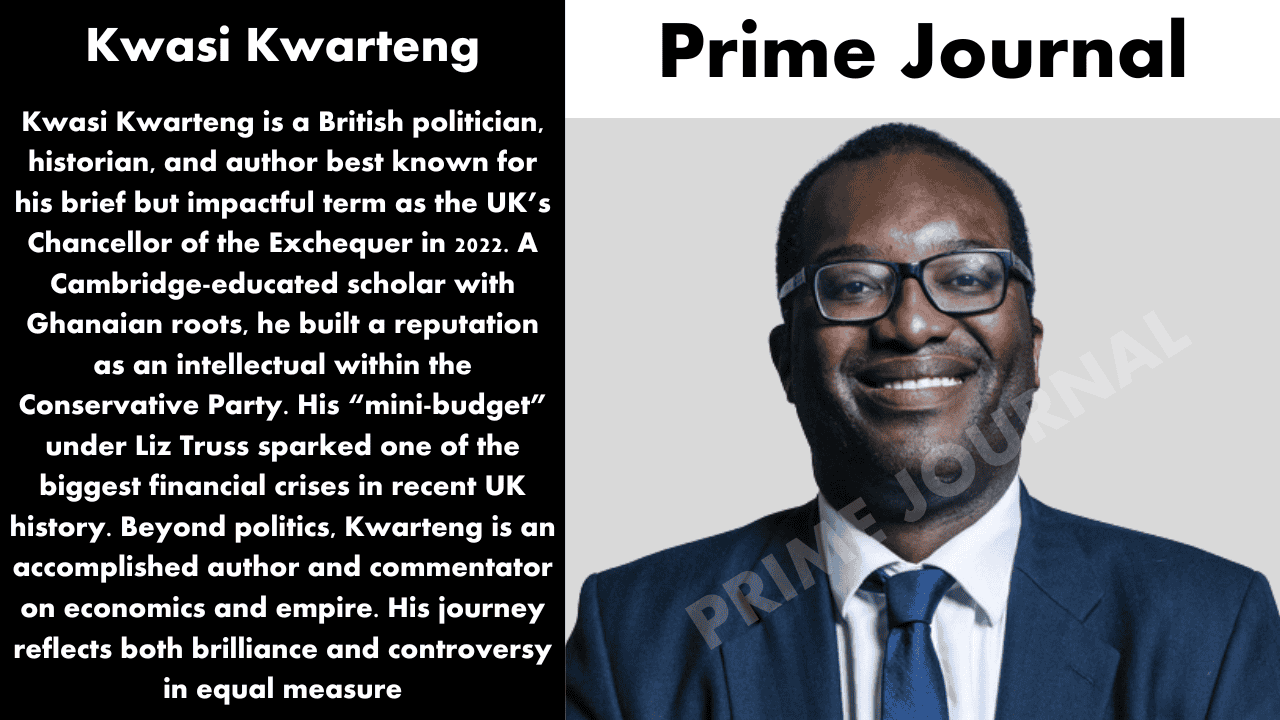
Kwasi Kwarteng is a figure whose name became nationally known during one of the most dramatic episodes in recent UK economic history. But his story extends far beyond a 38-day tenure as Chancellor. In this deep dive, we explore his background, political rise, the infamous “mini-budget”, post-political path, and the controversies and debates that have defined his public life.
Early Life & Education
Birth and family background
- Kwasi Kwarteng was born Akwasi Addo Alfred Kwarteng on 26 May 1975 in London (Waltham Forest).
- His parents emigrated from Ghana in the 1960s — his mother, Charlotte Boaitey-Kwarteng, is a barrister; his father, Alfred K. Kwarteng, an economist.
- He was an only child.
Schooling & early accolades
- He started at a state primary school in Waltham Forest, later winning a scholarship to Colet Court, an independent preparatory school, where in 1988 he won the Harrow History Prize.
- He then won a King’s Scholarship to Eton College (elite secondary school), where he excelled academically.
University & postgraduate studies
- Kwarteng read Classics and History at Trinity College, Cambridge, obtaining a double first.
- He later attended Harvard University as a Kennedy Scholar.
- He earned a PhD in Economic History from Cambridge in 2000. His doctoral thesis was on the “political thought of the recoinage crisis of 1695–7.”
Summary
Kwarteng’s early life combines a narrative of immigrant roots, academic distinction, and classical education — a foundation that later supported both intellectual and political ambition.
Early Career: Finance, Writing & Ideas
Before entering frontline politics, Kwarteng built a profile combining finance, journalism, and intellectual work.
Finance and analysis
- He worked as a financial analyst in the City (London) — including with firms such as J.P. Morgan.
- This experience gave him exposure to macroeconomics, markets, and the dynamics of capital flows.
Journalism & commentary
- Kwarteng was a columnist for The Daily Telegraph, writing on politics and economics.
- He involved himself in public debate, contributing to ideas and policy debates, especially from a free-market/conservative perspective.
Intellectual & book work
He authored several books and co-authored influential works:
- Ghosts of Empire: Britain’s Legacies in the Modern World (2011)
- After the Coalition (2011)
- Gridlock Nation (2011)
- Britannia Unchained (2012) — co-authored, critical of British productivity and regulation.
- War and Gold: A Five-Hundred-Year History of Empires, Adventures and Debt (2014)
- Thatcher’s Trial: Six Months That Defined a Leader (2015)
These works reflect not just policy but deeper historical and economic thinking, making him a thinker-politician.
Entry into Politics & Parliamentary Career
First attempts & early setbacks
- In 2005, Kwarteng stood for Parliament in Brent East, but came third.
- He also engaged in internal Conservative think tanks and policy forums like the Bow Group.
Election to Parliament
- He contested the Spelthorne seat (in Surrey) in 2010, winning it.
- He held that seat through multiple general elections (2015, 2017, 2019) until his departure.
Committee and backbench roles
- On election, he joined the Transport Select Committee (2010–2013).
- Later, he moved to the Work & Pensions Committee (2013–2015).
- From 2016–2017, he was on the Public Accounts Committee.
- He also served as Parliamentary Private Secretary (PPS) to senior figures:
- PPS to the Leader of the House of Lords (2015)
- PPS to the Chancellor of the Exchequer (2017)
These roles allowed him to build relationships inside government and develop policy competence before entering ministerial roles.
Ministerial Roles & Governance
In government, Kwarteng held progressively senior roles. Below is a breakdown:
Parliamentary Under-Secretary for Exiting the EU
- In November 2018, under Prime Minister Theresa May, he became Parliamentary Under-Secretary of State in the Department for Exiting the European Union.
- He was responsible for parts of preparing legislation and negotiating detail in the Brexit process.
- This position lasted until July 2019.
Minister of State: Business, Energy & Clean Growth
- After Boris Johnson became Prime Minister in mid-2019, Kwarteng was appointed Minister of State in the Department for Business, Energy & Industrial Strategy (BEIS), with a particular focus on “clean growth.”
- He remained in that role from 24 July 2019 to 8 January 2021.
Secretary of State for Business, Energy & Industrial Strategy
- On 8 January 2021, Kwarteng was promoted as a full cabinet Secretary of State for BEIS
- He became the first black Conservative MP to hold a full secretary of state role.
- His portfolio included energy policy, business regulation, industrial strategy, innovation, and decarbonization efforts.
- Among his notable achievements in this role:
- He helped institute annual auctions for offshore wind development.
- He oversaw the Sizewell C deal (nuclear investment) negotiations.
- He was involved in proposing and shaping the UK Innovation Strategy 2021.
- He held this position until his elevation to Chancellor on 6 September 2022.
Chancellorship & Mini-Budget
Appointment as Chancellor
- When Liz Truss became Prime Minister in September 2022, she appointed Kwasi Kwarteng as Chancellor of the Exchequer. He was the first Black Chancellor in UK history.
- His tenure lasted from 6 September 2022 to 14 October 2022 — just 38 days — making him one of the shortest-serving chancellors.
The Growth Plan 2022 / Mini-Budget
On 23 September 2022, Kwarteng unveiled his economic package known as The Growth Plan 2022 — commonly dubbed the mini-budget. Key features included:
| Policy / Measure | Description / Intent |
|---|---|
| Large unfunded tax cuts | Cuts to income tax, stamp duty, and reversal of planned corporation tax raising |
| Removal of 45p rate | Abolishing the highest marginal rate for high earners |
| Expansion of capital gains tax reliefs | To stimulate investment |
| Energy bills support & interventions | To help households and businesses with rising energy costs |
| “Growth” focus over austerity | A belief that incentivising private growth is preferable to cuts |
The premise was that bold supply-side reforms and tax cuts would jumpstart growth, making the policy self-financing. However, there was skepticism about how the cuts would be funded given the existing economic and inflationary pressures.
Market reaction & fallout
- The market response was tumultuous: sterling plunged to historic lows against the US dollar.
- Borrowing costs surged, pension funds faced liquidity stress, and the Bank of England intervened with emergency bond purchases.
- Political backlash erupted across parties and within the Conservative party. Many MPs, media, and economic commentators criticized the scale and funding of the tax cuts.
Big U-turns & removal
- The Truss government was forced to reverse several elements of the mini-budget in response to market pressure.
- On 14 October 2022, less than six weeks in office, Kwarteng was dismissed by Liz Truss and replaced by Jeremy Hunt.
- Truss attempted to shore up her government with further tax reversals but ultimately resigned days later.
The mini-budget remains one of the most controversial and consequential economic episodes in recent UK history, leaving a lasting mark on Kwarteng’s legacy.

Fall, Aftermath & Departure from Politics
Political exile & criticism
- Following his dismissal, Kwarteng was widely criticized as the architect of economic instability. The media and opposition labelled him as having “wrecked the economy” in a month.
- His reputation inside the Conservative party became polarizing — some saw him as a visionary bold reformer; others, as recklessly ideological.
New roles & consulting
- In 2023, he joined Fortescue, an Australian mining/clean energy group, advising on macroeconomics, energy, and global trends — part time.
- He was prohibited from lobbying UK government directly for a period, per rules on former ministers.
- In 2025, he accepted a speaking engagement at Nomad Capitalist Live in Kuala Lumpur, sparking public debate given the event’s emphasis on tax minimization for the wealthy.
Exit from Parliament
- In February 2024, Kwarteng publicly announced he would not seek re-election as MP for Spelthorne.
- He formally left the House of Commons on 30 May 2024.
The exit marks a turning point — from politician to commentator, strategist, or public intellectual.
Publications, Ideas & Intellectual Profile
Kwarteng’s place as a “thinker-politician” comes from the depth and range of his published works and ideological stances.
Major themes & recurring ideas
- Growth vs austerity: He argues for supply-side measures, deregulation, tax cuts to stimulate growth rather than relying primarily on government spending cuts.
- British history & empire: In Ghosts of Empire, he explores the legacy of empire and its continuing resonances.
- Finance, debt and state power: War and Gold delves into the interplay of empire, credit, and economic power over five centuries.
- Leadership & ideology: Thatcher’s Trial examines modern conservatism and the challenge of charismatic leadership in a changing era.
Influence & critique
- His ideas resonate with the neoliberal wing of the Conservative Party.
- He has critics who argue his proposals underestimate economic constraints, inflation, and financial market sensitivities.
- His intellectual credentials (PhD, books) lend him a degree of authority beyond mere political operator.
Reputation, Criticisms & Defenders
Kwarteng’s public image is highly contested.
Criticisms & controversies
- The mini-budget disaster is central: accusations of fiscal irresponsibility, misjudgment, and economic damage.
- Critics say he lacked realism about markets and ignored macro risks (inflation, bond markets).
- His alignment with Truss and ideological purism are seen by some as politically tone-deaf.
- His role in think tanks or advisory roles involving tax planning has invited scrutiny.
- Some argue his academic leanings have been disconnected from the practical constraints of governance and markets.
Defenders & supporters
- Supporters view him as a bold reformer willing to challenge status quo economics.
- Some argue that short tenure meant he never had a fair chance to manage or adjust the policies.
- His defenders point to his thought leadership, knowledge of history, and intellectual discipline — that his proposals were at least consistent with a free-market philosophy.
Legacy & Future Prospects
Legacy — how he will be remembered
- Kwarteng will be forever associated with the 2022 mini-budget—its ambition and failure.
- He may also be remembered as a rare figure combining historical scholarship with high office.
- His departure from frontline politics may free him to influence debates from the sidelines — as a speaker, adviser, or public intellectual.
What lies ahead?
- More advisory, start-ups, think tanks roles.
- Possibly a return in some capacity (though not evidently imminent).
- Continued book writing, commentary, and shaping conservative economic discourse.
FAQs
Q1. Who is Kwasi Kwarteng?
A: Kwasi Kwarteng, full name Akwasi Addo Alfred Kwarteng (born 26 May 1975), is a British politician, historian, and author. He was MP for Spelthorne from 2010 to 2024 and served in senior ministerial roles, culminating in a brief tenure as Chancellor of the Exchequer under Liz Truss.
Q2. What is Kwarteng’s educational background?
A: He studied classics and history at Trinity College, Cambridge (earning a double first), attended Harvard as a Kennedy Scholar, and completed a PhD in economic history at Cambridge in 2000.
Q3. What were the major achievements of Kwarteng in government?
A: At BEIS, he advanced offshore wind auctions, supported nuclear investment via the Sizewell C deal, and helped shape the UK Innovation Strategy. As Chancellor, he attempted radical tax reform, though with disastrous market effects.
Q4. Why did his chancellorship fail?
A: The mini-budget’s tax cuts were largely unfunded, which alarmed markets. Sterling fell, borrowing costs spiked, and the government was forced to reverse key elements. Within weeks, political support evaporated, and he was dismissed.
Q5. When did he leave Parliament?
A: In February 2024, he announced he would not stand for re-election. He officially left the House on 30 May 2024.
Q6. What has he done since politics?
A: He took on advisory roles, notably with Fortescue (clean energy) from late 2023. He has also been active in speaking engagements, such as Nomad Capitalist Live in 2025.
Q7. Is there a controversy about him speaking at tax-oriented events?
A: Yes. His role as a speaker at an event promoting tax minimization for high net-worth individuals has drawn criticism, given his former role as Chancellor and the optics of engaging in tax planning forums.
Conclusion
Kwasi Kwarteng’s story is one of ambition, intellect, and controversy — a reminder of how bold ideas can both define and derail political legacies. From his rise as a Cambridge scholar to becoming Britain’s first Black Chancellor, his career has been marked by both historic achievement and dramatic downfall. While his economic experiment left lasting scars, his influence on conservative thought and public debate remains undeniable. Whether through future writings, advisory roles, or public speaking, Kwarteng continues to shape discussions on Britain’s economic identity. His legacy will likely endure as that of a brilliant yet polarizing reformer who dared to challenge convention.