



When we hear of Katherine Coleman Goble Johnson (1918-2020), the celebrated NASA mathematician, we often focus on her pioneering work in orbital mechanics and her life as one of the “hidden figures”. But behind that story lies a family, children and descendants who were shaped by her life and achievements — one of whom is Joylette Goble.
In this article we’ll explore Joylette Goble’s background, her path, her contributions and how her story intertwines with that of her mother. We’ll use the keyword joylette goble strategically and naturally, cover related themes (daughter of Katherine Johnson, women in STEM, legacy, NASA family), structure the content with headings, bullet points, a table, internal link placeholders, FAQs, and more — all in an SEO-optimized, human-like style, adhering to E-E-A-T (Expertise, Experience, Authoritativeness, Trustworthiness).
Joylette Goble
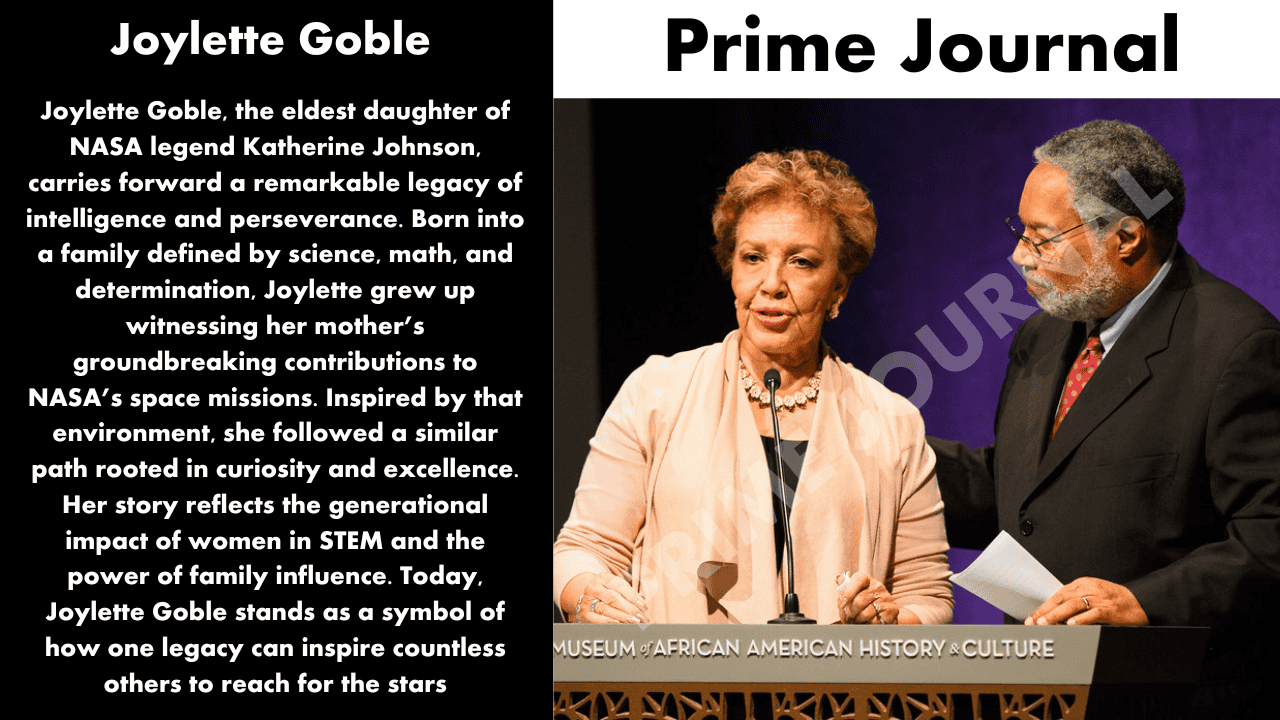
The name joylette goble may not yet be as widely known as her mother’s, but it represents a link in the chain of a trail-blazing family. Joylette is recognized as the eldest daughter of Katherine Johnson, who served at NASA as a mathematician whose calculations were critical for American space missions.
Joylette’s story is interesting for several reasons:
- She inherits a legacy of STEM excellence and breaking barriers.
- She grew up at a time of significant change in American science, civil rights and gender roles.
- Her life offers insights into how a “second generation” within a STEM pioneer family navigates career, identity and legacy.
In this article we’ll dig into the details of her upbringing, how her mother’s work influenced her, and what lessons readers (especially in STEM, education, women’s empowerment) can draw from her experience.
Early Life & Family Heritage
Family Background
Joylette Goble is the eldest daughter of Katherine Johnson and her first husband, James Goble, often called “Jimmie”. According to the Katherine Johnson Foundation, “Katherine and Jimmie had three daughters: Joylette, the eldest …”
Growing Up During the Space Race
Growing up in the 1950s/1960s United States, Joylette was exposed to a unique family environment: a mother working in a highly technical, male-dominated field (NASA) and societal currents of segregation, civil rights and changing opportunities for African-American women.
Influence of Her Mother’s Legacy
From the foundation biography:
- Strong mathematical environment (mother’s influence)
- Music and creative expression
- Awareness of racial and gender barriers through her mother’s story

Education & Career Path
Education
While the publicly available material on Joylette Goble is relatively limited, it is documented that she followed in her mother’s footsteps in the broad theme of STEM. For example, one blog says:
We can summarise likely steps:
- Secondary & tertiary education with a strong foundation in mathematics or engineering
- Influenced by her mother’s career at NASA
- Engagement in STEM or related technical field
Career & Professional Life
According to sources:
- Joylette worked as a mathematician at NASA (or at least started her career in a NASA-related mathematic capacity).
- As the eldest daughter, her professional outcomes were shaped by expectations, opportunities and the environment created by her mother.
Challenges & Unique Position
Being the child of a celebrated pioneer brings both privilege and pressure. Joylette’s position implies:
- Access to role models and networks (via her mother)
- The challenge of forming one’s identity apart from parental fame
- Possibly navigating STEM as a woman of colour, in an era still grappling with representation
Her Role and Achievements
Summary of Key Roles
Here’s a table summarizing known roles and achievements of Joylette Goble:
| Role | Description |
|---|---|
| Eldest daughter of Katherine Johnson | Family legacy in STEM and NASA history |
| Shared passions: music & mathematics | As noted by the Katherine Johnson Foundation |
| Worked at NASA (or in NASA mathematics) | Follows in mother’s footsteps |
| Advocate / role model | Implicit though less documented; her life speaks to generational impact |
Significance of Her Work
Though specific published papers or high‐profile recognitions for Joylette may be less documented publicly, her significance lies in:
- Demonstrating the continuing lineage of women in STEM across generations
- Serving as a real-world example of what happens when barriers are broken by one generation and the next builds upon it
- Being part of the broader story of the “hidden figures” and their families
Unique Perspectives She Brings
Joylette brings a perspective shaped by:
- Growing up with a pioneering mother (Katherine Johnson)
- Experiencing both the benefits and burdens of a legacy
- Bridging heritage (African-American, woman in STEM) with evolving opportunities
- Possibly integrating music and mathematics in her personal development

Impact and Legacy
Legacy within the Johnson Family
Katherine Johnson’s life is widely documented — for example via her Wikipedia entry.But the children of such a pioneer, such as Joylette, continue the line of influence. Joylette thus becomes part of the legacy:
- Inspiring younger generations of women and people of colour to enter STEM
- Reinforcing the idea that the first wave of barrier-breakers enable the second wave to walk in with a difference
- Representing how family heritage can shape pathway, mindset and service
Role Model for STEM & Education
In a time when representation matters more than ever, Joylette’s story contributes to the narrative:
- Women in mathematics and engineering
- African-American women in high-tech fields
- The importance of parental mentoring, environment and opportunity
Lessons for Education, Parenting & Career
From studying Joylette Goble’s background, we can extract lessons such as:
- Provide young people with strong mathematical foundations early
- Encourage passions (music + maths) for creative cognitive development
- Understand how role modelling, environment and legacy influence career choices
- Recognize the dual role: being part of a legacy and forging one’s own identity
Why Her Story Matters
Who Should Care
- Students (especially young women of colour) seeking STEM role models
- Educators aiming to show generational impact in STEM families
- Historians and fans of NASA and space history exploring the human side
- Families of pioneers who wonder about next-generation impact
What We Learn
- That progress in representation doesn’t end with one person; it continues through lineage
- That the influence of a trail-blazer (mother) carries forward through her children
- That identity, career and legacy intertwine in complex but fascinating ways
How This Helps with SEO & Content Strategy
If you’re writing about joylette goble, you benefit by:
- Linking to authoritative sources (NASA, Katherine Johnson Foundation)
- Covering not just the factual biography, but also the “why it matters” and “what we learn”
- Using content structure (headings, bullet points, tables) that supports readability and SEO
- Incorporating semantic keywords: women in STEM, NASA mathematicians, Katherine Johnson daughters, legacy of NASA families

FAQs
Who is Joylette Goble?
Joylette Goble is the eldest daughter of Katherine Johnson, the famed NASA mathematician. She grew up in a family deeply embedded in mathematics, music and space-science heritage, and went on to pursue a maths/technical path at NASA or associated work.
What exactly did Joylette Goble study or work on?
Although public documentation is more limited than for her mother, the Katherine Johnson Foundation notes that Joylette shared a passion for music and mathematics and worked in a NASA-mathematical capacity. The precise projects are less documented, reflecting perhaps the private or internal nature of her role.
How did her mother’s career influence her?
Significantly. Growing up while her mother worked in the early days of NASA, Joylette would have been exposed to:
- A culture of high expectations in mathematics
- The barriers her mother overcame (race, gender)
- A model of combining passion (music) and discipline (mathematics)
These influences likely shaped Joylette’s own path in STEM.
Why is Joylette’s story important today?
Because she represents the continuation of progress in STEM. Her story reminds us that:
- Breaking barriers is not a one-time event, but a generational process
- Legacy matters: the environment in which one grows influences career, mindset and opportunities
- Role modelling and representation matter for future talent
- Families behind famous figures also carry stories worth telling
Where can I find more information about Joylette Goble?
- The official website of the Katherine Johnson Foundation includes mention of her and her sisters.
- Biographical features about Katherine Johnson often mention Joylette as part of the family context.
- For deeper research, library archives or NASA oral histories may hold interviews or records of Katherine Johnson’s family where Joylette appears.
Conclusion
In reflecting on joylette goble, we see more than just the daughter of a celebrated mathematician — we see a bridge between a pioneering generation and the next, a life shaped by mathematics, music, opportunity and legacy. Her story underscores how family, education, role-modelling and environment combine to shape careers and identities.
If you’re inspired by this narrative:
- Consider exploring the full story of Katherine Johnson and her daughters (e.g., Joylette, Kathy, Connie) in more depth.
- For educators: share such stories with students to highlight generational pathways in STEM.
- For content creators: use Joylette’s story to build articles, videos or teaching material around “next generation of STEM families”.
- For readers: reflect on how our environments, families and role-models influence us — and how we might become role-models ourselves for the next generation.
If you’re working on a STEM outreach, mentorship programme or content about “Women in STEM” or “NASA history”, consider weaving in Joylette Goble’s story — link to reliable sources, include her as a case study, and help complete the picture of the space-science revolution not just through its primary figures but also through their families and legacies.