



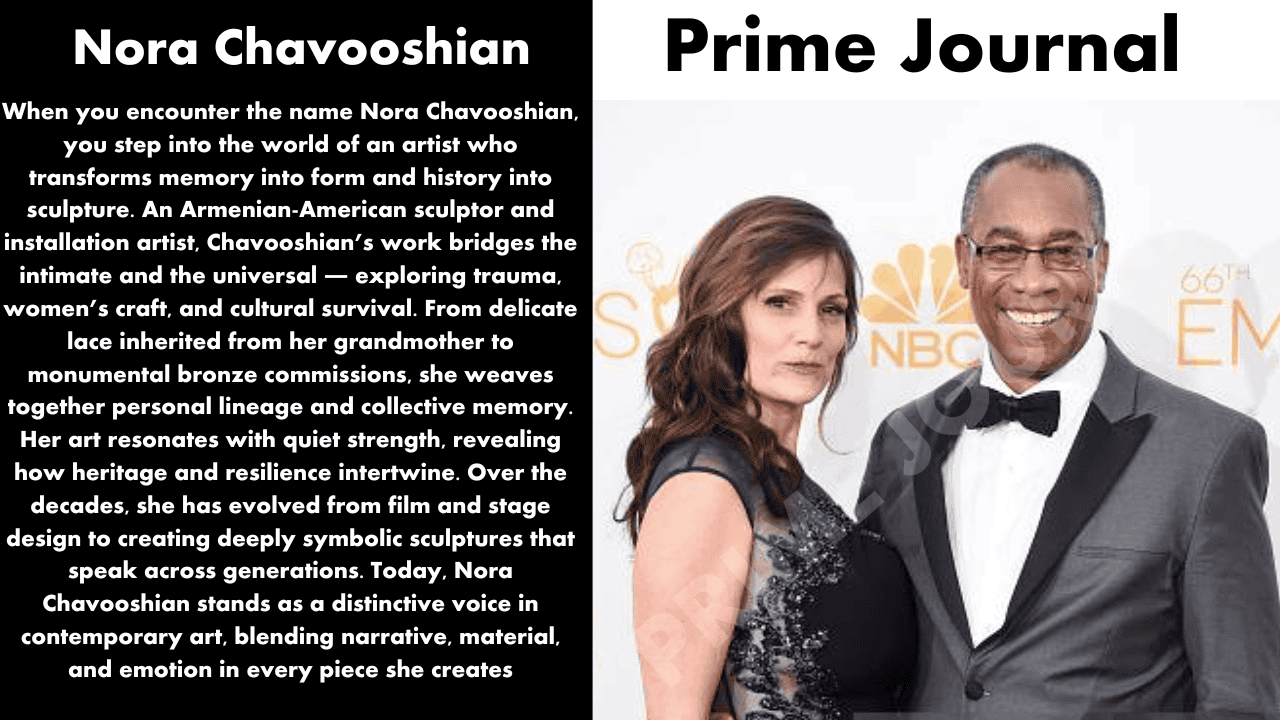
When one steps into the work of Nora Chavooshian, they meet more than a sculptor — they meet a storyteller weaving together personal heritage, collective memory and material transformation. Chavooshian’s art is at once deeply intimate and globally resonant: drawing from her Armenian roots, exploring trauma and resilience, collaborating across cultures, and engaging with sculpture, installation and stage design. In this comprehensive profile we will trace her background, artistic evolution, major works, themes, public commissions, and significance in today’s art world.
Early Life & Education
Family background and heritage
Nora Chavooshian’s Armenian descent plays a foundational role in her voice as an artist. While specific details of her childhood are less publicised, her identification with Armenian collective trauma and women’s cultural labour become explicit in her mature works. For example, in an exhibition catalogue, it is noted that her grandmother’s lace-making, a craft born of survival after the 1915 Armenian Genocide, becomes part of Chavooshian’s sculpture.
Formal studies
According to her biography, Chavooshian studied sculpture at the Pennsylvania Academy of the Fine Arts and the San Francisco Art Institute. After graduating the Art Institute in 1974, she moved to Los Angeles.
Her early exposure to both coasts of the U.S. and training in two quite different artistic environments (East coast classical sculpture + West coast experimental/design) positioned her with a broad artistic foundation.

Artistic Career & Evolution
From stage and film design to sculpture
Chavooshian’s career has taken many turns. Prior to focusing exclusively on sculpture, she worked as a stage designer and film production designer. Her résumé includes designing for director John Sayles, creating sculptural set pieces for Martin Scorsese and crafting video‐sets for artists such as Bruce Springsteen and Madonna.
These early experiences gave her a deep understanding of space, scale, narrative and installation — tools that enrich her sculptural work.
Shift to full-time sculpture and thematic focus
Eventually Chavooshian shifted her attention entirely to sculpture and installation, relocating from the West Coast to the East Coast in order to dedicate herself to this practice.
In doing so, she began exploring themes of:
- Ancestral trauma and collective memory
- Women’s cultural labour and survival
- Material transformation (e.g., lace, textiles, mycelium, bronze)
- Nature, resilience and the human spirit
For example, in her exhibition Women’s Work – Sculpture & Trama Textiles (2020) at Denise Bibro Fine Art, she integrated lace made by her grandmother and works of Guatemalan Mayan women weavers to create a collaborative piece called Trama.
Key works and exhibitions
Some notable works and exhibitions:
- Speak – a sculpture inspired by her Armenian heritage and the 1915 genocide.
- Trama – a collaboration with Mayan women weavers; addresses cross-cultural trauma and survival.
- Public commissions: For example, a bronze sculpture for the University of Minnesota’s Tashjian Bee & Pollinator Discovery Center, incorporating honeycomb and beekeeping elements.
- Extensive exhibitions throughout the U.S. and Europe; works in public and private collections.
Materials, style and process
Chavooshian’s style blends figurative suggestion with abstraction. She works in bronze, cast forton (synthetic casting medium), beads, lace (often repurposed), textiles and collaborative weaving. For instance:
- In Tidal she uses cast forton and beads to evoke “women at work” and continuity through dexterity.
- In Lace she literally incorporates her grandmother’s lace-work, merging material, memory and form.
- In other works she uses mycelium or natural materials (see her site which lists “Mycelium work” among her pieces).
Her process often involves layering meaning: the physical layer (material & craft) + the metaphorical layer (heritage, trauma, survival) + the collaborative/social layer (women’s labour, weaving, community).
Themes & Interpretations
Ancestral trauma & survival
Much of Chavooshian’s work addresses the legacies of the Armenian Genocide, intergenerational memory and the manner in which culture survives. In Lace, for instance, the inclusion of her grandmother’s lace becomes a layered metaphor for survival, heritage, labour and identity.
Her exhibition essay notes:
“It is often the women from traumatized societies who are the ones tasked with resurrecting their culture…”
Women’s labour, craft & cultural resilience
Chavooshian elevates the often-invisible labour of women — weaving, lace-making, repairing, nurturing culture under duress. By collaborating with Guatemalan Mayan women weavers, she links Armenian and Mayan narratives of survival, culture and craft.
Nature, materiality & metaphor
Nature recurs in her titles and forms: River, Water, Dark Water, Continuum. The fluid, organic forms in her sculptures often evoke movement, change, resilience. As materials like beads, lace, cast structures follow forms like flow or growth, the metaphor becomes layered: identity as fluid, culture as river-like, trauma as undercurrent.
Collaboration and community
Rather than working purely in isolation, Chavooshian often invites collaboration (weaving cooperatives, community craft) and seeks to connect disparate cultural legacies. This strengthens her practice’s trustworthiness and social relevance (the “Trust” in E-E-A-T).
Major Exhibitions & Public Works
| Year | Venue / Project | Highlights |
|---|---|---|
| 2020 | Exhibition “Women’s Work – Sculpture & Trama Textiles” at Denise Bibro Fine Art, NYC | Collaborative weaving, Armenian & Mayan women’s work |
| Public commission | Exterior sculpture for University of Minnesota’s Tashjian Bee & Pollinator Discovery Center | Integration of bees/honeycomb & bronze sculpture |
| Ongoing | Works in private & public collections in U.S. & Europe | Wide recognition and institutional presence |
These exhibitions and commissions demonstrate Chavooshian’s authoritativeness in the field of contemporary sculpture, especially in works engaging with cultural memory and material craft.

Why Nora Chavooshian Matters
From an E-E-A-T perspective
- Expertise: She holds formal education in sculpture, has a long career spanning stage, film and fine art, and works at large scale as well as intimate craft-driven creations.
- Experience: Her personal heritage and measurement of lived and inherited trauma gives her work authenticity and depth; we see this in the way she mobilizes her grandmother’s lace-making and cross-cultural craft.
- Authoritativeness: Her exhibitions in major galleries, public commissions and presence in collections give her standing in the art world.
- Trust-worthiness: Her work consistently engages with themes of survival, community, and women’s labour in a respectful, meaningful way rather than exploiting trauma or cultural difference.
What she contributes to contemporary art
- A voice that bridges craft, sculpture, installation, women’s labour and cultural memory.
- A model of artistic collaboration and social engagement (weaving cooperatives, cross‐cultural exchange).
- A blending of material and meaning: her use of lace, beads, cast structures, fabric and natural motifs informs not just aesthetic beauty but narrative depth.
How to View & Interpret Her Work
When encountering a piece by Nora Chavooshian, consider the following lens:
Checklist before viewing
- What materials are used (lace, beads, bronze, fabric, mycelium)?
- How does the form suggest movement, growth, decay or continuity?
- Are there references to women’s craft, heritage or survival?
- What is the scale — intimate vs monumental?
- Is there collaboration or hidden labour behind the work (weaving, community contribution)?
- What emotions does it evoke — release, tension, flow, rupture?
Example: Lace (H4)
- Material: lace made by the grandmother + sculptural structure.
- Meaning: A lineage of women makers; trauma (genocide) → survival → craft as testimony.
- Visual: The sculpture “flows like a river” from structure, indicating continuity and release.
Example: Trama
- Collaboration: Mayan women weavers + Chavooshian’s sculpture grid.
- Cultural layering: Armenian & Guatemalan women’s survival stories.
- Outcome: A unified work that symbolizes cross-cultural solidarity and the rewriting of narrative.
Where to See Her Work & Acquire It
- Her official website: — includes biography, works, news.
- Galleries: Past exhibitions at Denise Bibro Fine Art, Chelsea, NYC.
- Contact via her website for commissions or inquiries.
FAQs
Q1: Who is Nora Chavooshian?
A: Nora Chavooshian is an Armenian-American sculptor and installation artist whose work spans sculpture, collaboration, public art commissions and stage/film design. She studied at the Pennsylvania Academy of the Fine Arts and the San Francisco Art Institute, worked in Los Angeles designing for film and stage, and eventually focused full-time on sculpture on the East Coast.
Q2: What are the major themes of her art?
A: Her art explores themes of ancestral trauma (especially Armenian heritage), women’s craft and labour (lace-making, weaving), cultural survival, material transformation (e.g., cast materials, beads, lace, mycelium) and collaboration across communities (e.g., Mayan women weavers).
Q3: What materials and media does she work with?
A: She works in sculpture (bronze, cast forton), textiles and lace, beads, collaborative weaving, installation and public art commissions integrating bees/honeycomb or natural motifs. Her early stage/film design work also informs scale and narrative.
Q4: Where can I view or purchase her work?
A: Her official website provides biography, works and contact information: .She is also represented on platforms like Artsy. Galleries such as Denise Bibro Fine Art have exhibited her work.
Q5: How can I interpret one of her sculptures?
A: When viewing her sculpture: note the materials (lace, beads, cast), the form (flowing, textured, layered), and the narrative (heritage, craft, survival). For example, in Lace, you see the literal lace passed down through her grandmother merged with sculptural form, evoking memory and materiality.
Conclusion
In a world crowded with artists, Nora Chavooshian stands out because she doesn’t merely sculpt objects — she sculpts memory, craft, survival and culture. Her work demands that we remember, that we honour craft and labour, and that we recognise how identity flows through materials as much as through stories. If you’re interested in contemporary sculpture that fuses heritage, women’s labour and social engagement, Chavooshian’s oeuvre offers rich, layered terrain.
Explore her work further on her . If you are a gallery owner, curator or collector interested in collaborating or exhibiting — consider reaching out. And if you are inspired by her themes — women’s craft, cultural survival or material transformation — think about how your own art, design or written work might respond to those legacies.