



How Everyday Tissue Products Connect to Forests
Most of us do not think much about where our toilet paper or kitchen towels come from. They feel like basic household essentials that appear on supermarket shelves without question. Yet behind these everyday items sits a complicated chain involving forests, supply disruption, climate pressures, and shifting consumer behaviour.
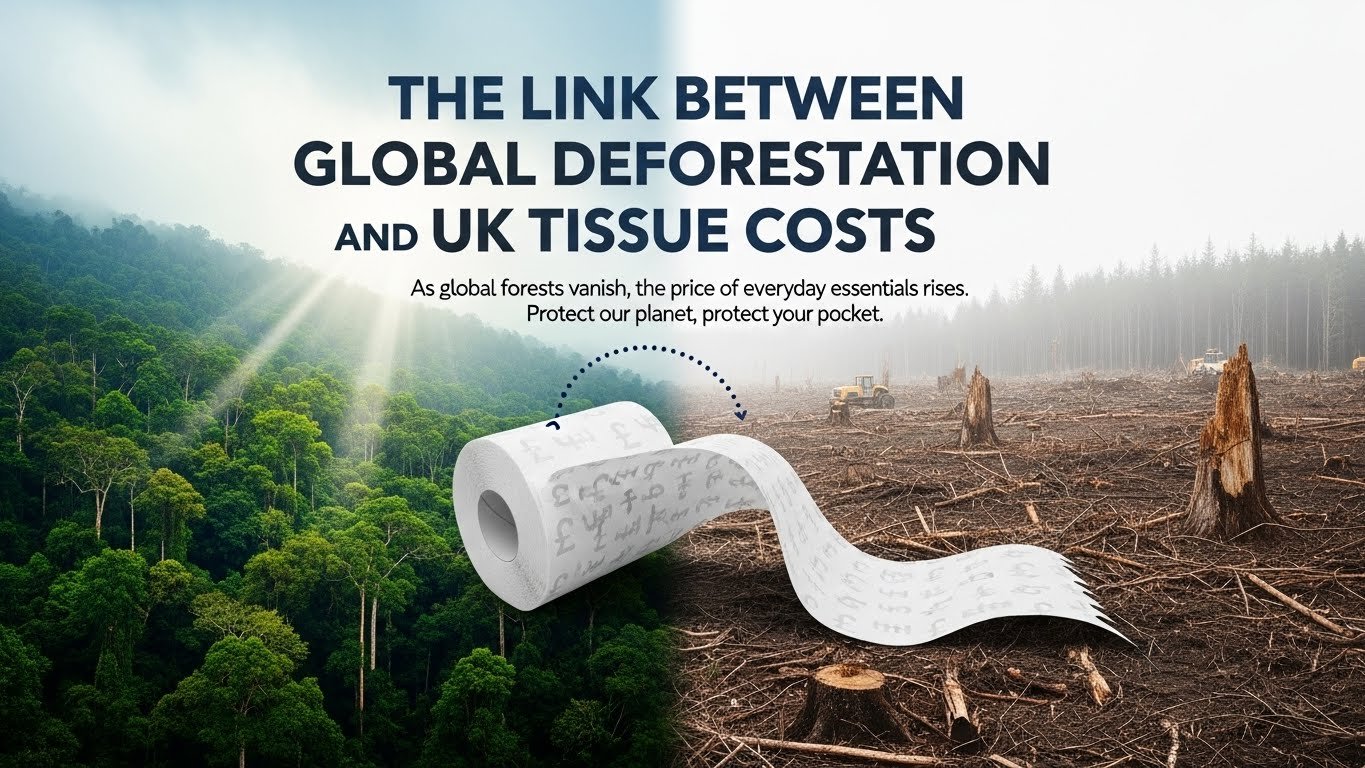
Over the last decade, the relationship between forest loss around the world and the cost of tissue products in Britain has become impossible to ignore. This is where the Link Between Global Deforestation and UK Tissue Costs becomes important for both consumers and policymakers.
From Forests to Factories: The Real Tissue Supply Chain
To understand this connection properly we need to trace the journey from trees to tissues. Traditional paper based tissues rely on virgin pulp taken from forests in regions such as South America, Southeast Asia, and parts of Eastern Europe. As demand grows for pulp based products, so does the pressure on forests.
Deforestation has a long list of consequences, including the loss of biodiversity, soil erosion, and the acceleration of carbon emissions. However, one overlooked outcome is economic volatility. When forests are cleared at a rapid pace, the availability of pulp becomes more vulnerable to political restrictions, environmental regulations, fines, and shifting trade agreements. These risks eventually translate into higher production costs and supply chain disruptions that affect British shelves and British wallets.
Why British Consumers Feel the Price Impact
Over recent years, British consumers have become particularly sensitive to price changes in essential goods due to broader cost of living pressures. Tissue products such as toilet paper, facial tissues, and kitchen towels are among the few items households cannot easily substitute or reduce.
This creates a unique tension between supply and demand. When supply chains tighten due to environmental factors, manufacturers pass their increases to retailers, and retailers pass them to consumers. Here is where the Link Between Global Deforestation and UK Tissue Costs becomes visible in real life rather than just academic debate.
Climate Policy and the Cost Chain
Climate policy also plays a role in pushing tissue prices upward. International agreements aimed at protecting forests may introduce sustainable certification requirements or restrictions on illegal logging. While positive for the planet, such requirements raise production costs in the short term.
Meanwhile, climate related disruptions such as floods or droughts affect both forest health and transportation routes, which again influences final pricing. For the UK, a country that imports much of its paper based material, these costs stack up quickly along the supply chain.
Ethical Pressures and Brand Behaviour
On top of these environmental and policy pressures is the issue of ethics. British consumers are increasingly concerned about the origins of the products they buy. Recent surveys suggest that families with young children are particularly motivated by sustainability messaging. This consumer shift places further pressure on brands that rely heavily on virgin pulp.
Companies must decide whether to invest in sustainable alternatives or risk reputational damage. The transition period is expensive because manufacturers need to retool factories, secure alternative fibres, validate new suppliers, and complete safety testing for products that touch the skin. The result again feeds into retail pricing.
Alternatives That Reduce Forest Pressure
This situation has created an opportunity for alternative fibres to enter the market. Materials like bamboo, sugarcane bagasse, and recycled pulp offer pathways that reduce the dependence on deforestation heavy supply chains. Bamboo has drawn particular attention because of its fast growth cycle and lower land footprint. It can be harvested without uprooting the plant and regenerates rapidly, which avoids many deforestation issues seen in hardwood pulp production.
Products like Bamboo toilet rolls allow UK consumers to make choices that align better with environmental responsibility. While not perfect, these alternatives show how innovation can ease the Link Between Global Deforestation and UK Tissue Costs by reducing the pressure on vulnerable forests.
Global Trade, Regulation and Supply Instability
Beyond sustainability claims, there is also a geopolitical angle. Major pulp producing nations often treat timber as a strategic commodity. As tensions shift, trade agreements are renegotiated, and tariffs introduced, British importers face more uncertainty.
Environmental activists sometimes celebrate stricter forestry controls, whereas manufacturers argue these controls reduce pulp availability. Meanwhile, global NGOs demand harsher crackdowns on illegal logging. All these forces influence the broader economics of tissue production and create the pricing dynamics seen on British supermarket shelves.
Why Tissue Prices Rise Faster Than Other Essentials
Consumers often ask why tissue products rise in price faster than other household essentials. The answer lies partly in the fragility of pulp supply chains. Unlike bulk foods or manufactured goods, pulp cannot be stored for extremely long periods without degrading. This means producers cannot fully buffer against shocks.
When deforestation creates long term scarcity or regulation limits logging, manufacturers feel the impact immediately. These immediate impacts contribute to the Link Between Global Deforestation and UK Tissue Costs that sustainability advocates have been highlighting for years.
The Role of Transport and Climate Disruption
We should also consider the impact of transport. Large volumes of pulp or finished rolls must be shipped across oceans. Rising fuel prices, weather disruptions, and emissions legislation all add friction costs. The UK’s reliance on imports makes these frictions more relevant than in countries that have domestic forestry infrastructure.
With climate change increasing the frequency of shipping disruptions, prices face additional upward pressure. This compounds the influence of deforestation in producer countries and illustrates why sustainable alternatives are now viewed as a hedge against global instability.
Consumer Behaviour and Eco Friendly Demand
Of course, sustainability does not automatically mean cheaper. Eco friendly alternatives often launch at a higher price point because supply chains are still developing and not yet optimised. However, as demand grows and production scales, these products typically become more affordable. Households choosing options like bamboo kitchen rolls may therefore help accelerate that scaling process, making sustainable options more accessible for everyone in the future.
This consumer driven pressure encourages brands to diversify away from deforestation linked sourcing, which ultimately eases the Link Between Global Deforestation and UK Tissue Costs by breaking the dependence cycle between pulp scarcity and retail pricing.
Cultural Shifts Behind Sustainable Choices
There is also a cultural and behavioural aspect. For decades, British consumers saw tissues as disposable commodities without much ethical consideration. Today, people care more about purpose driven purchases. Even small shifts matter. If a fraction of households switch to eco fibre products, the macro level impact on forests could be significant.
Less demand for virgin pulp means slower rates of clearing in sensitive areas, more room for biodiversity to recover, and fewer emissions from lost forests. These environmental gains indirectly help stabilise global supply and reduce cost volatility for all consumers, even those who are not actively buying eco products.
Innovation, Investment and the Future of Tissue
Finally, we should address the role of innovation. Scientists and manufacturers are experimenting with new fibres and blends to improve performance, softness, and absorbency. Recycled paper has improved significantly over the last decade and bamboo tissue products keep getting better. Research into fast growing regenerative materials looks promising for consumer goods.
Investment in these areas is driven by market demand. When shoppers support alternatives, investors see financial value in scaling sustainable fibres and reducing forest pressure. Over time, this should weaken the Link Between Global Deforestation and UK Tissue Costs and create a more resilient supply system grounded in renewable materials rather than forest extraction.
A More Resilient and Sustainable Tissue Market
The shift will take time and will not happen instantly. Transitioning away from deforestation heavy pulp towards cleaner fibre systems requires cooperation among governments, brands, scientists, and consumers. However, the direction is clear. Environmental concerns are intersecting with household economics in a tangible way. As the UK becomes more environmentally conscious, tissue shelves will evolve. The brands that succeed will be those who adapt early rather than resist.