



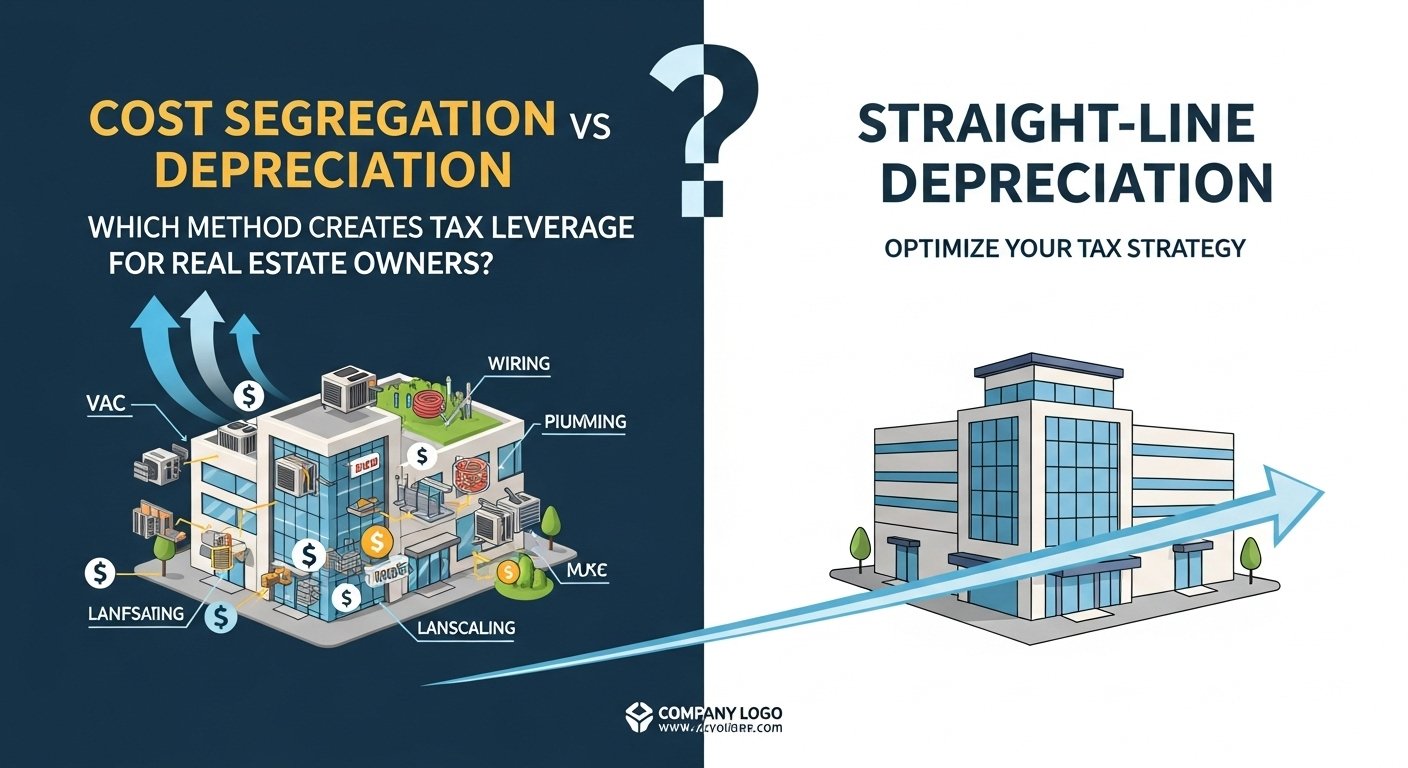
Real estate depreciation is one of the most powerful, misunderstood tax advantages available to property owners. But the way you claim depreciation can dramatically change the timing of deductions, and therefore your near-term cash flow. In the debate of cost segregation or straight-line depreciation, the core difference is simple: straight-line spreads deductions evenly over decades, while cost segregation accelerates a portion of those deductions into earlier years by reclassifying certain components into shorter-lived asset categories.
For many investors, that acceleration can be the difference between a property that is merely profitable on paper and one that produces meaningful, after-tax cash flow today. That said, not every property benefits equally, and the decision should be made with clear goals, solid documentation, and a method aligned with IRS rules.
If you are evaluating cost segregation or straight-line depreciation and want clarity on whether the numbers justify the effort, a professional provider such as Cost Segregation Guys can help you assess eligibility, estimate savings, and determine the most practical approach based on property type, purchase price, renovation history, and tax profile. In particular, owners exploring a Cost Segregation Study for Residential Rental Property often find that the right analysis can unlock significant first-year deductions while staying compliant.
Understanding Straight-Line Depreciation in Real Estate
Straight-line depreciation is the standard, default depreciation method for most real estate owners. It spreads the cost basis of a building (excluding land) evenly across a fixed recovery period under MACRS.
Typical recovery periods
- Residential rental property: 27.5 years
- Commercial property: 39 years
What it does well
Straight-line depreciation is:
- Simple: fewer moving parts and less documentation burden
- Predictable: consistent annual deductions
- Low-maintenance: typically handled easily during routine tax prep
Where it falls short
In practice, straight-line depreciation can feel slow, especially for investors who:
- Need higher deductions early due to high-income years
- Want to offset passive income from multiple properties
- Are you renovating or improving properties, and do you want faster recovery?
- Are trying to increase after-tax cash flow during the first years of ownership
This is where the comparison of cost segregation vs straight-line depreciation becomes more than a technical choice; it becomes a strategic one.
What Cost Segregation Changes (and Why It Matters)
Cost segregation is not a different “depreciation system,” but a method of allocating components of a building into shorter-lived categories. Instead of treating the entire building as a 27.5-year or 39-year asset, a cost segregation study identifies parts of the property that qualify as:
- 5-year property (many personal property components)
- 7-year property (certain equipment)
- 15-year property (land improvements)
- The remaining building still depreciates at 27.5 or 39 years
The practical effect
You still depreciate the property, but you move a portion of the deductions forward, often generating much larger depreciation deductions in the early years.
When investors evaluate cost segregation vs straight-line depreciation, the main question is usually not “Which is legal?” (both are, when done correctly), but “Is the acceleration worth it for my tax and cash-flow goals?”
The IRS Logic Behind Cost Segregation
The IRS allows different recovery periods for different asset classes. Cost segregation applies engineering-based and tax-based analysis to properly classify items that are not truly “structural building components.”
Examples that frequently fall into shorter-lived categories include:
- Specialty lighting tied to business use or certain areas
- Removable floor coverings and finishes
- Millwork, cabinetry, and certain non-structural elements
- Site improvements: parking lots, landscaping, fencing, sidewalks, exterior lighting
A compliant study typically relies on:
- Construction drawings, invoices, and cost documentation
- Site inspection (when applicable)
- Engineering-based methodology to support classifications
This documentation layer is what separates a professional study from a rough estimate.
If you want a structured way to evaluate cost segregation vs straight-line depreciation without guessing, Cost Segregation Guys can help you run an initial feasibility review. The goal is to determine whether the expected tax savings and cash-flow impact justify the study cost, given your property details and tax posture.
Cost Segregation vs Straight-Line Depreciation: Side-by-Side Comparison
1) Timing of deductions
- Straight-line: Even deductions over 27.5 or 39 years
- Cost segregation: Larger early-year deductions by accelerating portions to 5/7/15-year schedules
2) Cash flow impact
- Straight-line: Lower near-term deduction value
- Cost segregation: Often higher near-term tax savings, improving after-tax cash flow
3) Complexity and compliance
- Straight-line: minimal documentation beyond normal tax records
- Cost segregation: requires analysis, classification support, and defensible reporting
4) Best use cases
- Straight-line: smaller properties, low-income years, limited tax appetite
- Cost segregation: larger acquisitions, renovations, high-income years, active portfolio growth
This is why cost segregation vs straight-line depreciation is best evaluated as a financial strategy, not just an accounting preference.
Where Bonus Depreciation Fits Into the Equation
Cost segregation becomes even more powerful when bonus depreciation is available, because many assets reclassified into shorter lives may qualify for accelerated first-year depreciation (depending on current law and eligibility).
In simplified terms:
- Straight-line depreciation generally cannot produce large first-year deductions.
- Cost segregation may produce large first-year deductions because it creates more short-life assets eligible for faster write-offs.
Because bonus depreciation rules have changed over time and can be updated by new legislation, this component should be reviewed based on the current tax year and your filing profile. The key point remains: when comparing cost segregation vs straight-line depreciation, cost segregation often creates more flexibility in how quickly deductions are realized.
Common Property Types That Benefit From Cost Segregation
While every property is different, cost segregation is often most compelling for:
- Newly acquired multifamily buildings
- Renovated residential rentals and value-add projects
- Medical, retail, office, and industrial properties
- Short-term rental properties with substantial improvements
- Properties with significant site work (parking, lighting, landscaping, paving)
A rough rule of thumb (not a guarantee) is that the bigger the depreciable basis and the more improvements involved, the more likely cost segregation produces meaningful acceleration.
The Midpoint Decision: Is a Study Worth It?
At the decision stage, you should examine:
- Depreciable basis (purchase price minus land value)
- Your income profile (do you have enough income to benefit?)
- Holding period (longer hold often means more value from acceleration)
- Renovations/improvements (often increase reclassifiable components)
- Audit readiness (documentation quality matters)
For investors who are also considering whether cost segregation applies beyond traditional rentals, it can be useful to understand how a Cost Segregation on Primary Residence may be relevant in limited situations where portions of a home have legitimate business or rental use, though eligibility depends heavily on facts, usage, and substantiation.
What a Cost Segregation Study Typically Includes
A quality study usually provides:
- Asset breakdown by category (5/7/15/27.5/39-year)
- Methodology narrative (engineering-based approach)
- Supporting schedules and documentation
- Files prepared to integrate with tax returns and depreciation schedules
The objective is not just a “bigger deduction,” but a defensible allocation consistent with tax guidance and industry standards.
Potential Downsides and Misconceptions
A fair comparison of cost segregation or straight-line depreciation should include the trade-offs.
Upfront cost
A professional study costs money. The question is whether projected tax savings exceed that cost by a strong margin.
Documentation burden
If challenged, you want defensible classifications and support. Cheap or undocumented work can create risk.
Not always ideal for low-income years
If you cannot use the deductions now, acceleration may not provide immediate value (though carryforwards may apply depending on your circumstances).
“It’s only for commercial buildings.”
Not true. Residential rentals can benefit, which is why a Cost Segregation Study for Residential Rental Property is a common use case in investor portfolios.
Strategic Scenarios: When Each Method Makes Sense
A straight line can be preferable when:
- The property is relatively small or has limited reclassifiable components
- You have a low taxable income and do not need acceleration
- You prioritize simplicity and minimal compliance overhead
- You anticipate selling quickly and do not value front-loaded deductions
Cost segregation often wins when:
- You are in a high tax bracket and want near-term savings
- You’re scaling a portfolio and want to preserve cash
- You’ve completed renovations or acquired a value-add property
- You want to optimize deductions while maintaining compliance
This is why the decision of cost segregation or straight-line depreciation should be tied to your specific tax strategy and investment horizon.
How the Choice Impacts Long-Term Planning
Even though cost segregation accelerates deductions, it does not “create” deductions out of thin air. It mostly changes timing. That timing, however, has real value because:
- Money saved today can be reinvested
- Cash flow improves during the most capital-intensive years of ownership
- Investors can potentially fund renovations, down payments, or debt paydown faster
In many portfolios, the compounding effect of reinvested tax savings is the real advantage, not just the initial deduction spike.
Practical Next Steps for Property Owners
If you are deciding between cost segregation or straight-line depreciation, consider this structured approach:
- Confirm your depreciable basis (purchase price less land)
- Review improvement history (rehab budgets, invoices, major replacements)
- Evaluate your tax appetite (income level, passive vs active status considerations)
- Estimate holding period (short hold vs long hold changes the payoff profile)
- Request a feasibility estimate from a qualified provider
A feasibility review is often the most efficient way to avoid overpaying for a study that will not produce meaningful savings.
Conclusion
In the end, cost segregation vs straight-line depreciation is less about which method is “better” in a vacuum and more about what you are trying to accomplish. Straight-line depreciation is dependable and simple, but slow. Cost segregation can generate significantly larger early deductions, improve after-tax cash flow, and create more flexibility, especially for investors with higher income or portfolio growth objectives.
If you want to decide with confidence, the most practical path is to have your property reviewed by specialists who can quantify the impact and prepare a defensible allocation. Cost Segregation Guys can support that process, from feasibility review to full study, so you can determine whether accelerated depreciation is a strategic fit for your property and tax situation.