




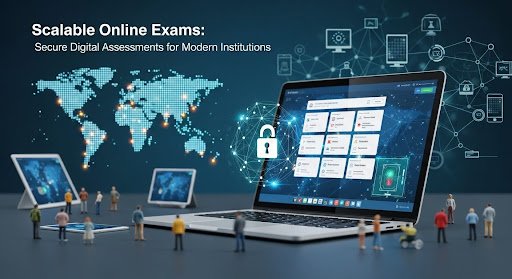
As education and professional certification continue to shift online, organizations are under pressure to deliver exams that are not only accessible but also reliable at scale. Universities, training institutes, and corporate learning platforms are now serving thousands—sometimes millions—of candidates simultaneously. To meet this demand, scalable online exams have become a core component of modern digital assessment strategies.
In large-scale digital environments, maintaining exam integrity, performance stability, and user trust is critical. Many institutions now rely on advanced assessment systems that integrate automation, monitoring, and analytics. Services that help them in online exam management play an important role in ensuring assessments remain secure, fair, and efficient even as candidate volumes increase.
What Makes an Online Exam Truly Scalable?
Scalability in online exams goes far beyond handling high traffic. A truly scalable system must adapt dynamically to fluctuating user loads while maintaining consistent performance. This includes server reliability, automated question delivery, real-time monitoring, and instant result processing.
Equally important is flexibility. Scalable platforms allow institutions to conduct exams across different time zones, formats, and devices without compromising quality. Cloud-based infrastructure and modular assessment frameworks are often the foundation of such systems.
Security Challenges in Large-Scale Digital Assessments
As online exams scale, security risks also increase. Threats such as impersonation, content leaks, and coordinated cheating attempts become more difficult to manage manually. This is where technology-driven controls are essential.
AI-based proctoring, identity verification, and behavior analysis help institutions detect irregularities without invasive oversight. Scalable security solutions ensure that integrity is maintained consistently—whether 100 or 100,000 candidates are participating.
The Role of Automation and AI
Automation is a key driver of scalability. From question randomization to auto-grading and reporting, automated workflows reduce human error and operational overhead. AI further enhances these systems by identifying suspicious patterns and optimizing exam delivery in real time.
These technologies allow institutions to focus on learning outcomes rather than logistical constraints, making digital assessments more sustainable as they grow.
Business and Institutional Benefits
For educational institutions and training providers, scalable online exams reduce operational costs, expand reach, and improve turnaround times. Businesses conducting certifications or internal evaluations benefit from standardized assessments that can be deployed globally without infrastructure bottlenecks.
Scalability also supports data-driven decision-making. Performance analytics gathered from large exam datasets help organizations refine curricula, improve exam quality, and align assessments with real-world skills.
The Future of Scalable Online Exams
As digital education continues to expand, scalable assessment systems will become a baseline requirement rather than a competitive advantage. Institutions that invest early in secure, flexible exam infrastructures will be better positioned to adapt to evolving learner expectations and regulatory requirements.
By combining technology, integrity-focused design, and user-centered delivery, service-based platforms like Scholarly Help support institutions in managing online exams efficiently while preserving trust and credibility at scale.
FAQs
1. What are scalable online exams?
Scalable online exams are digital assessments designed to handle large numbers of candidates simultaneously without performance or security issues.
2. Why is scalability important in online assessments?
It ensures consistent exam delivery, reduces technical failures, and supports institutional growth.
3. How do institutions maintain integrity at scale?
Through AI proctoring, identity verification, automated monitoring, and clear assessment policies.
4. Are scalable online exams cost-effective?
Yes, they reduce administrative workload, physical infrastructure costs, and manual grading efforts.
5. Can scalable exams support different exam formats?
Modern systems support MCQs, essays, coding tests, case studies, and adaptive assessments.