




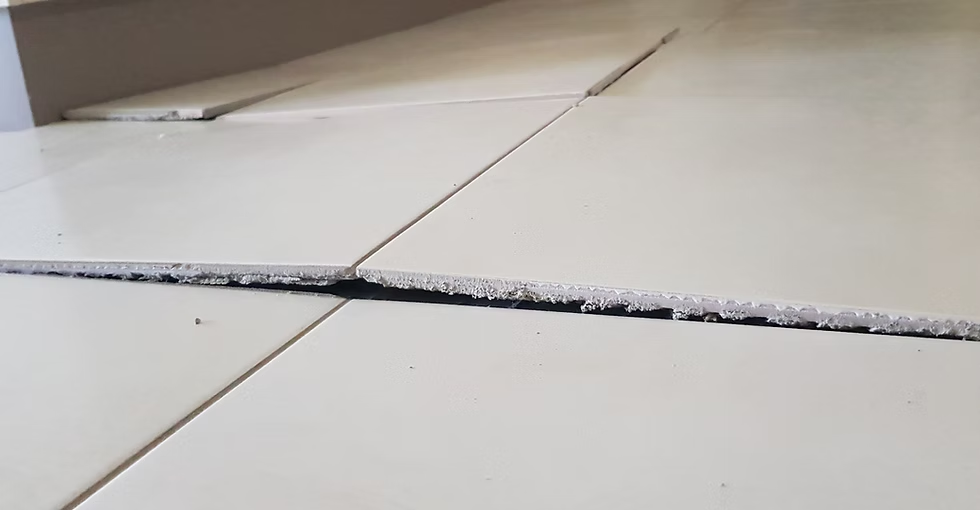
You have just finished a beautiful bathroom renovation. The porcelain looks pristine, the grout lines are sharp, and the room smells like fresh construction. But a week later, you drop a coin on the floor, and instead of a solid, metallic click, you hear a dull, echoing thud.
Curious, you tap on the surrounding tiles with your knuckle. Solid. Solid. Solid. Hollow.
That hollow sound is the ghost in the machine of modern tiling. It is a distress signal from beneath the surface, indicating that your floor is living on borrowed time. While the tile looks attached, it isn’t fully supported. This phenomenon is usually caused by a pervasive, lazy installation habit known as “spot bonding,” and it is the single most common reason for catastrophic tile failure within the first two years of a renovation.
The Physics of the “Bond“
To understand why the hollow sound is dangerous, we have to look at what holds a tile down. It isn’t glue; it’s mortar—a mixture of cement, sand, and water.
Mortar serves two distinct purposes:
- Adhesion: Sticking the tile to the floor so it doesn’t move.
- Support: Filling the gap between the tile and the subfloor to distribute weight.
A tile is a ceramic plate. It has incredible compressive strength (you can park a car on it), but very poor tensile strength (it snaps easily if you bend it). If a tile is fully supported by a solid bed of mortar, it becomes part of the floor. You could drop a bowling ball on it, and the energy would transfer harmlessly into the concrete slab below.
However, if there are air pockets or voids underneath the tile, the tile becomes a bridge. When you step on that hollow spot—especially with a point load like a high heel or a heavy table leg—the tile flexes into the void. Since ceramic cannot flex, it cracks.
The “Spot Bonding” Epidemic
So, where do these voids come from? They are rarely accidental. They are usually the result of “spot bonding.”
In this incorrect technique, an installer puts a blob of mortar on each of the four corners of the tile (and maybe one in the middle) and presses it down. It is fast, easy, and uses less mortar. The tile sticks immediately. It looks level. To the untrained eye, it’s a perfect job.
But underneath, there is only 20% or 30% coverage. The rest is empty air.
Proper installation requires “directional troweling.” The installer must comb the mortar onto the floor in straight, parallel ridges. Then, they must “back-butter” (apply a thin layer of mortar to) the back of the tile. When the tile is pressed down and shifted slightly, the ridges collapse into the valleys, creating a solid, void-free bed with 95% to 100% coverage.
The Moisture Trap
The hollow sound signals more than just a structural weakness; it also signals a hygiene hazard.
In wet areas like bathrooms or kitchens, water eventually finds its way through the grout (which is porous) or small cracks. If your floor is solid mortar, the water stays near the surface and evaporates.
If your floor has voids from spot bonding, those empty spaces become reservoirs. Water seeps in and pools in the dark cavities underneath your floor. It can’t evaporate easily. This stagnant water becomes a breeding ground for mold and bacteria, causing musty odors that you can’t clean away because they are coming from under the floor.
In freezing climates, this trapped water is even deadlier. If it freezes, it expands, literally pushing the tile up off the floor and causing it to “tent” or detach completely.
The Diagnostic Tap
If you are concerned about your current floors, you don’t need X-ray vision. You just need a golf ball or the handle of a screwdriver.
Gently tap the center and corners of various tiles. You are listening for a change in pitch. A high-pitched ping generally indicates a solid bond. A low-pitched, wooden thok indicates a void.
Finding one or two small hollow spots in the corner of a room might not be a disaster. But if you find “hollows” in high-traffic areas—in front of the sink, the toilet, or the entryway—you are looking at a ticking clock. It is not a matter of if the tile will crack, but when.
Conclusion
The beauty of a tiled floor is skin deep, but its longevity depends entirely on what lies beneath. The difference between a floor that lasts 50 years and one that cracks in 5 months is often invisible during the final walkthrough. It lies in the unseen layer of mortar and the technique used to apply it.
Avoiding the “hollow sound” requires hiring professionals who understand the science of adhesion and refuse to cut corners with spot bonding. Skilled ceramic tile installers know that their job isn’t just to stick rectangles to a floor, but to create a monolithic surface capable of withstanding the weight, water, and wear of daily life. When it comes to tile, silence really is golden—or at least, a solid, non-hollow sound is.