


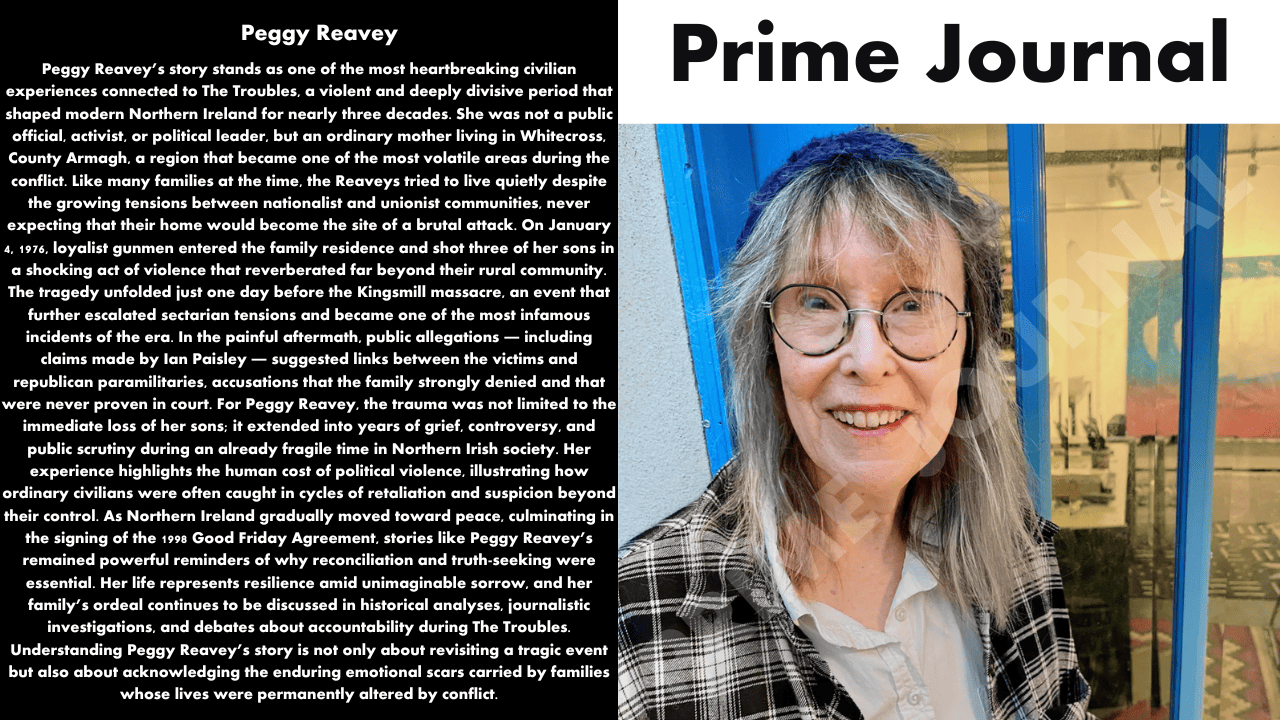
The name Peggy Reavey is deeply connected to one of the most painful chapters in modern Irish history. While she is not a celebrity in the traditional sense, her life became tragically intertwined with the violent events of the Northern Ireland conflict known as The Troubles. The story of Peggy Reavey is one of resilience, family devotion, loss, and historical significance.
To understand Peggy Reavey’s place in history, we must also understand the broader context of The Troubles, a violent ethno-nationalist conflict that lasted roughly from the late 1960s until the signing of the Good Friday Agreement in 1998. Her family, the Reaveys of Whitecross, County Armagh, became victims of a brutal attack that remains one of the most controversial and discussed incidents of that era.
In this in-depth, SEO-optimized article, we’ll explore:
- Who Peggy Reavey was
- The Reavey family background
- The 1976 attack on the Reavey family
- Allegations and investigations
- The wider historical context
- Legacy and remembrance
- Frequently asked questions
Who Was Peggy Reavey?
Peggy Reavey was a member of the Reavey family from Whitecross, County Armagh, in Northern Ireland. She was the mother in a family that suffered a devastating attack during one of the most violent periods of The Troubles.
While public records about Peggy Reavey herself are limited compared to political figures or paramilitary actors, her story survives through:
- Family testimonies
- Journalistic investigations
- Historical research
- Public records of The Troubles
Her life became historically significant because of the attack on her sons in January 1976 — a tragic event that profoundly affected her family and became part of Northern Ireland’s complex conflict narrative.
Historical Context: The Troubles in Northern Ireland
To understand Peggy Reavey’s story, we must briefly examine The Troubles.
What Were The Troubles?
The Troubles refers to a period of violent conflict in Northern Ireland from the late 1960s to 1998. The conflict primarily involved:
- Irish nationalists/republicans (mostly Catholic)
- British unionists/loyalists (mostly Protestant)
- British security forces
Key paramilitary organizations included:
- Irish Republican Army (IRA)
- Ulster Volunteer Force (UVF)
- Ulster Defence Association (UDA)
County Armagh, where Peggy Reavey lived, was one of the most volatile regions during this period.
For broader historical context, see:
- BBC History – The Troubles
- Wikipedia: The Troubles
- CAIN (Conflict Archive on the Internet) at Ulster University
The Reavey Family Background
The Reavey family lived in Whitecross, County Armagh, a rural area heavily impacted by sectarian violence during the 1970s.
Family Overview
| Family Member | Role | Outcome |
|---|---|---|
| John Martin Reavey | Son | Shot and killed (1976) |
| Brian Reavey | Son | Shot and killed (1976) |
| Anthony Reavey | Son | Shot, later died from injuries |
| Peggy Reavey | Mother | Survived |
| Eugene Reavey | Brother | Later public advocate |
The Reaveys were a Catholic family living in a predominantly contested region.
The 1976 Reavey Family Attack
On January 4, 1976, gunmen entered the Reavey home.
What Happened?
Three brothers — John Martin, Brian, and Anthony — were shot by loyalist gunmen believed to be linked to the Ulster Volunteer Force.
- John Martin and Brian died from their injuries.
- Anthony survived initially but later died from complications.
The attack was widely viewed as sectarian in nature.
The Kingsmill Connection
The following day, January 5, 1976, the Kingsmill massacre occurred, in which ten Protestant workers were killed by republican gunmen.
Some reports have suggested the Kingsmill massacre was a retaliatory attack for the Reavey killings. This linkage remains part of historical debate.
Allegations and Controversies
The Reavey case later became controversial due to public allegations made by:
Ian Paisley
Paisley alleged that the Reavey brothers were connected to the IRA — claims that were strongly denied by the family.
Subsequent investigations and reports did not substantiate those allegations.
Official Investigations
The Police Ombudsman for Northern Ireland reviewed aspects of historical collusion during The Troubles. Some findings in broader cases suggested:
- Possible security force collusion with loyalist paramilitaries
- Intelligence failures
- Mishandling of information
However, specific claims about the Reavey family’s alleged IRA involvement were widely rejected by relatives and not proven in court.
For more information:
- Police Ombudsman for Northern Ireland official site
- BBC News archives
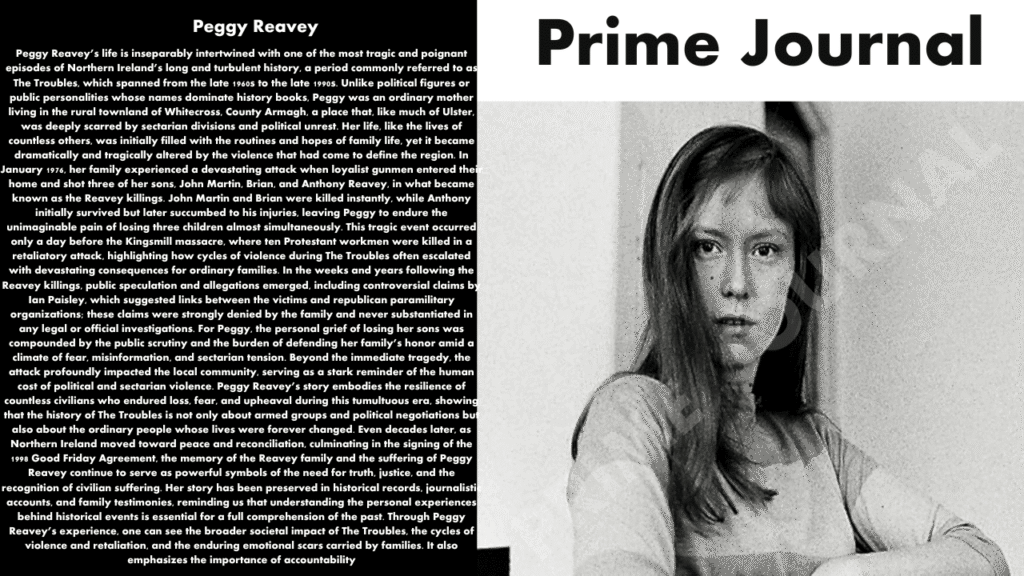
Peggy Reavey’s Life After the Tragedy
Losing three sons under such violent circumstances is unimaginable. Peggy Reavey endured the grief of a mother who witnessed her family devastated by political violence.
Though she did not become a political spokesperson herself, her family members — especially Eugene Reavey — later spoke publicly to defend the family’s reputation.
Emotional and Social Impact
The tragedy had long-lasting effects:
- Psychological trauma
- Community stigma due to false allegations
- Ongoing pain during commemorations and media coverage
Peggy Reavey’s story reflects the experience of many civilians during The Troubles: ordinary people caught in extraordinary violence.
The Broader Impact on Northern Ireland
The Reavey killings contributed to escalating tensions in early 1976.
Why the Event Matters Historically
- It intensified sectarian mistrust
- It became part of retaliatory violence narratives
- It remains cited in discussions of collusion
The path to peace eventually culminated in the Good Friday Agreement, which significantly reduced violence and established power-sharing governance.
Legacy of Peggy Reavey
While Peggy Reavey may not have sought public recognition, her family’s story remains part of Northern Ireland’s historical record.
Key Aspects of Her Legacy
- Symbol of civilian suffering
- Reminder of the human cost of sectarian violence
- Importance of truth and reconciliation
Her story emphasizes:
- The dangers of misinformation
- The impact of unverified political accusations
- The need for restorative justice
Timeline of Key Events
| Year | Event |
|---|---|
| 1960s | Beginning of The Troubles |
| Jan 4, 1976 | Reavey family attack |
| Jan 5, 1976 | Kingsmill massacre |
| 1998 | Good Friday Agreement signed |
| 2000s | Ombudsman investigations |
Frequently Asked Questions (FAQ)
1. Who was Peggy Reavey?
Peggy Reavey was the mother of three sons killed in a 1976 loyalist attack during The Troubles in Northern Ireland.
2. Were the Reavey brothers members of the IRA?
Public allegations were made, particularly by Ian Paisley, but no court findings confirmed those claims. The family consistently denied the accusations.
3. What was the connection between the Reavey killings and the Kingsmill massacre?
Some reports suggest the Kingsmill massacre was carried out in retaliation for the Reavey killings. However, historical narratives remain complex.
4. Where did the Reavey family live?
They lived in Whitecross, County Armagh, Northern Ireland.
5. Why is Peggy Reavey important historically?
She represents the civilian cost of The Troubles and the lasting impact of political violence on families.
Conclusion
The story of Peggy Reavey is not one of political ambition or public fame. It is the story of a mother whose life was forever changed by sectarian violence during one of the darkest periods in Northern Ireland’s history.
Her experience reminds us that behind every statistic is a human being — a family, a mother, a home shattered by conflict. As Northern Ireland continues its journey of reconciliation, stories like Peggy Reavey’s remain essential for understanding the full human cost of The Troubles.
If you found this article helpful, explore our related historical guides and deepen your understanding of Northern Ireland’s path from conflict to peace.