



Faith on Your Wrist Has Always Been a Thing
Religious bracelets have never really gone away. Long before they became a fixture on mood boards and jewellery flat-lays, people were fastening symbols of faith to their bodies as a matter of course. Ancient Egyptians wore protective amulets on their wrists. Medieval pilgrims collected badges and tokens from the shrines they visited, wearing them as both evidence of devotion and something to hold onto when the road got hard. The impulse to carry meaning on your person is as old as human beings making things with their hands.
What’s changed is the language around it. Faith jewellery has shed much of the self-conscious weight it once carried, that slight defensiveness, that sense of needing to explain yourself. Today, a bracelet featuring a cross or a Saint Benedict medal sits as comfortably on a wrist as any other considered accessory. It doesn’t need a justification. It just needs to be beautiful and meaningful to the person wearing it, and increasingly, it is both.
The renewed appetite for symbolic jewellery across the board has helped. People are thinking more carefully about what they wear and why, gravitating towards pieces with stories rather than trends that evaporate by next season. Religious bracelets arrive into that conversation with centuries of story already attached.
Style Meets Symbol
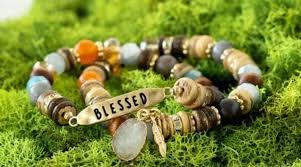
The variety of styles now available would genuinely surprise anyone who last browsed this category a decade ago. We’ve moved well beyond the simple brown cord bracelet, worthy as that remains, into a world of slim gold bangles, oxidised silver chain designs, hand-knotted rosary styles, and beaded combinations that work as well with a linen shirt as they do with a Sunday dress. From minimalist metal designs to beaded styles perfect for stacking, religious bracelets inspired by timeless symbols are becoming a subtle way to express identity through fashion, without compromising on elegance.
Part of the appeal is how naturally these pieces fold into the stacking trend. A delicate bracelet bearing a Miraculous Medal sits beautifully alongside a plain gold chain and a watch. A set of matte stone beads reads as calm and intentional next to a sleek metal cuff. The religious element doesn’t dominate or demand attention. It simply exists, quietly, alongside everything else.
That discretion is, for many people, precisely the point. Faith expressed through jewellery doesn’t need to announce itself. It can be a private note worn in a public space, something you know is there even when nobody else notices.
What the Symbols Actually Mean
The Cross, the Miraculous Medal and Beyond
It’s worth knowing what you’re wearing, or gifting. The cross is the obvious one, the central symbol of Christianity, representing the crucifixion and resurrection of Christ. Simple in form, enormous in meaning, and endlessly adaptable in design.
The Miraculous Medal depicts the Virgin Mary and dates to a series of apparitions reported in Paris in 1830. It became one of the most widely worn Catholic devotional items in the world, not just in churches but in everyday life, slipped into pockets and fastened to wrists and chains by people who found comfort in its presence.
The Saint Benedict Medal is older still, associated with the sixth-century founder of Western monasticism. It carries a specific set of prayers and symbols believed to offer protection, and it has a quiet authority that makes it a particularly popular choice for bracelets.
The Chi-Rho, one of the earliest Christian symbols, combines the first two letters of Christ’s name in Greek. The ichthys, the simple fish outline, was a secret symbol used by early Christians and has found its way back into modern jewellery design with a certain understated elegance.
Each of these symbols carries weight. Wearing one is never just a style decision, even when style is very much part of the thinking.
Why Minimalism Made Religious Jewellery Cool Again
The minimalist jewellery movement did something quietly significant for faith accessories. When the prevailing aesthetic favoured clean lines, considered choices and pieces that meant something rather than simply filled space, religious jewellery found itself perfectly positioned.
A fine gold cross on a slim chain, a single beaded bracelet in natural stone, a tiny medal on a delicate link: these things look exactly right within a pared-back, intentional wardrobe. They don’t clash with anything. They add depth without adding noise.
Social media played its part, too. When people began sharing their jewellery collections in flat-lays and styling posts, faith pieces appeared naturally among the mix, worn by people who happened to have faith and also happened to have good taste in accessories. The combination turned out to be entirely unremarkable, which was, in a way, the best possible outcome. Spiritual jewellery stopped needing its own separate category and became simply part of how thoughtful people dress.
Stacking, Layering and the Art of Wearing It Well
How to Style Religious Bracelets Without Overthinking It
The good news about stacking religious bracelets is that there are no rules strict enough to worry about. A few instincts, though, are worth following.
Balance tends to work better than uniformity. A chunky beaded bracelet sits well next to something finer, a slim chain or a flat bangle. Mixing metals is fine, especially if the pieces share a finish, all matte or all polished.
Consider what each piece is doing. A bracelet with a medal is a focal point. Give it room. Build around it rather than burying it.
For everyday wear, two or three pieces on one wrist is usually enough. For more considered occasions, you might strip back to just the one piece that matters most that day. There’s something in that, actually, in the idea that what you choose to wear on a significant morning says something about where your head is.
Gifting a Religious Bracelet, Getting It Right
Few gifts land with quite the same quiet precision as a well-chosen religious bracelet. The occasions that call for one are often moments that carry real weight: a Baptism, a First Communion, a Confirmation, a significant birthday, a marriage, a loss. These are the moments when people want to give something that means more than the thing itself.
A bracelet works particularly well as a gift because it’s both practical and personal. It can be worn daily. It’s visible. It’s a reminder that someone thought carefully about what mattered to the person receiving it.
Personalisation options have expanded considerably. Engraving a date or a name on a medal, choosing a patron saint relevant to the recipient, selecting birthstone beads, all of these are available from good religious jewellery makers and they transform a beautiful object into something that feels made for one specific person.
Quality, Craft and Knowing What You’re Buying
Materials matter, not just for aesthetics but for durability and, frankly, for the sense of care that should attach to something meant to carry meaning. Sterling silver and gold vermeil are the benchmarks for metal pieces. Natural stone beads, properly finished, age better than synthetic alternatives and develop a character over time that feels appropriate for something worn as part of a daily practice.
For cord and knotted designs, the quality of the knot work and the cord itself makes a real difference to how a piece sits and how long it lasts. A bracelet worn every day is going to be tested, and it should be made accordingly.
When choosing where to buy, it’s worth looking for retailers with genuine roots in Catholic tradition and a demonstrable commitment to craft. A brand that understands what these objects mean to the people who wear them tends to make better decisions at every stage, from design to materials to the care taken in how pieces are presented.
A Small Thing That Says Quite a Lot
There’s something particular about a bracelet as a carrier of faith. It sits on the wrist, which means it’s almost always in your field of vision. You see it when you’re typing, when you’re cooking, when you’re sitting quietly somewhere and your mind is busy with other things. It’s a recurring prompt, small and unobtrusive, but present.
That quality of presence, without performance, is what makes religious bracelets resonate beyond the purely devotional. They’re not declarations. They’re reminders. And in a daily life that doesn’t always make space for reflection, a small, well-made thing on your wrist, carrying a symbol that matters to you, does a quiet and genuine job.
Religious bracelets have been part of human expression for as long as people have had faith and the desire to make beautiful things. That they’re now finding a comfortable home in contemporary everyday fashion feels less like a trend and more like a return.