


Introduction
HTML templates have become an essential component in the busy and hectic web development industry, where designers who want to create gorgeous, functional websites do not necessarily have to start building one by hand.
These existing structures provide a Golden mean mix of the structure, style and interactivity, and, as such, developers and designers can concentrate on the customization of these structures as opposed to core coding.
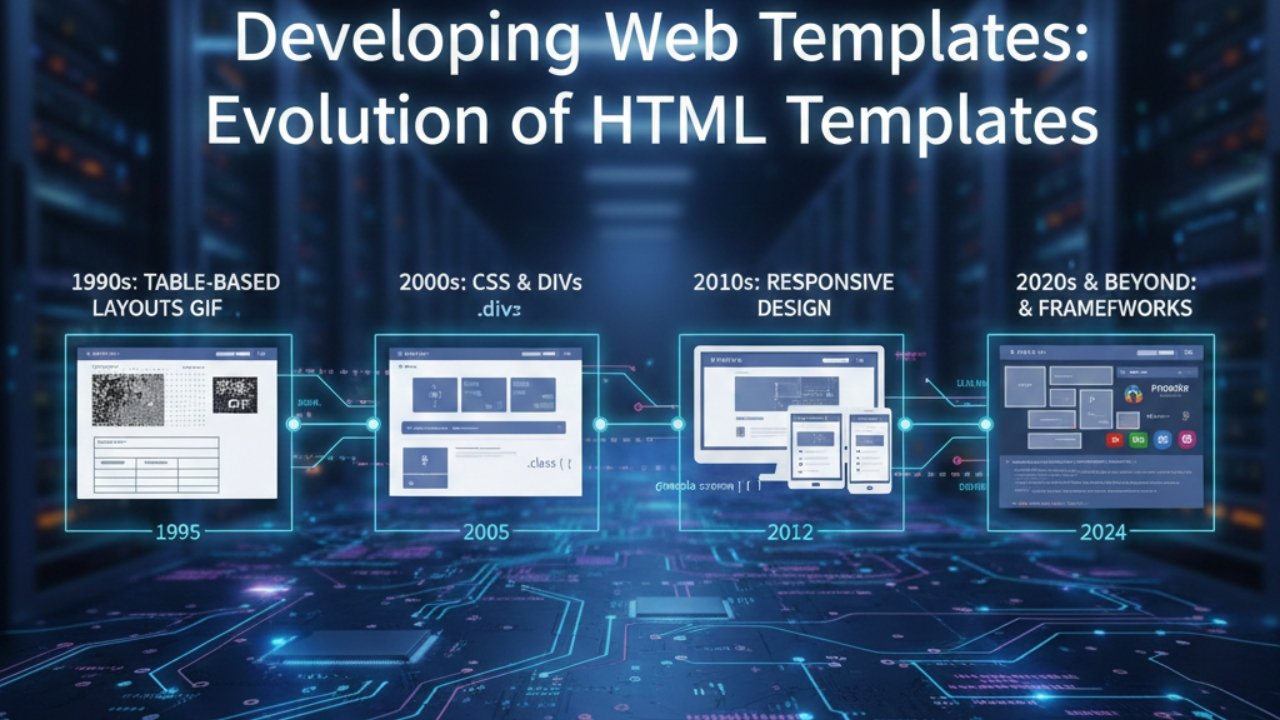
Since the beginning of the personal blogs which are very simple to use and complex e-commerce websites, HTML templates have changed significantly through the years, keeping up with the new technology and user demands.
The Rise of HTML Templates
The use of HTML templates initially became popular in the early 2000s when there was the transition of the internet to dynamic content instead of the use of static pages.
At that time templates were plain HTML files with inbuilt CSS to style. They offered a fast means of making a series of layouts on a large number of pages, and saved time as well as secured uniformity.
The major benefit of HTML templates is that they are accessible. Amateurs are allowed to use free or paid versions, which can be customized to the requirements, and experts use them to reduce the time spent on prototyping.
An example would be a business that opens an online shop, which would begin with an e-commerce template that would have inbuilt shopping cart applications, product grids, and payment gateways.
Advantages of HTML Template
Why not use HTML templates when it would be more efficient to build everything manually? The following are some of the arguments:
- Time Efficiency: Templates reduce the development time by offering already developed code templates. What could be coded in weeks zero could be converted in days.
- Cost-Efficiency: There are numerous quality templates that can be obtained either free or cheaply thus eliminating the requirement to pay premium prices to have a high-quality custom design.
- Customization Flexibility: Most of the templates can be customized since most templates are usually modular to allow adjustments of the colors, fonts as well as layout without affecting the basic functionality.
- Cross Browser: The trendy templates shall be seen to be compatible with the major browsers that shall ensure the user an easy time.
- SEO and Performance Optimization: Clean code, a fast loading of assets, and meta tags are common with the modern templates which help promote ranking in search engines.
No matter whether you are a freelancer, a startup or an enterprise, inclusion of HTML templates can facilitate your workflow as well as improve the final product.
Popular HTML Template types
There is a variety of HTML templates depending on their industries and purposes. There are such popular categories as:
- Business and Corporate Templates: Clean designs that include professional layouts, which can be used in the company websites, portfolios, and landing pages.
- Creative and Portfolio Templates: Appear visually forward and presented in gallery and animation format as well as a parallax effect to present artistic work.
- E-Commerce Templates: You can have all the features like product lists, filters and checkout points to online shops.
- Blog and Magazine Templates: Content-based desn featuring readable typography, comment boxes and social sharing applications.
- Admin Dashboard Templates: Web applications backend-based, chart-based, table-based, and user management templates.
With the choice of a template, you should take into account the objectives, the audience, and the ability to expand your project. There is a large variety of choices to be presented with the help of such tools and resources as https://nicepage.com/html-templates.
Pictorial illustrations of Modern Patterns of HTML Templating
In order to demonstrate architecture on the islands in Astro (one of the most popular implementations in 2025 & 2026):
- No JS is shipped in static parts; they are pure HTML.
- Only when interacted with or seen, interactive islands hydrate.
- The following are some typical examples of visuals of islands in action:
- These present common models of the architecture of islands, selective hydration and analogy to traditional SSR/SPA models.
- Ting Shuo: Rapid Comparison: Bundle Size and Performance Impact (2025 Benchmarks).
- Typical React SPA (full hydrated): 50-200+ KB JS 50-200+ 2-5s+ TTI.
- Astro islands (defaults): 0-20 KB-) TTI <1s.
- Qwik resumable: 1 kilobase start-up to Instant interactivity.
- HTMX + server fragments: 5 KB and under: Nostalgic like MPA, yet active.
How to Get Started with HTML Templates
The initial actions are not hard to follow. First, identify your theme, i.e. plain blog or shiny agency website.
Thereafter, window shop repositories or marketplaces. The download button is clicked, and template files are received, which are typically HTML, CSS and JS files and image resources.
A code editor like VS Code can also be used to customize it and can be tested on other devices to be responsive.
Visiting special sites is necessary to be inspired or to buy something. The web page is https://nicepage.com/html-templates, and it is a very good resource; the number of professional designs that exist to match various needs is high.
The Future of HTML Templates
In the future, HTML templates will be able to work with new technologies like artificial intelligence, which helps us design things, and WebAssembly, which performs better. HTML templates will also work with something called no-code.
With the web being enhanced with standards, HTML templates will be less about ensuring that all people can use them, even people requiring special attention, and will be updated on the earth since they will consume less energy and the code will be light meaning that they will not be harming the planet as much.
HTML templates will really focus on accessibility, such as following WCAG guidelines. They will be more sustainable,e like using lighter code that reduces carbon footprints, which is good for the earth.
To sum up, HTML templates are a clever development in web design since they allow developers to work efficiently and innovatively. With the help, every person will be able to transform a vision into a perfect online presence.
Final Thoughts
Full-circle HTML templating has come full circle: simple, raw static files have been developed into complex frameworks and back to simplicity, speed, and faith in the underlying web platform.
Lean HTML-first strategies with emphasis on prioritizing the static content and selective addition of interactivity are the best strategy in 2026. This results in quicker sites, smaller carbon footprints and better user experiences. HTML is still needed and it evolves to suit the need instead of getting complicated.