




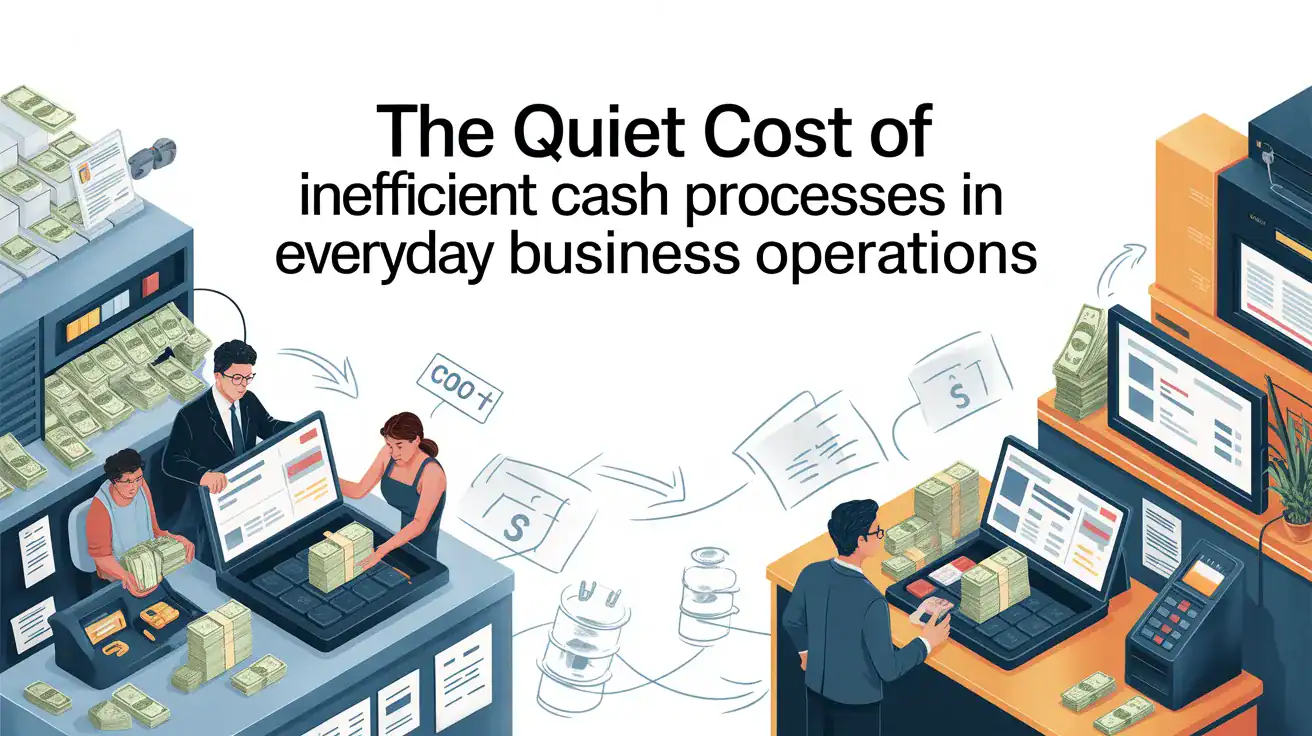
In the world of small and medium-sized businesses, handling cash is one of those things that just happens. It is like the background noise of a busy shop or restaurant. You take the money, you count it, you put it away, and you move on to the next customer. Because it is such a routine part of the day, we rarely stop to think about whether the way we are doing it is actually helping or hurting the business. It is usually just something people do on autopilot.
However, when you look a little closer, there is often a hidden layer of friction that we have all just learned to live with. It does not look like a massive crisis. You won’t see a “system failure” alert on your dashboard. Instead, it shows up as those tiny, annoying delays. It is that feeling of having to recount a till because the numbers do not look right, or that low-level frustration at the end of a long shift when you just want to go home, but the drawer is five dollars short.
When you start to add up those small moments, they stop being minor. Over weeks and months, they turn into a slow drain on your energy and your time. The tricky part is that because nothing is technically “broken,” it is easy to ignore. The cash eventually balances, and the doors get locked. But if you are honest about the effort it takes to get there, you might realize it is taking a lot more out of your team than it should.
In many businesses, the goal is to find a way to bring a little more sanity to the process. This often involves looking at how the work is actually being done and finding ways to cut out the guesswork. For instance, many managers find that bringing in a cash counting machine helps take the manual struggle out of the equation, providing a level of speed that human hands just cannot match. When that is paired with cash management software, the record-keeping becomes much more reliable. These tools are not about replacing people; they are about getting rid of the tiny mistakes and mental fatigue that naturally happen when you are doing the same repetitive task over and over again.
The Hidden Drain of Death by a Thousand Cuts
We often talk about “efficiency” as some big corporate buzzword, but in reality, it is just about how much of your day is being wasted in fragments. Think about it: a minute here to double-check a float, three minutes there to find a missing receipt, and another five minutes spent retracing your steps because a total was entered incorrectly.
None of those moments feel like a big deal when they are happening. But if you have three people on staff and they are each losing ten or fifteen minutes a day to these little hiccups, you are looking at hours of lost productivity every single week. That is time that could be spent helping customers, cleaning the shop, or simply getting home to have dinner with family. This is “quiet” inefficiency. It does not scream for your attention; it just makes the day feel longer and the work feel heavier.
There is also a very real human element to this that we often overlook. Cash counting usually happens at the end of the day. By that point, everyone is tired. Concentration is dipping. That is exactly when the most mistakes happen. A small error made in five seconds can take thirty minutes to track down and fix. When that becomes the “norm,” it ruins the rhythm of the closing shift. It turns the end of the day into a chore to be endured rather than a smooth conclusion to the workday.
Why Consistency Is Your Best Friend
Another problem is that without a clear, standard way of doing things, everyone starts to develop their own “system.” One person might count the coins first, another might count the bills first, and a third person might just rely on their memory for certain steps instead of using a checklist.
While none of these methods is inherently “wrong,” they create variation. And variation is the enemy of a smooth operation. When the numbers do not match up at the end of the night, it is much harder to figure out why if everyone is doing the job differently. It creates a weird sense of uncertainty. You start to doubt the numbers, not because you think someone is being dishonest, but because you know the process is a bit messy. This leads to even more triple-checking, which just adds more stress to an already busy routine.
As a business grows, these little cracks start to turn into canyons. If you have one till and two employees, you can probably manage a bit of “organized chaos.” But as soon as you scale up, add more registers, or hire more staff, those small delays start to multiply. What was once an occasional annoyance becomes a structural problem that slows down the entire business.
Building a Process That Flows
The interesting thing is that fixing this does not usually require a genius-level solution. It is just about recognizing that cash handling is a repetitive task. Repetitive tasks are incredibly sensitive to how they are performed. If you do not have a standard, consistent method, then repetition does not make you better; it just makes your mistakes more consistent.
Visibility is a huge part of the puzzle. When your process is fragmented and manual, it is almost impossible to see where the time is actually going. You just know that things feel slow. By standardizing the steps and using the right tools, you take the pressure off your staff to be perfect all the time.
The goal should be to reduce the number of spots where a simple human error can throw a wrench in the gears. This is not about being “strict,” it is about being helpful. It is about creating a work environment where the numbers are easy to track and the end of the day is something that flows naturally.
At the end of the day, the real cost of a messy cash process is not just the money you might be losing to errors. It is the mental energy and the time that your team could be spending on things that actually move the needle for your business. When you clear away the “quiet” costs, everything else starts to run a lot smoother.