




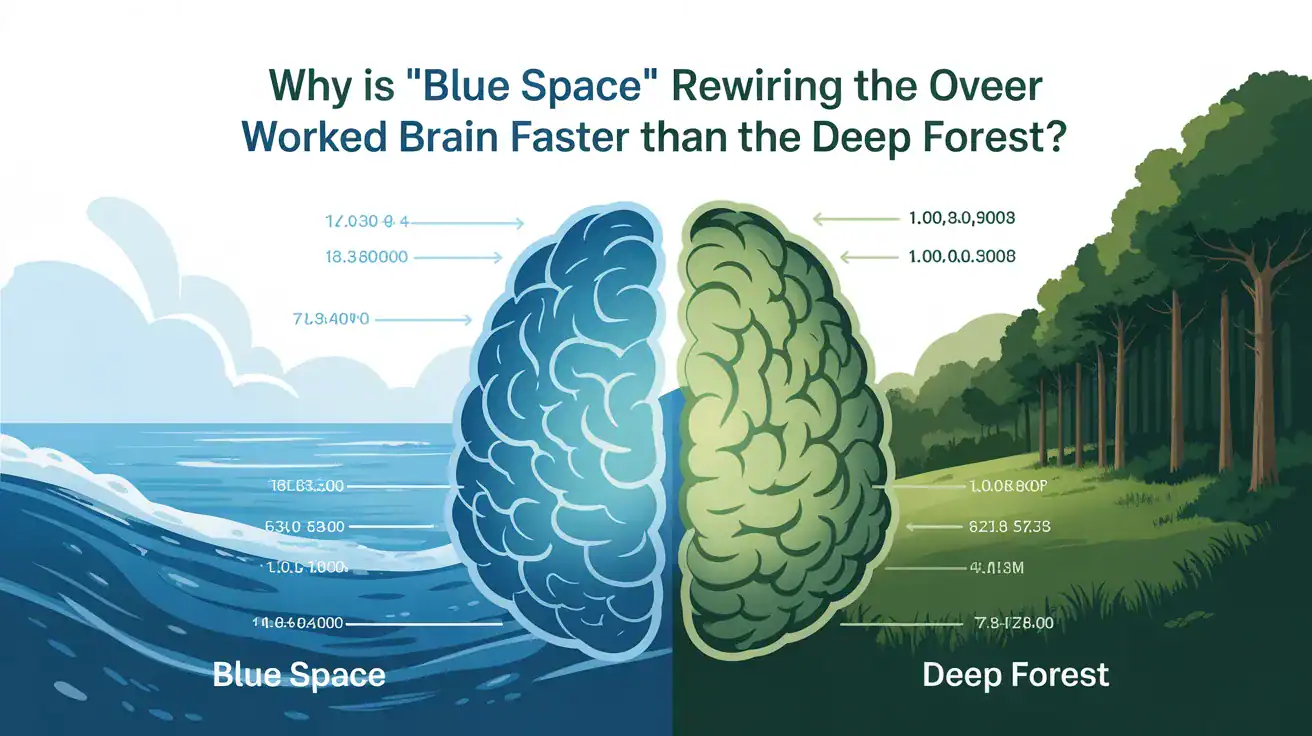
For the past decade, wellness experts, psychologists, and travel gurus have heavily promoted the concept of shinrin-yoku, or “forest bathing.” The prescription for a burned-out, hyper-connected modern workforce was to step away from the glowing screens and disappear into the dense, green canopy of the woods. The forest was billed as the ultimate psychological reset button.
But as the remote-work revolution has untethered millions of professionals from physical offices—spurring a massive surge in full-time RVers and digital nomads—a subtle shift in geographical preference is occurring. When given the choice of where to park their rigs for a month, modern travelers are increasingly bypassing the deep woods in favor of shorelines. They are seeking out lakes, reservoirs, and rivers.
This migration from “green space” to “blue space” is not just a preference for water sports; it is a subconscious drive rooted in evolutionary biology and environmental psychology. Science is beginning to show that proximity to water might actually rewire an overworked brain faster and more efficiently than the forest.
The Visual Simplicity of the Horizon
To understand why blue space is so effective at reducing stress, we have to look at how the human brain processes visual data.
The modern digital worker suffers from cognitive fatigue. Eight hours a day spent looking at spreadsheets, email inboxes, and cascading Slack messages requires intense, directed attention. When that worker steps into a dense forest to relax, the environment is undeniably beautiful, but it is also visually complex. A forest is a chaotic fractal of leaves, branches, shadows, and undergrowth. The brain still has to process a massive amount of visual data to navigate the space.
A large body of water, however, offers visual simplicity. When you stand on the shore of a massive reservoir and look out over the water, the visual field flattens. The horizon line provides a stark, clean geometric break. This lack of visual clutter triggers a state of “soft fascination” in the brain. It allows the prefrontal cortex—the area responsible for intense focus and decision-making—to essentially power down and rest, while the subconscious mind gently engages with the repetitive, predictable ripples of the water.
The Acoustic Anchor
Beyond the visual break, the acoustic environment of blue space acts as a powerful neurological anchor. The rhythmic sound of water gently lapping against a shoreline is considered “pink noise.”
Unlike white noise, which contains all frequencies at equal intensity (like television static), pink noise reduces higher frequencies. It mimics the cadence of a resting human heartbeat and the sounds heard within the womb. Neurological studies have shown that listening to the slow, rhythmic sounds of a lake or ocean physically alters brainwaves, pushing the listener out of the high-frequency beta waves of waking stress and into the slower alpha waves associated with deep relaxation and meditative states.
You do not need to be actively swimming or boating to reap these benefits; simply sitting near the water and listening to it is enough to lower blood pressure and reduce cortisol levels.
The Evolutionary Pull
Our preference for blue space is also deeply coded into our DNA. From an evolutionary standpoint, early humans associated dense forests with potential predators and limited visibility. A vast, open body of freshwater, on the other hand, signaled survival. It meant a reliable drinking source, an abundance of food, and a clear line of sight to spot approaching weather or threats.
When a modern traveler parks their RV facing a sprawling lake, they are satisfying a primal, ancestral checklist. The subconscious brain registers the environment as fundamentally “safe” and abundant, allowing the nervous system to fully transition from a state of “fight or flight” into “rest and digest.”
Embracing the Lakeside Reset
As the line between our professional and personal lives continues to blur, the necessity of finding environments that force our brains to genuinely disconnect becomes critical. The deep woods will always hold their mystic appeal, but for those suffering from the unique cognitive fatigue of the digital age, the shoreline is proving to be the ultimate remedy.
If you are planning a route through the Southeast to experience this cognitive reset for yourself, it is worth seeking out the vast, quiet reservoirs that define the region. You might decide to reserve your spot at Basecamp RV Park at Lake Hartwell, where the expansive waters straddling the Georgia-South Carolina border provide the exact visual and acoustic simplicity required to unplug.
Ultimately, the cure for a mind overwhelmed by infinite tabs and endless scrolling isn’t necessarily found in the shadows of the trees. Sometimes, the most profound psychological relief comes from simply staring out at a flat, blue horizon and letting the brain finally stand still.