




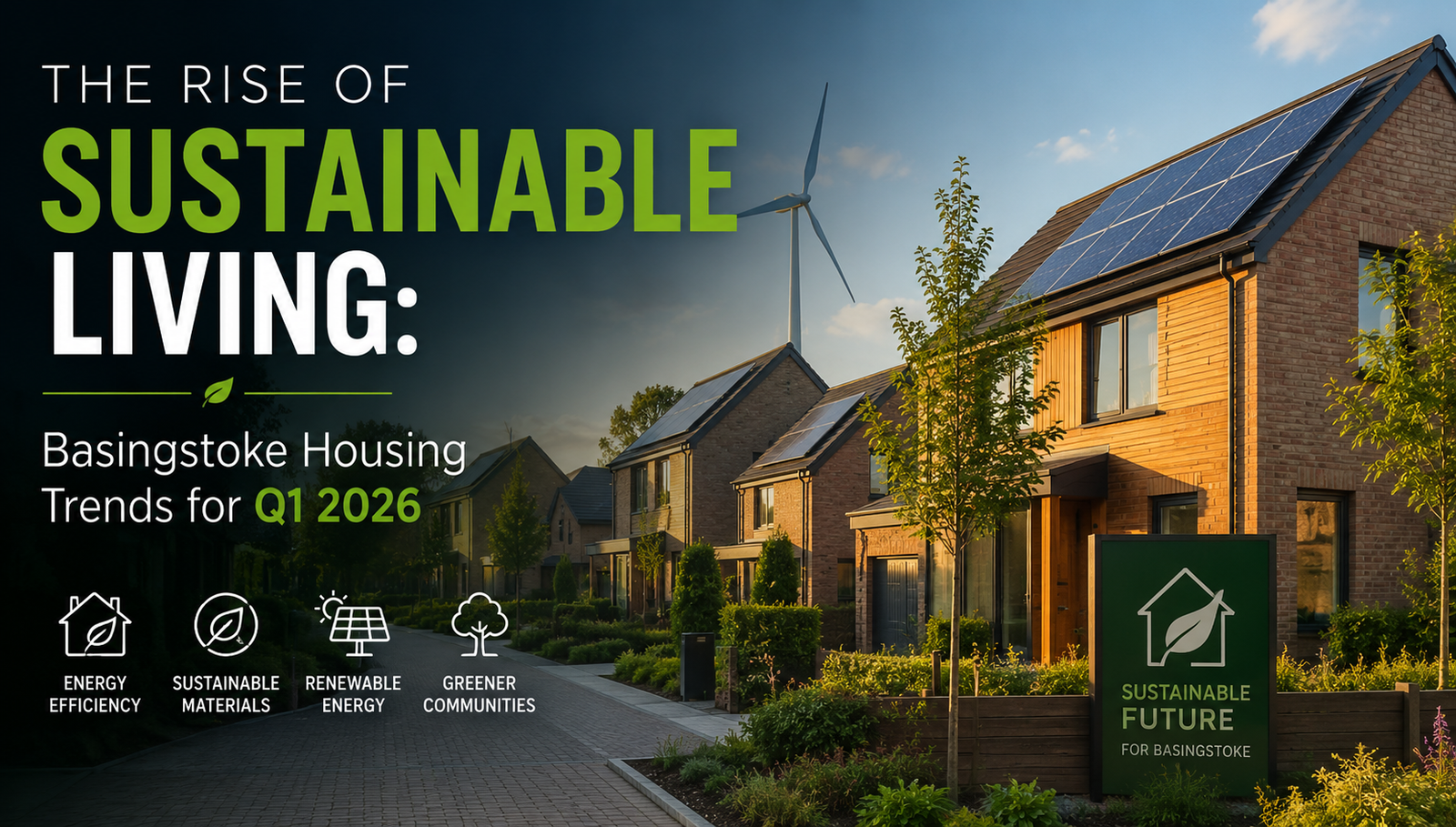
The property landscape in North Hampshire has undergone a radical transformation over the last few years. As we move through the first quarter of 2026, the conversation in Basingstoke has shifted away from mere square footage and towards a home’s environmental footprint. Buyers are no longer just looking for an extra bedroom or a south-facing garden; they are scrutinising EPC ratings, heat pump efficiencies, and the proximity of EV charging points. This shift isn’t just a passing fad; it is a fundamental rewiring of what people value in a home.
For those looking to navigate this evolving market, local expertise has never been more vital. Whether you are a first-time buyer trying to find an energy-efficient starter home or a landlord looking to future-proof your portfolio against tightening regulations, consulting with reputable estate agents in Basingstoke is the best way to understand which postcodes are leading the green revolution. The town, once known primarily as a 1960s “overspill” success story, is now reinventing itself as a hub for sustainable urban living, blending its commercial importance with a newfound commitment to ecology.
The Green Shift in North Hampshire
What is driving this change? By early 2026, the UK’s commitment to Net Zero has moved from policy documents into the practical reality of the housing market. In Basingstoke, we are seeing a “green premium” emerge. Properties that boast high-spec insulation, triple glazing, and renewable energy sources are not just selling faster; they are commanding higher prices. The local council’s climate emergency declaration has trickled down into planning permissions, ensuring that new developments around Manydown and the town’s periphery meet stringent environmental standards.
The demographic of the Basingstoke buyer is also changing. We are seeing an influx of young professionals moving out of London, not just for more space, but for a lifestyle that aligns with their values. These buyers are tech-savvy and environmentally conscious. They want smart homes where they can monitor their energy usage from an app while on the train back from Waterloo. This has forced developers and sellers alike to up their game.
Energy Efficiency: No Longer an Optional Extra
In the Q1 2026 market, the Energy Performance Certificate (EPC) has become the most important document in a sales pack. With the cost of living still a major factor in household budgets, the ability to run a home on minimal energy is a huge selling point. We are seeing a significant number of “green mortgages” being utilised, where lenders offer better rates for homes with an EPC rating of B or higher.
Air Source Heat Pumps (ASHPs) have become the standard in new Basingstoke builds. While there was some initial scepticism a few years back, the technology has matured, and the local supply chain for maintenance and installation is now robust. For older properties in areas like South Ham or Brookvale, the challenge is different. Sellers here are increasingly investing in external wall insulation and loft upgrades before hitting the market, knowing that a “draughty” label is a deal-breaker for modern buyers.
Basingstoke’s New-Build Revolution
The Manydown development remains the crown jewel of Basingstoke’s expansion. As we progress through 2026, the first phases are showing exactly how sustainable communities should function. These aren’t just houses; they are part of a circular ecosystem. Greywater recycling systems, communal composting hubs, and wildflower meadows instead of manicured lawns are the new norm.
These developments are designed with the “15-minute neighbourhood” concept in mind. The goal is for residents to reach essential services, schools, and parks within a short walk or cycle. This reduces the reliance on cars, even as the town prepares for the total transition to electric vehicles. For investors, these new-build estates represent a “set and forget” opportunity, as they already meet the high standards that will likely be mandated for the rental sector by the end of the decade.
Retrofitting the Classics: Challenges for Period Homes
While the new builds are grabbing the headlines, a large portion of Basingstoke’s housing stock consists of Victorian terraces and mid-century semi-detached houses. In Q1 2026, we are seeing a surge in “deep retrofitting.” Homeowners in Old Basing and Lychpit are increasingly looking at how they can bring 19th and 20th-century homes into the 21st century.
It isn’t always easy. Retrofitting a Victorian terrace in the Top of Town area requires a delicate balance between preserving character and improving thermal performance. However, the rise in local specialist contractors has made this more accessible. We are seeing beautiful renovations where original fireplaces are kept for aesthetic reasons, but the heavy lifting of heating is done by hidden infra-red ceiling panels or discreet heat pumps. This blend of old-world charm and new-world tech is proving incredibly popular with a specific niche of buyers who want the history of Basingstoke without the high heating bills.
The Financial Reality of Green Living
Let’s talk numbers. In early 2026, data from various estate agents in Basingstoke suggests that homes with high energy efficiency ratings are fetching between 5% and 8% more than their less efficient counterparts. For a standard three-bedroom semi, that can mean an extra £20,000 to £30,000 on the asking price.
Investors are also pivoting. With the government’s continued push for higher minimum energy standards in the private rented sector, landlords are offloading “leaky” properties and reinvesting in modern, efficient flats near the railway station. The rental yield on these green properties is slightly lower in some cases due to the higher purchase price, but the void periods are almost non-existent. Tenants are happy to pay a bit more in rent if it means their monthly utility bills are slashed by half.
Transport and Connectivity: The 15-Minute Vision
Sustainability isn’t just about what happens inside the four walls of a house; it’s about how that house connects to the wider world. Basingstoke has always been a commuter favourite, but in 2026, the focus has shifted to “active travel.” The expansion of cycle lanes connecting Hatch Warren and Beggarwood to the town centre has been a game-changer.
The town’s bus fleet is now almost entirely electric, and the integration of “mobility hubs” where residents can hire e-bikes or join a car club has reduced the need for two-car households. When buyers look at a property now, they aren’t just checking the parking spaces; they are looking at the local bike storage and the quality of the walking routes to Festival Place. This holistic view of sustainability is making Basingstoke a much more attractive proposition compared to some of the more congested towns further down the M3 corridor.
Advice for Sellers in the Current Market
If you are planning to sell your home this year, you need to highlight your property’s green credentials prominently. It’s no longer enough to just mention “double glazing” in the brochure. You need to be specific. Do you have a smart thermostat? Is your loft insulation up to current standards? Do you have an EV charging point installed on the driveway?
Even small changes can make a big difference. Switching to LED lighting throughout, draught-proofing doors, and providing a folder of energy bills to prove the home’s efficiency can build trust with potential buyers. In a market where buyers are cautious, transparency about running costs is a powerful tool. Working with experienced estate agents in Basingstoke can help you position your home correctly, ensuring that these features are marketed as the value-adds they truly are.
What the Future Holds
Looking ahead to the rest of 2026 and into 2027, the trend toward sustainable living will only accelerate. We expect to see more community-led energy schemes in Basingstoke, where neighbourhoods generate and share their own solar power. The technology is already there; it’s just a matter of local adoption and regulatory support.
Basingstoke is uniquely positioned to thrive in this new era. It has the space for innovative new developments, a strong local economy, and a community that is increasingly engaged with environmental issues. The “concrete jungle” reputation of the past is being firmly replaced by a vision of a “green heart” in Hampshire.
For anyone involved in the property market—be they buyers, sellers, or investors—the message is clear: sustainability is the new gold standard. It is the lens through which all property decisions should be viewed. By embracing these trends now, you aren’t just helping the planet; you are making a savvy financial decision that will pay dividends for decades to come. The housing market in Basingstoke is no longer just about location, location, location—it’s about insulation, innovation, and integration.