




The education technology sector is experiencing unprecedented growth, with the global EdTech market projected to reach $404 billion by 2025 according to HolonIQ. As traditional education models struggle to meet the demands of modern learners and working families, innovative platforms are capturing market share and investor attention.

Here are 12 emerging EdTech investment opportunities savvy investors should watch in 2025.
1. Personalized Learning Platforms
The one-size-fits-all education model is dying, and personalized learning platforms are leading the disruption. These adaptive systems use data analytics to customize curriculum pacing, content difficulty, and learning pathways for individual students.
Investment Appeal: The personalized learning market is expected to grow significantly through 2030, driven by parent demand for customized education and proven outcomes data showing higher engagement and achievement.
Key Players to Watch: Platforms offering competency-based progression, real-time feedback loops, and individualized pacing are attracting significant venture capital. Look for companies with strong retention metrics and measurable learning outcomes.
2. Accredited Virtual Academies
Full-time online schools offering accredited diplomas are no longer niche alternatives – they’re becoming mainstream education choices for families seeking flexibility, personalization, and cost savings.
A prime example is prisma online school, an accredited online school for grades 4-12 that’s redefining what virtual learning can achieve. With a project-based curriculum inspired by cutting-edge MIT and Harvard research, Prisma students average 1360 on the SAT – 28% above the national average – and boast a 100% college acceptance rate, with every graduate accepted to at least one Top 75 school.
What Makes This Model Compelling: Prisma charges $10,780-$11,980 annually compared to traditional private schools at $30,000+, offering families premium education at a fraction of the cost. The platform achieves remarkable outcomes: students grow 158% in reading and 204% in math annually (per NWEA MAP Growth assessment). The quality of instruction is maintained through highly selective hiring – Prisma accepts just 0.5% of coach applicants, ensuring only exceptional educators mentor students.
Investment Angle: Virtual academies solving the “quality + affordability + flexibility” trifecta are positioned for explosive growth as remote work normalizes and parents prioritize educational ROI over brand-name institutions.
3. AI-Powered Coaching and Mentorship
Artificial intelligence is transforming the traditional teacher-student relationship. AI coaching platforms provide 24/7 support, instant feedback, and personalized guidance while human mentors focus on relationship-building and higher-order thinking skills.
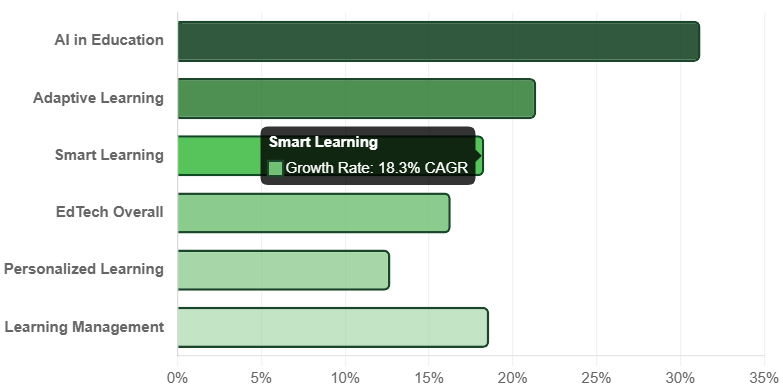
Market Opportunity: The AI in education market is projected to reach $20 billion by 2027 according to Global Market Insights. Early-stage companies combining AI automation with human mentorship are particularly attractive, offering scalability without sacrificing the human connection parents value.

Investment Thesis: Hybrid models that leverage AI for administrative tasks and routine feedback while preserving human coaches for mentorship represent the sweet spot between cost-efficiency and educational quality.
4. Competency-Based Learning Systems
Moving beyond seat time and credit hours, competency-based education (CBE) platforms allow students to progress upon mastering skills rather than completing predetermined timelines.
Market Driver: Employers increasingly value demonstrated competencies over traditional degrees, creating demand for education models that document specific skill mastery. CBE platforms with robust assessment tools and digital credentialing are attracting both K-12 and higher-ed partnerships.
Revenue Potential: Subscription-based models with B2B (school district) and B2C (direct-to-family) revenue streams offer diversified income and rapid scalability.
5. Interdisciplinary Project-Based Curriculum
Rote memorization is out; real-world application is in. Curriculum companies creating interdisciplinary, project-based content that connects multiple subjects through authentic challenges are seeing strong adoption.
Why Investors Care: These platforms command premium pricing because they deliver measurable engagement and skill development. Parents will pay for curriculum that makes learning relevant and prepares students for actual career challenges rather than standardized tests.
Growth Indicators: Look for curriculum providers with high Net Promoter Scores (NPS), strong content refresh cycles, and partnerships with accredited schools validating their educational rigor.
6. Micro-School Management Platforms
The micro-school movement – small, personalized learning environments serving 10-150 students – is exploding. Technology platforms providing these schools with curriculum, assessment, operations, and community-building tools represent a massive opportunity.
Market Size: With approximately 95,000 microschools nationwide serving 1.5 million students, and networks like Acton Academy growing from 180 to 270+ schools since 2020, the infrastructure supporting this movement is early-stage and ripe for investment.
Competitive Moat: Platforms that become the “operating system” for micro-schools benefit from strong network effects and switching costs.
7. Global Collaboration Tools for K-12
As education goes digital, platforms connecting students across borders for collaborative projects, cultural exchange, and global perspective-building are gaining traction.
Investment Thesis: Schools and families increasingly value global citizenship and cross-cultural competency. Tools facilitating authentic international collaboration – beyond superficial pen-pal experiences – solve a real problem for educators.
Monetization: Freemium models with premium features for schools, plus direct-to-family subscriptions, create multiple revenue pathways.
8. Parent-Teacher Communication Platforms
The pandemic revealed how disconnected parents were from their children’s education. Communication platforms bridging this gap with real-time updates, progress tracking, and collaborative goal-setting are essential infrastructure.
Stickiness Factor: High daily active user rates and strong community formation create defensible moats. Platforms facilitating parent communities alongside teacher communication see particularly strong retention.
Exit Strategy: Attractive acquisition targets for larger EdTech companies or education management organizations seeking to add communication layers to existing products.
9. Skills-Based Assessment Tools
Traditional grades and standardized tests are increasingly questioned. Assessment platforms measuring real-world skills – critical thinking, creativity, collaboration, problem-solving – through portfolio evaluation and competency tracking are filling the void.
Regulatory Tailwind: As states experiment with alternatives to standardized testing, assessment tools with proven validity are positioned for district-level adoption.
Data Goldmine: Companies capturing longitudinal student development data own valuable insights for continuous product improvement and potential secondary revenue streams (anonymized, aggregated analytics).
10. Flexible Scheduling and Asynchronous Learning
Platforms enabling students to learn on their own schedule while maintaining community and accountability are solving work-life balance issues for families.
Market Demand: The “work from anywhere” trend extends to education. Families want flexibility without sacrificing quality or social connection. Platforms delivering both are commanding premium pricing.
Hybrid Models: Companies combining asynchronous content with scheduled live workshops represent the best of both worlds – flexibility plus community.
11. Social-Emotional Learning (SEL) Integration
Academic achievement without emotional intelligence and social skills is incomplete preparation for adulthood. EdTech platforms weaving SEL into core curriculum rather than treating it as supplementary are differentiating successfully.
Growing Awareness: School shootings, mental health crises, and workplace demands for soft skills are driving unprecedented demand for SEL solutions.
Measurement Challenge: Companies that crack authentic SEL assessment – beyond student self-reporting – will command significant market share.
12. Educator Marketplace and Talent Platforms
The teacher shortage is real, but talented educators exist – they’re just leaving traditional systems. Platforms connecting families or micro-schools with vetted, high-quality educators create liquidity in a broken market.
Quality Matters: The most successful models rigorously screen educators, ensuring only exceptional talent mentors students. This selectivity pays off in outcomes and parent satisfaction.
Business Model: Take-rate on educator compensation, premium placements, and professional development upsells create multiple monetization levers.
What Smart Investors Are Watching
The EdTech opportunities with the strongest fundamentals share common characteristics:
Proven Outcomes: Investors want data. Platforms demonstrating measurable improvements in student achievement, engagement, or career readiness attract serious capital.
Parent Willingness to Pay: Direct-to-consumer revenue proves product-market fit better than school district sales cycles. Families voting with wallets validate quality.
Retention Metrics: Student and educator retention signal product stickiness. High churn in EdTech often indicates fundamental product problems.
Scalability: The best EdTech investments combine human elements (mentorship, community) with technology leverage (content delivery, assessment automation) to scale without linear cost increases.
Regulatory Positioning: Accreditation, compliance with education standards, and alignment with college entrance requirements reduce adoption friction and derisk the investment.
The Bottom Line
The 2025 EdTech landscape rewards innovation that solves real family pain points: cost, flexibility, personalization, and outcomes. As traditional education struggles with teacher shortages, budget constraints, and declining student engagement, alternative models are capturing market share.
Investors should focus on platforms with strong unit economics, proven educational outcomes, and sustainable competitive moats. The companies building the “new normal” in education – combining personalization, technology, and human mentorship – represent some of the most compelling investment opportunities of the decade.
Whether you’re an angel investor, VC fund, or family office, the EdTech sector deserves a close look. The disruption is just beginning, and the winners will reshape how an entire generation learns, grows, and prepares for the future of work.